Category Archives: Kids

Holiday & Vacation Reminders

“Rest and be thankful.” – William Wordsworth

Holidays and vacations are a great opportunity to rest, recharge and explore the U.S.

Memorial Day Weekend is the unofficial start of summer travel season. Here are some reminders about program rules regarding holidays and vacations.

Holidays

  • Host families are not required to give au pairs any specific holidays.
  • Each host family will make different arrangements on holidays, some au pairs will be off and others will be required to work.
  • Au pairs should not make plans for holidays without checking with your host family first.

Vacations

  • Au pairs earns 2 weeks of paid vacation during the course of her year.
  • Vacation time should be mutually agreed upon.
  • All vacation should be preplanned (at least 4 weeks in advance.)
  • All au pair’s friends and/or family visits/vacations should be pre-approved prior to purchasing tickets.
  • If an au pair travels with her host family, it should be discussed in advance whether this is the au pair’s vacation or if she is working.
  • If an au pair travels with the host family to work, the host family is required to pay for her transportation, lodging and meals.

Important: If an au pair is traveling outside of the U.S., she must have her DS2019 signed (travel validation) PRIOR to her departure from the US. More information about this may be found here on the Au Pair in America website.

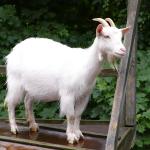
Photo: torbakhopper (Flickr)

Handling Expenses

Host parents often ask for suggestions on how best to handle common expenses that occur as au pairs are caring for the children.

Miscellaneous Expenses

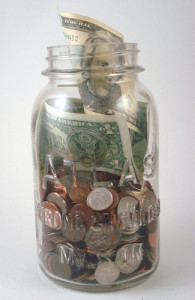
There are different ways to handle the little day to day expenses that come up.  Things like when an au pair takes the kids out for ice cream or picks up a gallon of milk.  Some families keep a cookie jar fund, a little cash that they set aside weekly or monthly for these types of expenses. Others give their au pair a prepaid debit card for this purpose. Below are some suggestions for avoiding problems with expenses.

Host Families

  • It’s important to be clear about how long this money should last and what types of expenses are approved.
  • Let the au pair know whether or not you expect receipts.

Au Pairs

  • Only spend the money on approved expenses.
  • If it is something you are not sure about, ask first.
  • Put your receipts in the cookie jar in place of the money to avoid any confusion.

Gas and Fare Cards 

Host families are responsible for the au pair’s transportation costs: to and from classes, cluster meetings and when driving the kids.

It is a good idea to figure out how much gas an au pair will use for these trips and either put gas in the car or give a gas allowance.   If your au pair is riding to classes or cluster meetings with another au pair, you should offer to share the cost of gas.

Au pairs are responsible for their own transportation at all other times.  You should replace the amount of gas used for personal use.

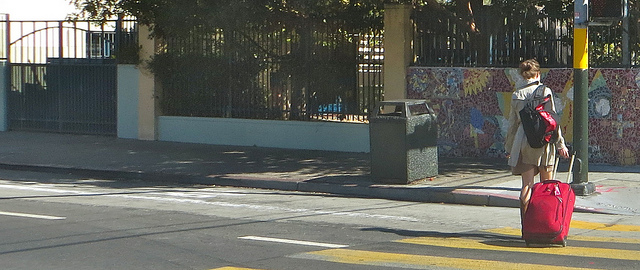
Photo: Andrea Travillian

Happy 4th of July

UnknownKnown as the Fourth of July and Independence Day, July 4th has been a federal holiday in the United States since 1941, but the tradition of Independence Day celebrations goes back to the 18th century and the American Revolution (1775-83). In June 1776, representatives of the 13 colonies then fighting in the revolutionary struggle weighed a resolution that would declare their independence from Great Britain. On July 2nd, the Congress voted in favor of independence, and two days later its delegates adopted the Declaration of Independence, a historic document drafted by Thomas Jefferson. From 1776 until the present day, July 4th has been celebrated as the birth of American independence, with festivities ranging from fireworks, parades, family gatherings and barbecues.
This weekend you can count on enjoying traditional favorites such as hamburgers and hot dogs, chicken, ribs, potato salad, chips and watermelon.

A few facts about this Holiday! Unknown-2
· Fourth of July is the federal holiday marking the Colonies’ adoption of the Declaration of Independence on July 4, 1776,
· The Fourth of July was not declared a national holiday until 1941.
· The oldest, continuous Independence Day celebration in the United States is the 4th of July Parade in Bristol, Rhode Island; it began in 1785.
· The Pennsylvania Evening Post was the first newspaper to print the Declaration of Independence.
· Benjamin Franklin proposed the turkey as the national bird but was overruled by John Adams and Thomas Jefferson, who wanted the bald eagle.
· The “Star Spangled Banner” was written by Francis Scott Key during the War of 1812 and not decreed the official national anthem of the United States until 1931.
· In 1776, there were 2.5 million people living in the new nation. (Today there are over 311 million.)
· here are more than 30 towns nationwide that have the word “Liberty” in their names.
· Approximately 150 million hot dogs are consumed on this day. It’s the biggest hot dog holiday of the year.

Unknown-3Have fun with the children too, visit the link below for fun coloring pages, craft ideas, puzzles and games to celebrate the 4th of July holiday
Image result for 4th of july clip art
http://www.apples4theteacher.com/holidays/fourth-of-july/

Have a wonderful 4th of July Weekend!

Celebrating Spring Holidays!

easter_1Celebrating Easter

Easter is celebrated throughout the world by the followers of Christian community. It is believed that this was the day when Christ resurrected after crucifixion. This day is of great significance in the Christian community.

Church services and festive celebrations blend together during the Easter weekend. On Easter Sunday in New York and other cities, large Easter parades are held. The popular trend of Easter symbols such as the Easter bunny and egg tree were introduced to the American folklore by the German settlers who arrived in the Pennsylvania Dutch country during the 1700s. Gradually American people took to crafts such as egg and Easter tree decoration. Easter in the United States is also a time to enjoy special Easter foods such as baked ham, potatoes and vegetables. Several special recipes are made at each home. Easter parties are also organized where traditional Easter delicacies are served and people enjoy wonderful get together along with Easter games and music.

click here for Easter Crafts and Activities
Observing Passover

Passover is an eight day celebration observed each year in the Jewish religion. It commemorates the freedom of Jewish slaves from Egypt during the reign of Pharaoh Ramses II. imagesFamilies celebrate Passover by having a seder. With special foods, songs, and customs, the Seder is the focal point of the Passover celebration. Seder means order, and the Passover story is read in order from a book  called a haggadah.

Click here to read the Passover Story

Valentine’s Day in the USA

Happy-Valentines-Day-Wallpaper-03Valentine’s day is celebrated in the United States every year on February 14th. There are many stories and legends behind who the real St. Valentine was, but most scholars agree that he was a martyr who was killed by Roman soldiers because he was marrying people in secret at a time when marriage was outlawed. Later in the Middle Ages, a great writer named Geoffrey Chaucer wrote a poem as a present to King Richard II, who was going to be married soon. In it, he mentioned St. Valentine, and over time, the idea of Valentine’s Day became associated with the idea of love.
During the Victorian times (in the 1800s), Valentine’s Day became extremely popular! Men and women spent a lot of time making beautiful Valentine’s cards with ribbon, fancy paper and even lace. In those days, people were very reserved and they did not often say what they were feeling. Valentine’s day gave them a way to express their feelings to someone they were in love with anonymously. The sender would remain a mystery until they could speak more freely.
In the last few decades, Valentine’s day has changed a lot! Today we still exchange cards, but many people buy ready-made cards instead. We also give flowers or chocolates as a gift to remind people of our friendship and love for them. Most Valentine’s gifts and cards make use of the colors red and pink, and are decorated with images of hearts or roses. Another common symbol of love on this day is Cupid, the Roman god of love. He is usually shown as a little angel with a bow and arrow. According to legend, anyone who is struck by his arrows will fall in love.
Here are some links with ideas about how you can celebrate and have fun with the children you care for over the next couple of weeks!
Click here for Valentine’s Day Cards, coloring pages, recipes, crafts, games and puzzles:          Cards, Crafts, Games

Check out our Au Pair in America Pinterest page for Valentine’s Day for more ideas:            Au Pair in America Pinterest

Have fun!

Believe it or not! Spring is here!

bee-easter-egg-craft-photo-260-FF0302EGGA03

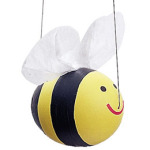
Easter Eggs: Bee Egg

With this project, kids blow an egg, then turn it into a flying wonder. All you need is a raw egg, paint, craft supplies, and fishing line for hanging the egg. The best part? This blown-egg creature will keep indefinitely.

Materials

  • eggs
  • newsprint
  • egg dye
  • paper towels
  • birthday candles or crayons
  • red and black acrylic or tempera paint
  • brushes
  • white tissue
  • glue

Instructions
  1. Blow the Egg: Wash and dry the raw egg. Cover your table with newsprint and set out bowls, pushpins, and paper towels. Shake the egg to break the yolk. Next, pierce the top and bottom with a pushpin, making the hole on the wider end a bit larger. Position the egg over the bowl and blow through the small hole, allowing the inside of the egg to seep into the bowl. Set the empty egg, with the large hole down, in an egg carton to dry. Be sure children wash their hands after handling raw egg.
  2. Degg-orate the Egg: Let the kids paint half of the egg, stand it atop a bottle cap to dry (use a hair dryer to speed things up), then paint the other half. Centering the face on either hole, paint on features with contrasting colors. Paint your bee bright yellow, then paint on a red smile, black eyes, and black stripes. Glue on white tissue paper wings.
  3. Take Flight: Tape a long length of fishing line to the end of an unfolded paper clip. Starting at the small hole, thread the line through the decorated egg and out the large hole. To keep your flying critter upright, tape the fishing line just above the hole in the critter’s back. Hang it from the ceiling or an egg tree.

Grow a Grassapillar

Grassapillar Celebrate the arrival of spring by bringing this fuzzy critter to life.Begin by mixing 3/4 cup of potting soil and 2 tablespoons of grass seed in a bowl. Add water to moisten the mixture, then set it aside.Cut away a three-cup section of an egg carton, then trim the section along the longer edges so that your grassapillar will look the same from both sides. With a permanent marker, draw a face on one end as shown. Gently spoon the seed mixture into the cups.

Set your creation on a dish in a brightly lit spot and keep the soil moist. The grass should sprout in about a week.

origami-butterfly-craft-photo-260-FF0399KDCOTA02Origami Butterfly

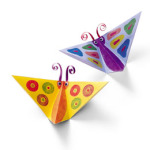
Origami, Japan’s traditional craft of paper-folding, has been used since the 10th century to sculpt animals and wrap gifts. Animals, birds, fish and insects are favorite origami subjects. After folding the butterfly featured here, you can make it flutter by pressing on its back with the tip of your finger.

Materials
  • 6 x 6-inch sheet of origami paper
  • Glue
  • 1 x 4-inch strips of origami paper or curling ribbon
  • Scissors
  • 2 googly eyes
  • Markers

X

Instructions
  1. Origami Butterfly Step 1 This colorful creature is created not by metamorphosis but by folding the origami paper in half to form a triangle.
  2. Origami Butterfly Step 2 Fold the triangle in half again.
  3. Origami Butterfly Step 3 Unfold the second triangle, then fold each side so that it crosses the center crease at a right angle.
  4. Origami Butterfly Step 4 (Continuation of above directions.)
  5. Origami Butterfly Step 5 Unfold. Glue on the strips for antennae and curl them using the edge of a scissor. Glue on the googly eyes and decorate with markers.

Blueberry Picking

Ripe for the picking!

Ripe for the picking!

It is time for blueberries – picking is ripe!

Consider taking the kids to Honey Pot Orchard in Stow.  Not only can you pick berries in the patch, you can have fun in the Hedge and tunnel maze, and   picnic by the barnyard animals.

Honey Pot Hill

THE BLUEBERRY PATCH

The blueberry patch is open for picking with lot’s of berries.   Go to the store to get information about container sizes (which they provide) and price.   The containers take a long time to fill so if you’re  with little ones be careful about the size you buy!

Cider donuts and caramel apples made fresh daily and can also be purchased at their store.

race to the center!

race to the center!

The Hedge Maze

Go and have lots of fun getting lost in the Hedge maze, the exact replica of the famous ‘Hampton Court’ Maze in England. Great fun for the kids, ages 4 thru 11.  There is also a Tunnel maze for children (no adults) to crawl through.  All for $1.50 per person.

Barnyard Animals

At the Barnyard!

At the Barnyard!

Visit with the barnyard animals – “3 little pigs”, 10 energetic goats playing on their goat walk,
the never ending cock-a-doodle-doo
roosters,
bunnies
and ducks.

Water Safety Tips from the Red Cross

IloveSwimming Take Steps to Stay Safe Around Water

Swimming is the most popular summer activity.

Follow these safety tips whenever you are in, on or around water with you.

Make Water Safety Your Priority

  • Swim in designated areas supervised by lifeguards.
  • Always swim with a buddy; do not allow anyone to swim alone. Even at a public pool or a lifeguarded beach, use the buddy system!
  • Ensure that everyone in the family learns to swim well. Enroll in age-appropriate Red Cross water orientation and Learn-to-Swim courses.
  • Never leave a young child unattended near water and do not trust a child’s life to another child; teach children to always ask permission to go near water.
  • Have young children or inexperienced swimmers wear U.S. Coast Guard-approved life jackets around water, but do not rely on life jackets alone.
  • Establish rules for your family and enforce them without fail. For example, set limits based on each person’s ability, do not let anyone play around drains and suction fittings, and do not allow swimmers to hyperventilate before swimming under water or have breath-holding contests.
  • Even if you do not plan on swimming, be cautious around natural bodies of water including ocean shoreline, rivers and lakes. Cold temperatures, currents and underwater hazards can make a fall into these bodies of water dangerous.
  • If you go boating, wear a life jacket! Most boating fatalities occur from drowning.
  • Avoid alcohol use. Alcohol impairs judgment, balance and coordination; affects swimming and diving skills; and reduces the body’s ability to stay warm.

Prevent Unsupervised Access to the Water

  • Install and use barriers around your home pool or hot tub. Safety covers and pool alarms should be added as additional layers of protection.
  • Ensure that pool barriers enclose the entire pool area, are at least 4-feet high with gates that are self-closing, self-latching and open outward, and away from the pool. The latch should be high enough to be out of a small child’s reach.
  • If you have an above-ground or inflatable pool, remove access ladders and secure the safety cover whenever the pool is not in use.
  • Remove any structures that provide access to the pool, such as outdoor furniture, climbable trees, decorative walls and playground equipment.
  • Keep toys that are not in use away from the pool and out of sight. Toys can attract young children to the pool.

Maintain Constant Supervision

  • Actively supervise kids whenever around the water—even if lifeguards are present. Do not just drop your kids off at the public pool or leave them at the beach—designate a responsible adult to supervise.
  • Always stay within arm’s reach of young children and avoid distractions when supervising children around water.

Know What to Do in an Emergency

  • If a child is missing, check the water first. Seconds count in preventing death or disability.
  • Know how and when to call 9-1-1 or the local emergency number.
  • If you own a home pool or hot tub, have appropriate equipment, such as reaching or throwing equipment, a cell phone, life jackets and a first aid kit.
  • Enroll in Red Cross home pool safety, water safety, first aid and CPR/AED courses to learn how to prevent and respond to emergencies.

Gardening & Learning about insects

banner_teddy_watering

Gardening

One way to spend time outside with the children (any age from two up) is to work in the garden. A garden is more than just plants. It’s also a home for birds, bees, butterflies, earthworms and other creatures that help the garden grow.

Children love to care for other living things, and plants are an easy choice that can give a great sense of accomplishment. Check with your host parents about where you can garden. Ideally, your little garden will have at least six hours of sun a day.

For outdoor gardening you will need to buy some seeds. If your garden has less than six hours of sun, choose seeds that can grow in “partial” sun. Select flower seeds that germinate quickly. The back of the seed packet will tell you how long before the plants sprout. Marigolds and morning glories are easy to grow and will come up quickly. Buying vegetable seeds will allow children to eat and share what they grow. Radishes are the fastest growing vegetable – from seed to salad in just three weeks. Green beans, tomatoes, summer squash and cucumbers are other good choices, but they do take longer. Be sure to plant extra seeds because not every one will germinate. This is an important lesson for children – mistakes are natural and an inevitable part of life. If you are starting late and want to make sure you will have a vegetable harvest, you can also buy small plants at a local plant nursery.

Before you plant the seeds, use a shovel, trowel or spade to loosen the soil. Remove weeds, stones and grass from the area. If the soil is very hard (like clay) or very sandy, it would be a good idea to add peat moss or compost to the soil. You will also need a hose or a watering can so that the children can water the earth when it doesn’t rain. If the plants look droopy or the soil feels dry, it is time to water. It is very important to water even before the plants sprout. It is best to water early in the morning or in the late afternoon.

Gardening includes other simple science lessons, all concepts that children can understand. Plants lean or turn towards light. Plants use water, but some of it evaporates into the air. What happens to the water that has evaporated? Without water plants will dry up and die. Plants come from other parts of the world, and sometimes their form gives clues to their origin. Can you find seeds that are native to your country?

When you go out into the garden, take care of the plants, pulling up weeds gently and also any sprouted seeds that are growing too close to another plant. But also look around and look closely at the ground to find birds and bugs that are a part of gardening. You can discuss how living things rely on plants to live, and how the plants need their animal friends. Birds spread seeds; earthworms loosen the dirt for the roots of the plants. What do bees do?

Look for books about gardening in the library. Carrot Seed by Ruth Krauss is a wonderful book for very young children. Take photographs of your gardening project. It will be surprising and satisfying to look at the starting photos at the end of the harvest. And don’t forget to put on sunscreen before you do your gardening!
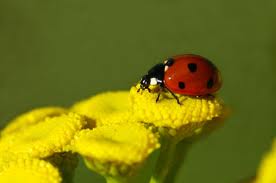

Lady Bug

Lady Bug

Learning about insects

Talking to children about insects is a fun activity in the summer when there are so many around!

Some easy facts for you to know:

  • There are more kinds of insects than any other kind of animal.
  • They live all over the world, even in ice and snow.
  • They never have more than 3 pairs of legs. If it has more, it’s not an insect!
  • All insects come from eggs.

Outside Activity: To learn more about insects, go on a hunt outside. Collect the insects you find in a jar and then examine them with a magnifying glass.

Recipe: Make a snack of “ants on a log.” Spread peanut butter on a stick of celery and then add raisins on the top.

Read: Children up to age seven will enjoy “The Very Hungry Caterpillar” by Eric Carle. Look for it in the library.

Inside activities:

  • Make a caterpillar from a cardboard egg carton cut in half lengthwise. Turn each section upside down to paint with water-based paint. Use pipe cleaners to make the antennae. Draw or glue eyes and a mouth.
  • Make a butterfly by putting small pieces of colored tissue paper in a clear sandwich bag. Seal the bag. Squeeze the bag in half with the sealed edge at the top. Twist a tie around the middle and adjust the end of the twist tie to make antennae.

Mother’s Day

Never forget MOM

Never forget MOM

Sunday, May 11, 2014

Mother’s Day in the United States is annually held on the second Sunday of May. It celebrates motherhood and it is a time to appreciate mothers and mother figures. Many people give gifts, cards, flowers, candy, a meal in a restaurant or other treats to their mother and mother figures, including grandmothers, great-grandmothers, stepmothers, and foster mothers.

Help your kids make something special for mom this year!

Check out these crafts on Pinterest

Gifts for Mom