Tag Archives: cultural exchange

HALLOWEEN IS COMING OCTOBER 31st !

HALLOWEEN FUN AND SAFETY!
batsHistory –    Halloween, celebrated each year on October 31, is a mix of ancient Celtic practices, Catholic  and Roman religious rituals and European folk traditions that blended together over time to create the holiday we know today. Straddling the line between fall and winter, plenty and paucity and life and death, Halloween is a time of celebration and superstition. Halloween has long been thought of as a day when the dead can return to the earth, and ancient Celts would light bonfires and wear costumes to ward off these roaming ghosts. The Celtic holiday of Samhain, the Catholic Hallowmas period of All Saints’ Day and All Souls’ Day and the Roman festival of Feralia all influenced the modern holiday of Halloween. In the 19th century, Halloween began to lose its religious connotation, becoming a more secular community-based children’s holiday. Although the superstitions and beliefs surrounding Halloween may have evolved over the years, as the days grow shorter and the nights get colder, people can still look forward to parades,                                                                                                                      costumes and sweet  treats to usher in the season.
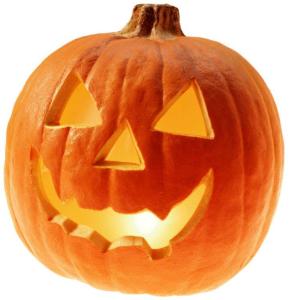
pumpkin Pumpkins and the Legend of Stingy Jack

Jack-o-lanterns are an Irish tradition brought to America by early Irish immigrants. But early jack-o-lanterns were not pumpkins, they were turnips, rutabagas or gourds that were hollowed out. Lights were placed in them to ward off evil spirits and to keep “Stingy Jack” (the legendary Irish drunkard and prankster, believed to have made a deal with the devil and condemned to walk the earth upon death, whose namesake has been given to modern day, carved pumpkins) away. It was not until the 1800’s when Irish immigrants came to America and found pumpkins to be so plentiful and easier to carve, that the tradition was altered.

Tick-or-treating – why we do it

The American Halloween tradition of “trick-or-treating” probably dates back to the early All Souls’ Day parades in England. During the festivities, poor citizens would beg for food and families would give them pastries called “soul cakes” in return for their promise to pray for the family’s dead relatives.

Trick or Treat

Trick or Treat

The distribution of soul cakes was encouraged by the church as a way to replace the ancient practice of leaving food and wine for roaming spirits. The practice, which was referred to as “going a-souling” was eventually taken up by children who would visit the houses in their neighborhood and be given ale, food, and money.

The tradition of dressing in costume for Halloween has both European and Celtic roots. Hundreds of years ago, winter was an uncertain and frightening time. Food supplies often ran low and, for the many people afraid of the dark, the short days of winter were full of constant worry. On Halloween, when it was believed that ghosts came back to the earthly world, people thought that they would encounter ghosts if they left their homes. To avoid being recognized by these ghosts, people would wear masks when they left their homes after dark so that the ghosts would mistake them for fellow spirits. On Halloween, to keep ghosts away from their houses, people would place bowls of food outside their homes to appease the ghosts and prevent them from attempting to enter.


Our Favorite Halloween website for crafts and cooking ideas

Visit this Disney site for great Halloween crafts and cooking fun.   –

http://familyfun.go.com/halloween/
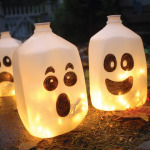
Spirit Jugs


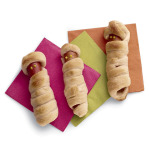
Yummy Mummy Dogs

Yummy Mummy Dogs

Au Pairs helping children stay Safe on Halloween   halloween-safety-4


  1. Make sure to inspect the children’s Trick Or Treat candy to make sure everything is in a sealed wrapper and appears safe.
  2. Small children should not eat hard candy because of chocking.
  3. Children should be supervised when they go Trick-or-Treating.  Many parents will come home early from work on the day to go with their children.  Check with Host Parents about this.


Halloween Safety Tips for Drivers

Halloween is a wonderful holiday, but because of increased foot traffic and that Trick-or-Treaters are out at night, the potential for automobile related accidents with young pedestrians increases four times on this night according to a CDC (Center for Disease Control) study.

Streets are literally crawling with all sorts of witches, ghosts, goblins, vampires and all other sorts of costumed people. This makes for added responsibility for drivers to make sure that they drive safer than normal.

In many areas, people drive their kids into subdivisions and let them out to walk from house to house. Usually the parent follows behind in the car. This can cause traffic jams in small areas and much confusion as kids dart between cars on the streets going from house to house. A driver is already distracted because they are trying to keep an eye on their own kids and usually aren’t paying attention to much else.

Children and adults tend to be preoccupied and may not pay as much attention to safety as they should. They may not see your vehicle or just assume that you see them automatically. Stay on the defensive and you shouldn’t have a problem while driving on Halloween night

* Don’t use a cell phone or other electronic device while driving on Halloween night. You shouldn’t be doing this anyway, the rate of cell phone related auto accidents has jumped dramatically since the use of cell phones and texting has risen so high. Some states have already made laws concerning this and others are working on it.

Make sure your child carries a flashlight, glow stick or has reflective tape on their costume to make them more visible to cars. Left them know if they carry a flash light to never shine itin the eyes of a driver. This can cause blindness on the drivers part temporarily and they may not see your child.

Drive below the posted speed limit in residential areas during trick-or-treating hours. This will allow you time to break if you see a child dart in front of you.
.

HAVE SOME FUN THIS MONTH

house90Haunted Happenings in October


The month of October brings exciting activities to the city of Salem, Massachusetts. There are many activities relating to the city’s history and penchant for things macabre, including walking tours, haunted houses, trolley rides, spooky performances, exhibits, harbor cruiss and more. There will be the Derby Street Carnival on October 15 and a free concert on Saturday, October 30, starting at 8PM on a stage on Washington Street. Visit their website for all the details: http://www.hauntedhappenings.org/

In Westford MA, visit Witches Woods   http://witchswoods.com .  Haunted Hayride and Halloween Screampark – open Thursday – Sunday  nights 6:30-10:30.

In Southern New Hampshire, you will find Canobie Lake Park’s SCREEMFEST. The fun amusement park has been taken over by goblins and ghosts! It runs on weekends through the month of October. Visit here for all their details: http://www.canobie.com/SCREEEMFEST/index.html
HAPPY HALLOWEEN!

First Day of Fall – September 22nd

fall_Fall is a magical time of year!

The leaves change colors, the air is crisp and cool and Halloween and Thanksgiving are just around the corner.   Try it to get in the mood for fall!

When the crisp fall air invites you outside for a walk gather some brightly colored leaves.  Press them in sheets of newspaper under heavy books for a few weeks.  When they have dried they will still have their     bright colors and can be glued onto paper.

Make leaf prints by painting one side of a leaf with tempera paint and then pressing it down gently into paper to form the leaf pattern.  Make designs for fun, or use large sheets of paper (tissue paper, brown paper or even newspaper) and save the painted paper to use as gift-wrap.  FallLeaves_SM_000

Place some leaves between pieces of wax paper and iron.  This will keep them from crumbling and give the leaves a glossy sheen.  You can then glue them onto paper – try adding bits of bark or seeds too.

Try putting leaves between pieces of clear contact paper.  You can hang them in the window or use them as place mats.

This Wednesday, September 22 is the Autumnal Equinox, which marks the first day of fall! The sun will be directly over the Earth’s equator, and there will be equal hours of day and night.  After Wednesday, the days will get shorter.

Happy Fall!


BACK TO SCHOOL

school-bus-stop-color

It is that time of year again when students of all ages get ready for the first day of school.  Here are some tips to assist with the “back to school” transition and hopefully great start to the new school year.

MAKING THE FIRST DAY EASIER

  • Remind your child that she is not the only student who is a bit uneasy about the first day of school. Teachers know that students are anxious and will make an extra effort to make sure everyone feels as comfortable as possible.
  • Point out the positive aspects of starting school: It will be fun. She’ll see old friends and meet new ones. Refresh her positive memories about previous years, when she may have returned home after the first day with high spirits because she had a good time.
  • Find another child in the neighborhood with whom your youngster can walk to school or ride with on the bus.
  • If you feel it is appropriate, drive your child (or walk with her) to school and pick her up on the first day.

BACKPACK SAFETY

  • Choose a backpack with wide, padded shoulder straps and a padded back.
  • Pack light. Organize the backpack to use all of its compartments. Pack heavier items closest to the center of the back. The backpack should never weigh more than 10 to 20 percent of the your child’s body weight.
  • Always use both shoulder straps. Slinging a backpack over one shoulder can strain muscles.
  • Consider a rolling backpack. This type of backpack may be a good choice for students who must tote a heavy load. Remember that rolling backpacks still must be carried up stairs, and they may be difficult to roll in snow.

EARTH DAY

Mobilize the Earth. Earth Day. 4.22.15

Earth-Day-Bulletin-Board1On April 22, more than one billion people around the globe will participate in Earth Day 2012 and help Mobilize the Earth™. People of all nationalities and backgrounds will voice their appreciation for the planet and demand its protection. Together we will stand united for a sustainable future and call upon individuals, organizations, and governments to do their part.

Attend a local Earth Day event and join one of our Earth Day campaigns as we collect A Billion Acts of Green® and elevate the importance of environmental issues around the world. Together we will Mobilize the Earth™ on April 22 and demand change

Each year, Earth Day — April 22 — marks the anniversary of what many consider the birth of the modern environmental movement in 1970.

The height of hippie and flower-child culture in the United States, 1970 brought the death of Jimi Hendrix, the last Beatles album, and Simon & Garfunkel’s “Bridge Over Troubled Water”. Protest was the order of the day, but saving the planet was not the cause. War raged in Vietnam, and students nationwide increasingly opposed it.

At the time, Americans were slurping leaded gas through massive V8 sedans. Industry belched out smoke and sludge with little fear of legal consequences or bad press. Air pollution was commonly accepted as the smell of prosperity. “Environment” was a word that appeared more often in spelling bees than on the evening news.  Although mainstream America remained oblivious to environmental concerns, the stage had been set for change by the publication of Rachel Carson’s New York Times bestseller Silent Spring in 1962.  The book represented a watershed moment for the modern environmental movement, selling more than 500,000 copies in 24 countries and, up until that moment, more than any other person, Ms. Carson raised public awareness and concern for living organisms, the environment and public health.

Earth Day 1970 capitalized on the emerging consciousness, channeling the energy of the anti-war protest movement and putting environmental concerns front and center.

Christmas Party 2014

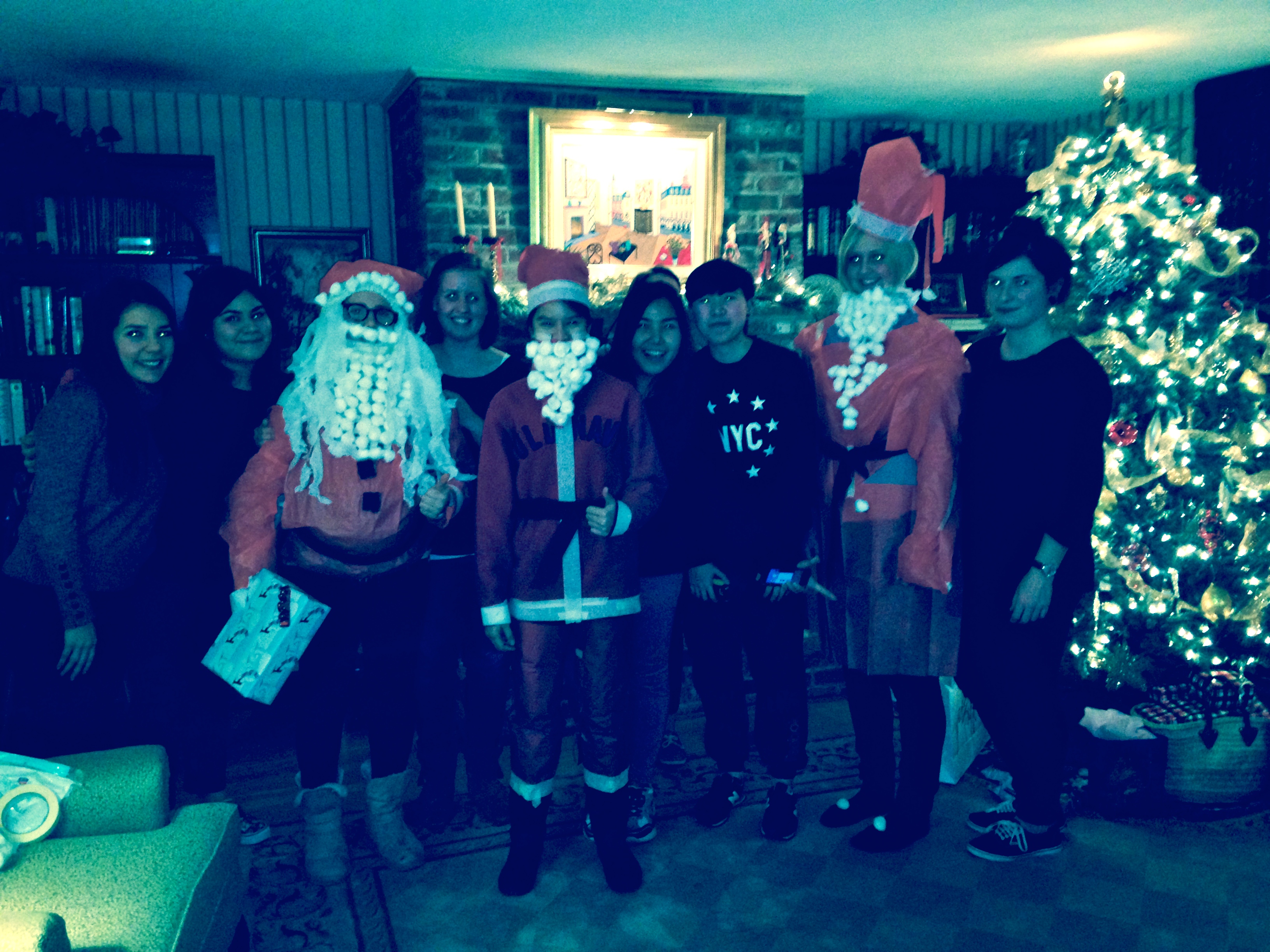
IMG_1354IMG_1366Our Holiday Party was held at my home.   Au Pairs brought dishes from their country to serve with a full turkey dinner.  There was a traditional Yankee Swap after which everyone was  divided into teams and were given tissue paper, cotton balls, streamers and masking tape to create a Santa.  The results were amazing!

Blueberry Picking

Ripe for the picking!

Ripe for the picking!

It is time for blueberries – picking is ripe!

Consider taking the kids to Honey Pot Orchard in Stow.  Not only can you pick berries in the patch, you can have fun in the Hedge and tunnel maze, and   picnic by the barnyard animals.

Honey Pot Hill

THE BLUEBERRY PATCH

The blueberry patch is open for picking with lot’s of berries.   Go to the store to get information about container sizes (which they provide) and price.   The containers take a long time to fill so if you’re  with little ones be careful about the size you buy!

Cider donuts and caramel apples made fresh daily and can also be purchased at their store.

race to the center!

race to the center!

The Hedge Maze

Go and have lots of fun getting lost in the Hedge maze, the exact replica of the famous ‘Hampton Court’ Maze in England. Great fun for the kids, ages 4 thru 11.  There is also a Tunnel maze for children (no adults) to crawl through.  All for $1.50 per person.

Barnyard Animals

At the Barnyard!

At the Barnyard!

Visit with the barnyard animals – “3 little pigs”, 10 energetic goats playing on their goat walk,
the never ending cock-a-doodle-doo
roosters,
bunnies
and ducks.

Water Safety Tips from the Red Cross

IloveSwimming Take Steps to Stay Safe Around Water

Swimming is the most popular summer activity.

Follow these safety tips whenever you are in, on or around water with you.

Make Water Safety Your Priority

  • Swim in designated areas supervised by lifeguards.
  • Always swim with a buddy; do not allow anyone to swim alone. Even at a public pool or a lifeguarded beach, use the buddy system!
  • Ensure that everyone in the family learns to swim well. Enroll in age-appropriate Red Cross water orientation and Learn-to-Swim courses.
  • Never leave a young child unattended near water and do not trust a child’s life to another child; teach children to always ask permission to go near water.
  • Have young children or inexperienced swimmers wear U.S. Coast Guard-approved life jackets around water, but do not rely on life jackets alone.
  • Establish rules for your family and enforce them without fail. For example, set limits based on each person’s ability, do not let anyone play around drains and suction fittings, and do not allow swimmers to hyperventilate before swimming under water or have breath-holding contests.
  • Even if you do not plan on swimming, be cautious around natural bodies of water including ocean shoreline, rivers and lakes. Cold temperatures, currents and underwater hazards can make a fall into these bodies of water dangerous.
  • If you go boating, wear a life jacket! Most boating fatalities occur from drowning.
  • Avoid alcohol use. Alcohol impairs judgment, balance and coordination; affects swimming and diving skills; and reduces the body’s ability to stay warm.

Prevent Unsupervised Access to the Water

  • Install and use barriers around your home pool or hot tub. Safety covers and pool alarms should be added as additional layers of protection.
  • Ensure that pool barriers enclose the entire pool area, are at least 4-feet high with gates that are self-closing, self-latching and open outward, and away from the pool. The latch should be high enough to be out of a small child’s reach.
  • If you have an above-ground or inflatable pool, remove access ladders and secure the safety cover whenever the pool is not in use.
  • Remove any structures that provide access to the pool, such as outdoor furniture, climbable trees, decorative walls and playground equipment.
  • Keep toys that are not in use away from the pool and out of sight. Toys can attract young children to the pool.

Maintain Constant Supervision

  • Actively supervise kids whenever around the water—even if lifeguards are present. Do not just drop your kids off at the public pool or leave them at the beach—designate a responsible adult to supervise.
  • Always stay within arm’s reach of young children and avoid distractions when supervising children around water.

Know What to Do in an Emergency

  • If a child is missing, check the water first. Seconds count in preventing death or disability.
  • Know how and when to call 9-1-1 or the local emergency number.
  • If you own a home pool or hot tub, have appropriate equipment, such as reaching or throwing equipment, a cell phone, life jackets and a first aid kit.
  • Enroll in Red Cross home pool safety, water safety, first aid and CPR/AED courses to learn how to prevent and respond to emergencies.

Valentine’s Day!

Saint Valentine’s Day

teddy-heartThe tradition of Valentine’s Day originated in Rome in the 5th century as a tribute to St. Valentine, a Catholic bishop who was beheaded by Emperor Claudius on February 14, 270 A.D. The story goes that the Emperor banned marriage in his empire and put Valentine to his death when he found out that Valentine was secretly marrying young people.
Originally, the day was marked by sending poems and gifts (such as flowers) but it became quite commercialized already in the 1800’s.

Today, Valentine symbols include Cupid, flowers, chocolates and hearts.

Sending a valentine in the United States is not a serious declaration of love as in some other countries. Children usually send valentines to the other children in their class and to the teacher. Friends and relatives exchange valentines.

Check out the APIA Pinterest

Valentine’s Day

You also might like this site  below for some fun valentine crafts to make with your kids

Valentine Crafts for Kids

Au Pair insurance – What you should know

Is it risky to do winter sports without the sports insurance?


YES!! If you have to pay your own hospital bills for a broken bone, you might be shocked at how much that would cost. I checked this website for some cost estimates.

Here are a couple examples:

  • Without medical coverage, to treat a broken arm or leg (that does not require surgery) it could cost up to $2500.
  • Without medical coverage, to treat a broken arm or leg (requiring surgery) it could cost $16,000 or more.
  • I wanted to make sure everyone understands how the medical coverage works for sports related injuries. There is a list of “high-risk sports/activities” that are not covered with the basic or upgrade medical insurance plans. Those activities are only covered with the Sports Insurance Package (also known as Option A.)

    The Sports Insurance Package was available pre-departure and may also be purchased at any time during your year. It takes effect within 48 hours of your enrollment and it is good for the remainder of the year. The cost will be the same ($60) whether you have a month left or your whole year ahead of you. I recommend you pay for it early on, if you didn’t already purchase it. You never know when an opportunity might present itself and you don’t want to miss out on an adventure. You also don’t want to take a risk on getting injured and being responsible for the bill on your own.

    Below is a partial list of sports that are only covered with the sports insurance package:
    Football, Rugby, Scuba diving, Ski-doo,  Wakeboarding, Skydiving, Parachuting, Rock climbing, Zip line, Skate boarding, Rollerblading, Roller skating, Ice Skating, Skiing, Snowboarding, Snowmobiles & Snowshoeing.  View the full list on page 3 of the insurance brochure HERE
    Note: Injuries sustained while partaking in these sports are covered with purchase of the Sports Insurance ONLY.

    How to register for the Sports Insurance
    Download the form SPORTS INSURANCE FORM and follow the instructions.

    Harvard University Tour 2013

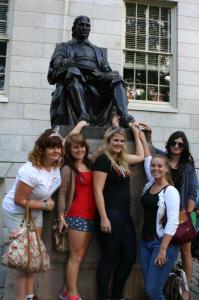
    Touching John Harvard's shoe for luck!

    Touching John Harvard's shoe for luck!

    Au Pairs from the Boston area gather each year to tour the hallowed grounds of Harvard University.  On a beautiful September day over 80 girls came to Cambridge to learn about student life and the diversity of one Americas oldest and most prestigious schools.

    Tour guides provided us with historical facts and stories.  Did you know that the statue of John Harvard (which by the way is not John Harvard, but a student who was asked to model, in the absence of any known pictures of John) is the 3rd most photographed statue in the country?   Want to guess what the top two are?    Needless to say the day was full of interesting facts and sights of Harvard!

    click here for pictures  —-> Harvard Tour 2013