
Many au pairs from different countries attended a Holiday Party. They brought food and exchanged gifts.
> “>
“> “>
“> “>
“> “>
“>
Many au pairs from different countries attended a Holiday Party. They brought food and exchanged gifts.
>“>“>“>“>
Thanksgiving is a uniquely American holiday, one that the au pairs look forward to experiencing. Please plan to include your au pair in your Thanksgiving celebration if at all possible. Thanksgiving with an au pair offers an opportunity to consider the relevance of the history and meaning of Thanksgiving as you compare the hospitality offered by the Native Americans to the recently arrived Pilgrims and the hospitality you offer your au pair.
Homesickness can be a problem during the holidays, even if it hasn’t been at any other time of the year. Au pairs often miss their friends and familiy, familiar places and their own traditions and customs. The holiday activities in the United States seem, and may actually be, different just at a time when an au pair would welcome something familiar. It is common for au pairs’ emotions to be close to the surface during the holidays. Her highs are higher, her lows are lower. The enormity of what she has done–actually living in another country (which is an amazing thing when you think about it!)–hits her and throws her into a self-protective mode. You can help her through this unfamiliar territory by talking to her about what your specific family activities will be (gifts, meals, visitors, religious services, in-home traditions, or none of these, as the case may be). In the spirit of cultural exchange, ask her if she has any favorite holiday traditions or foods that you might be able to incorporate into your family’s celebration of the season. Let her know what you will be doing, when you will be doing it, and what she can expect. Talk to her about what has to be accomplished and get her involved and interested. Don’t expect her to just “know” what needs to be done. Give her some clear, agreed upon assignments. Make her feel a part of things. And, let her know her contribution is needed and appreciated.
For au pairs with religious beliefs different from your own, you may choose to encourage her to share the associated traditions with your family. If you are not comfortable with this aspect of cultural exchange, your au pair may need your help as well as appropriate time off to participate in her own holiday traditions with another family, with a community group or with a religious institution. Enabling her to do this is very important. Her holiday or her time to celebrate the holiday may not be the same as yours; try to take this into consideration if you can when you make her work schedule. You may find that there is no conflict in giving her time off if her traditions are different, and it can relieve a great deal of anxiety to take her preferences into consideration. If you do need your au pair to work during the holiday, please tell her way in advance so that it is not a surprise. Help her to see this as a positive aspect of the cultural exchange if she will be actively sharing in the holiday celebration.
The dynamics of established relationships and routines change during the holiday. The parents are home more, and this is unsettling to the children as well as to the au pair. Some different work expectations may be needed since the kids may prefer to hover around the parents. This can make an au pair feel unwanted and unsure of what is expected of her. The high emotions and energy of the children (compared to their more reasonable behavior during the rest of the year) may seem like craziness to the au pair. Assure her that this new set of behaviors is temporary and the household will be back to normal soon. In the meantime, suggest specific things she can do to help. Encourage her to roll with the punches and enjoy the craziness. Also, the quantity of gifts, food, decorations, etc., can be unfamiliar and overwhelming. Try to include the au pair in some quiet, meaningful time together when the true spirit of the holidays is shared.
The holidays are a time when au pairs want to be with their friends. Christmas Eve, in some countries, is spent with friends rather than family. New Year’s Eve in America is a very special occasion to them. Discuss your plans and expectations with each other. Be as generous with time as possible.
These are important days ahead. This is perhaps the greatest opportunity of the year to respect and learn about cultural differences, which is, indeed, one of the basic elements of the Au Pair in America program. There will be fun-filled memories. This should be a time of love and understanding.
Sis-U International is a seminar series developed exclusively for Au Pairs and cultural exchange students by Kathy Korman Frey, faculty at the George Washington University School of Business, Center for Entrepreneurial Excellence. Check http://sisuintl.wordpress.com/
Who takes the class? Au Pairs and cultural exchange students of all different backgrounds. All students want to:
•Enhance leadership skill
•Think entrepreneurially
•Develop skills for career success
•Meet other Au Pairs as part of their cultural exchange experience
•Meet DC business women as part of their cultural exchange experience
•Have fun, be creative, and contribute to the class experience
******
Where: GW’s Foggy Bottom Campus near 22nd and G streets NW in Washington, DC.
When: 1/27- 3/31, 8 to 10 pm (please fill out SIGN UP form for updates. A second Saturday (12-5 pm) series of sessions is being considered for students who live in Ashburn, Baltimore, and other places farther away from DC.)
Hours: 36 hours per semester. A letter will be provided to all participants confirming their participation. University credit is not provided. Cultural exchange students: This class fulfills 36 of your 72 hours of required education.
* In addition to homework, there is approximately one hour required each week for group meetings outside of class.
Price: $350 via check and $362 via credit card (click link in box at top of page “Register and pay for…)
Course material cost: $40 for course workbook which will serve as a life-long leadership skills book beyond the au pair experience.
*Access to a computer and phone each week will be required.
Instructor; Kathy Korman Frey, GW School of Business faculty member and founder of the Hot Mommas Project research initiative..
2011 Schedule of Weekend Classes (subject to change based on enrollment)
January 8-9, 2011 – TOEFL Review Course
January 8-9, 2011 – American Language and Culture,
January 22-23, 2011 – American Government and Personal Development
January 22-23, 2011 – Computer Software/Certification: Word (Non-lodging Course)
January 22-23 and March 12-13, 2011 – Interior Design Two Weekend Program
March 5-6, 2011 – American Culture and Tourism
March 5-6 and May 7-8, 2011 – Hospitality and Tourism Two Weekend Program
March 12-13, 2011 – American Language and Culture
March 12-13 and April 9-10, 2011 – Travel Spanish Two Weekend Course
March 12-13 and April 30-May 1, 2011 – English as a Second Language Two Weekend Course
March 12-13, 2011 – Computer Software/Certification: PowerPoint (Non-lodging Course)
March 12, 19, 26 – Art History (Non-lodging Course), Washington, D.C.
April 2-3, 2011 – Caring for Special Needs Children and American Culture
April 2-3 and June 11-12, 2011 – Child Care Two Weekend Program
April 9-10, 2011 – Understanding American Language Culture and Government
April 30 and May 1 – Volunteerism in America (Non-lodging Course)
May 7-8, 2011 – American Culture and Personal Development
May 7-8 and June 11-12, 2011 – Travel French Two Weekend Program
May 14, 21, 28 – Art History (Non-lodging Course), Washington, D.C.
To register visit our new website: www.weekendprogram.org
Please note the location of Weekend Courses:
The Conference Center at the Maritime Institute
692 Maritime Boulevard Linthicum, MD 21090-1952
(410)-859-5700 Front Desk ext 0
For questions call Angela Garnett, Program Coordinator at 301-213-2404 or email: info@weekendprogram.org

 HANUKKAH (DECEMBER 1-9) ,CHRISTMAS (DECEMBER 25) and KWANZA (DECEMBER 26 TO JANUARY 1) ARE HOLIDAYS BEING CELEBRATED THIS MONTH!
These holidays are a time of celebrating, giving and sharing. Our Bethesda/Washington DC cluster is going to celebrate these holidays by attending a Holiday Party when au pairs will bring food, counselor will bring ham, there will be music and fun.
Traditions: Tell the children how you celebrate special holidays in your country.
Chanukah
Chanukah (also spelled Hanukkah), a Jewish holiday, is known as the Festival of Lights. It is a celebration of religious freedom based on historical events that occurred more than 2100 years ago. It commemorates rebellion against oppression, the first serious attempt in history for a nation to accept religious and cultural diversity.
Chanukah is celebrated for 8 days during the winter with the lighting of candles in a special lamp called a menorah or hanukiah. It is also traditional to exchange gifts or gelt (Yiddish for money), in the form of real coins or chocolate wrapped in gold foil, and to play a game of put-and-take with a four-sided top called a dreidel. The Hebrew letters on the sides of the top stand for words which mean a great miracle happened there.
The traditional legend of the miracle of Chanukah is that a single day’s supply of oil burned for eight days in the Temple in Jerusalem. Because of this Jews eat foods fried in oil on Chanukah, most often fried potato pancakes, known at latkes, and doughnuts, called sufganiyot in Hebrew.
As the essence of Chanukah is about the acceptance of cultural diversity, it is particularly appropriate for au pairs to join in the celebration. Helping children make simple gifts for each other and for their parents, or making Chanukah decorations for the house can add to everyone’s enjoyment of the holiday.
Christmas :
Christmas or Christmas Day is a holiday observed generally on December 25 to commemorate the birth of Jesus, the central figure of Christianity. The date is not known to be the actual birthday of Jesus, and may have initially been chosen to correspond with either the day exactly nine months after some early Christians believed Jesus had been conceived, the date of the winter solstice on the ancient Roman calendar, or one of various ancient winter festivals. Christmas is central to the Christmas and holiday season, and in Christianity marks the beginning of the larger season of Christmastide, which lasts twelve days.
Although nominally a Christian holiday, Christmas is also widely celebrated by many non-Christians, and many of its popular celebratory customs have pre-Christian or secular themes and origins. Popular modern customs of the holiday include gift-giving, music, an exchange of greeting cards, church celebrations, a special meal, and the display of various decorations; including Christmas trees, lights, garlands, mistletoe, nativity scenes, and holly. In addition, several similar mythological figures, known as Saint Nicholas, Father Christmas and Santa Claus among other names, are associated with bringing gifts to children during the Christmas season.
Kwanzaa:
Kwanzaa, or “First Fruits of the Harvest,” is an African-American and Pan-African holiday which celebrates and strengthens community, family and culture over a period of seven days. Kwanzaa begins December 26th. Each day, a principle of Kwanzaa is celebrated.
In order to appropriately cite these principles, the officialkwanzaawebsite.org describes these 7 Kwanzaa Principles, authored by Maulana Karenga, in this way:
Umoja or Unity: To strive for and maintain unity in the family, community, nation and race.
Kujichagulia or Self-Determination: To define ourselves, name ourselves, create for ourselves and speak for ourselves.
Ujima or Collective Work and Responsibility: To build and maintain our community together and make our brother’s and sister’s problems our problems and to solve them together.
Ujamaa or Cooperative Economics: To build and maintain our own stores, shops and other businesses and to profit from them together.
Nia or Purpose: To make our collective vocation the building and developing of our community in order to restore our people to their traditional greatness.
Kuumba or Creativity: To do always as much as we can, in any way we can, in order to leave our community more beautiful and beneficial than we inherited it.
Imani or Faith: To believe with all our heart in our people, our parents, our teachers, our leaders and the righteousness will victory of our struggle.
Note that the 7 Principles incorporate the words first in Swahili and then English.
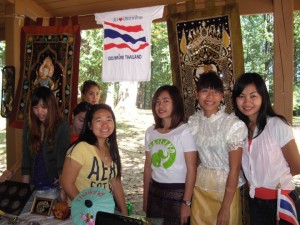 Many families and au pairs attended the picnic on September 19, 2010 at the Cabin John Reginal Park. Au pairs from Thailand presented the culture of their country through wearing beautiful traditonal dresses. There were colorful posters, various artifacts and brochures.
August 30 – The Importance of Discipline and Limit Setting with Kids of all Ages. Speaker – Robbye Fox, Certified Parent Educator, Parent Encouragement Program.
September 19 – Host Family and Au pair Picnic
October – Dance Class
November 8 – Suntrek Presentation
December – Holiday Party
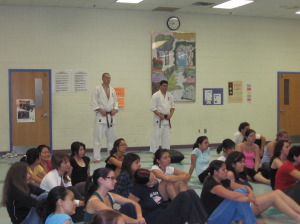
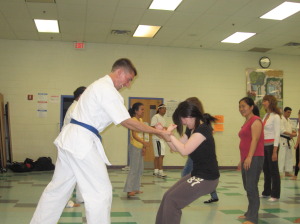
 On Tuesday, May 25th at 6:30pm. many aupairs from 3 clusters had a self-defense class with a real Karate school. They learned how to protect themselves, avoid potentially dangerous situations, be street smart.
 ,
,
The next APIA Advantage UCLA Extension Class is set to start on March 29. Time is running out to register. There are still spaces available, but you need to act quickly to register.
American Studies Online is a 19-week media-rich, mostly self-paced online course of study. Designed specifically in cooperation with the American Institute For Foreign Study’s “Au Pair in America” program, UCLA Extension’s course offers successful participants 6 quarter units (4 semester units) and a certificate of completion from UCLA Extension. This class satisfies the whole education requirement for au pairs and half of the requirement for Educare companions. View the brochure here.
Participants will read lessons, engage in activities, write, share resources, network with one another, and even collaborate on special projects – all designed to further their understanding of US culture.
The Community Involvement segment of the program takes the au pairs into face-to-face contact with the community. Au pairs will relate these experiences to their academic coursework in American Studies Online.
The interdisciplinary course of study will include:
• US History
• Arts in the US
• US literature
• Career counseling
• English language study (optional)
• TOEFL preparation (optional)
Each group is assigned a “Course Manager” who acts as an “online concierge” to provide high levels of service to ensure a rewarding and trouble-free educational experience.
For course descriptions and current schedule, visit http://www.uclaextension.edu/aupairs
For further information call (310) 206-6671 or email online@uclaextension.edu

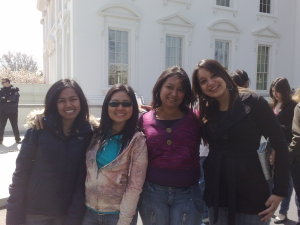 Seventy five au pairs visited the White House in March. The tickets were arranged by Congressman Chris Van Hollen’s office.