Category Archives: Blog

Smithsonian Folklife Festival

The Annual Smithsonian Folklife Festival will take place June 29-July 4 and July 6-9. 

The Annual Smithsonian Folklife Festival is an international exhibition of living cultural heritage. This year will be the 50th anniversary of this popular event. Attracting more than one million visitors yearly, the two-week long celebration is the largest annual cultural event in the United States.

The Festival is held outdoors on the National Mall in Washington, D.C., between 7th and 12th Streets and inside the Arts & Industries Building. There is no admission charge. Visitors should dress for hot and humid weather. Parking around the Mall is extremely limited, so visitors are advised to use public transportation. Smithsonian is the closest Metro station to the Festival site. L’Enfant Plaza, National Archives, and Federal Center stations are within a half-mile. For general Smithsonian visitor information, http://www.si.edu/Visit or call 202.633.1000 (voice).

Festival hours are 11 a.m. to 5 p.m., with special events taking place most evenings beginning at 5:30 or 7 p.m. View the schedule here.

I highly recommend that you visit their website to plan your visit http://www.festival.si.edu/

Preventing Dehydration in Hot Weather

Dehydration means that the body lacks the necessary amount of fluid. Infants and small children are more likely to become dehydrated than older children or adults, because they can lose relatively more fluid quickly.

Here are some steps to take to make sure children remain hydrated in the summer months:

  • Encourage your child to drink plenty of water. On hot days, children should drink significantly more water than usual, as they are losing more due to the heat.
  • Do not wait until your child is thirsty to give him water. By the time they feel thirsty, they are already becoming dehydrated.
  • If your child is resistant to drinking enough water, have other liquids on hand for your child to drink throughout the day.
  • Be alert to changes in behavior. A child may act confused or more irritable when they are becoming dehydrated/overheated. Get them into cooler temperatures and drinking more fluids.
  • Dress your child in lightweight clothing in the summer months, particularly if she’ll be playing outdoors in warm weather. You may also consider clothes that are well ventilated as they do not trap heat close to the body.
  • When there are heat and/or air quality advisories because the weather is dangerously hot, you should avoid taking the children outdoors. Check with your host parents for further guidance on this topic.

Remember to follow these tips for yourself too, so you stay well hydrated.

Photo: Darwin Bell (Flickr)

Holiday & Vacation Reminders

“Rest and be thankful.” – William Wordsworth

Holidays and vacations are a great opportunity to rest, recharge and explore the U.S.

Memorial Day Weekend is the unofficial start of summer travel season. Here are some reminders about program rules regarding holidays and vacations.

Holidays

  • Host families are not required to give au pairs any specific holidays.
  • Each host family will make different arrangements on holidays, some au pairs will be off and others will be required to work.
  • Au pairs should not make plans for holidays without checking with your host family first.

Vacations

  • Au pairs earns 2 weeks of paid vacation during the course of her year.
  • Vacation time should be mutually agreed upon.
  • All vacation should be preplanned (at least 4 weeks in advance.)
  • All au pair’s friends and/or family visits/vacations should be pre-approved prior to purchasing tickets.
  • If an au pair travels with her host family, it should be discussed in advance whether this is the au pair’s vacation or if she is working.
  • If an au pair travels with the host family to work, the host family is required to pay for her transportation, lodging and meals.

Important: If an au pair is traveling outside of the U.S., she must have her DS2019 signed (travel validation) PRIOR to her departure from the US. More information about this may be found here on the Au Pair in America website.

Photo: torbakhopper (Flickr)

Helping Young Children Learn Language

Being an au pair is an important role in a child’s life. When you are caring for a young child up to 45 hours per week, there are lots of opportunities to help them learn language. Many host parents are eager for their children to be exposed to foreign language. If this is true of your host parents, you can try the suggestions below, in both English and your native language.
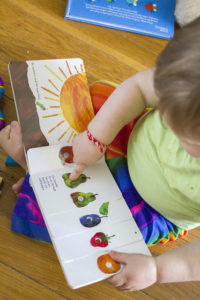
Below are a few tips to start with, for more ideas, check out Ready at Five.

  • Read – Read to them daily, point out pictures and ask questions. Even if they can’t answer the questions, this is still modeling conversation.
  • Talk – Point out objects around them, names of their body parts, explain what you are doing and places you are going. Long before babies can speak, they benefit greatly from being spoken to.
  • Sing – You can sing childhood classics or make up your own silly songs. If you are looking for song ideas, HERE is a great website with lists of songs, lyrics and links to YouTube videos* of the songs.  Children’s music is also available at the public library and even on iTunes.
  • Words – As children move from toddlers to preschoolers begin to point out written language.
  • Writing – Toddlers and preschoolers can begin to learn pre-writing skills by drawing with crayons or doing finger paints.

*The American Academy of Pediatrics recommends no screen time for babies under 18 months of age. For children 18 months to 5 years they recommend no more than 1 hour of high quality content. You can play the songs on youtube for the audio and not necessarily show the screen to the child.

Photo: Quinn Dombrowski (Flickr)

Handling Expenses

Host parents often ask for suggestions on how best to handle common expenses that occur as au pairs are caring for the children.

Miscellaneous Expenses

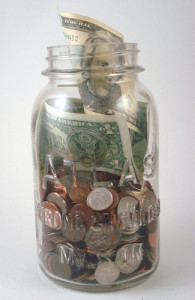
There are different ways to handle the little day to day expenses that come up.  Things like when an au pair takes the kids out for ice cream or picks up a gallon of milk.  Some families keep a cookie jar fund, a little cash that they set aside weekly or monthly for these types of expenses. Others give their au pair a prepaid debit card for this purpose. Below are some suggestions for avoiding problems with expenses.

Host Families

  • It’s important to be clear about how long this money should last and what types of expenses are approved.
  • Let the au pair know whether or not you expect receipts.

Au Pairs

  • Only spend the money on approved expenses.
  • If it is something you are not sure about, ask first.
  • Put your receipts in the cookie jar in place of the money to avoid any confusion.

Gas and Fare Cards 

Host families are responsible for the au pair’s transportation costs: to and from classes, cluster meetings and when driving the kids.

It is a good idea to figure out how much gas an au pair will use for these trips and either put gas in the car or give a gas allowance.   If your au pair is riding to classes or cluster meetings with another au pair, you should offer to share the cost of gas.

Au pairs are responsible for their own transportation at all other times.  You should replace the amount of gas used for personal use.

Photo: Andrea Travillian

Winter Sports and Sports Insurance


Is it risky to do winter sports without the sports insurance?
Yes. If you have to pay your own hospital bills for a broken bone, you might be shocked at how much that would cost. I checked this website for some cost estimates.

Here are a couple examples:

  • Without medical coverage, to treat a broken arm or leg (that does not require surgery) it could cost up to $2,500.
  • Without medical coverage, to treat a broken arm or leg (requiring surgery) it could cost $16,000 or more.

I wanted to make sure everyone understands how the medical coverage works for sports related injuries. There is a list of “high-risk sports/activities” that are not covered with the basic or upgrade medical insurance plans. Those activities are only covered with the Sports Insurance Package (also known as Option A.)

The Sports Insurance Package was available pre-departure and may also be purchased at any time during your year. It takes effect within 48 hours of your enrollment and it is good for 12 months. The cost will be the same ($85) whether you have a month left or your whole year ahead of you. I recommend you pay for it early on, if you didn’t already purchase it. You never know when an opportunity might present itself and you don’t want to miss out on an adventure. You also don’t want to take a risk on getting injured and being responsible for the bill on your own.

Below is a partial list of sports that are only covered with the sports insurance package:
Football, Rugby, Scuba diving, Ski-doo,  Wakeboarding, Skydiving, Parachuting, Rock climbing, Zip line, Skate boarding, Rollerblading, Roller skating,  Ice Skating, SkiingSnowboardingSnowmobiles & Snowshoeing.  View the full list on page 3 of the insurance brochure HERE(2015 arrival au pairs) & HERE for (2016 arrival au pairs)
Note: Injuries sustained while partaking in these sports are covered with purchase of the Sports Insurance ONLY.

How to register for the Sports Insurance
Contact Lisa or Christine to get a copy of the Sports Insurance Enrollment Form. It takes a few days for your coverage to begin. If you think you will be doing any of these sports, you should get it now.

An Explanation of the Education Requirement

Au pairs are required to complete 6 credits or 8 CEUs or 72 or more hours.

EduCare Companions are required to complete 12 credits or 16 CEUs or 144 or more hours.

You may take credit or non-credit classes from an accredited college. Look on the right side of this page under “Education Options” for accredited schools in our cluster area. If you want to take a class at a school not listed here on my blog, please check with me first to make sure it is accredited. Otherwise, it would not count toward your education requirement.

Your host family will pay an education allowance to assist you in completing your education requirement. Au Pairs education allowance – $500, EduCare education allowance – $1000

There are ways to get your credits for just your education allowance, but it will not give you a lot of choices. Normally au pairs will contribute some of their own money ($200+) towards their education.

The APIA Advantage UCLA Course is the only State Dept. approved class with an online component. No other online classes are accepted.

Note: Au pairs should only take one weekend course for their education requirement. Using only weekend courses to meet your education requirement could result in the denial of your extension application (should you decide to extend.)

How to Write a Check or Money Order

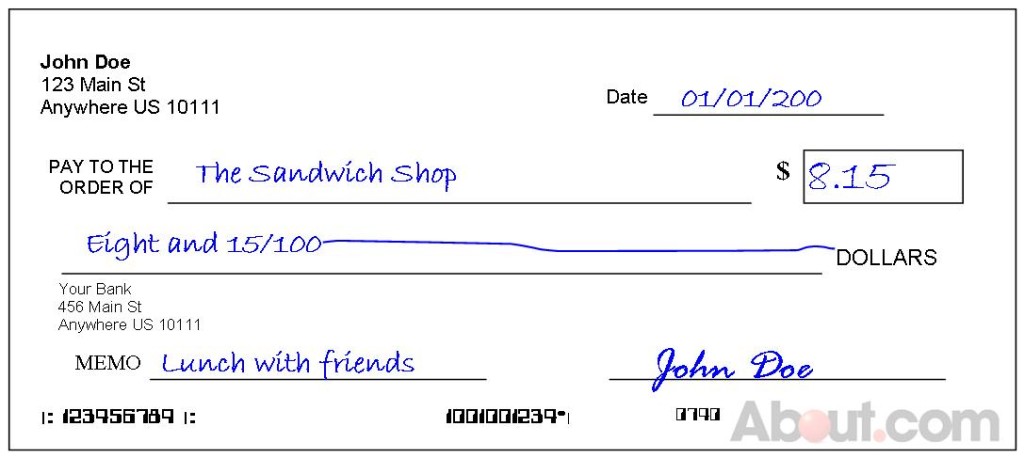
This question comes up from time to time and with the tax deadline approaching, I thought I would post a link with a great step by step tutorial.  Click on the image of a check below to go to the tutorial on About.com.

write_a_check_step5_sign_memo

Remember: Use pen and don’t leave extra blank space where someone can make changes.

If you don’t have a checking account and need to make a payment by check, you have two other options: money order or cashier’s check (bank check.) Money orders are available for purchase at your bank, the post office or the customer service desk of some retail stores (CVS, Safeway, WalMart.) You will be charged a small fee, $1.50-$5.  Money orders need to be paid for with cash (not credit cards.) You will fill out the money order similarly to a check and keep your receipt portion for your records.

If you are paying your taxes:

  • Make check or money order payable to “United States Treasury.”
  • Write this info somewhere on the check:
    • Your full name
    • Your address and phone number
    • Your Social Security Number
    • 2013 Form 1040 NR-EZ
  • Mail your tax forms (keep copies for your records) and payment to: Internal Revenue Service
    P.O. Box 1303
    Charlotte, NC 28201–1303
    U.S.A.
  • (Source: https://blogs.aupairinamerica.com/mdf/2014/03/03/how-to-write-a-check/)

How to Address an Envelope

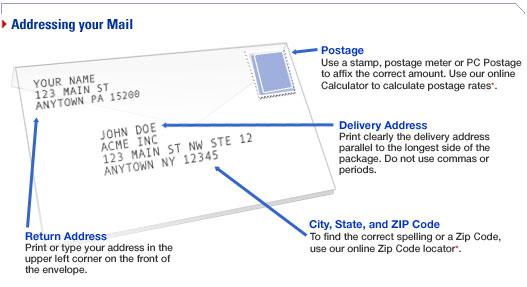
This is another common question, since the way people address mail around the world varies.  Here is an image of where to put the information when you are sending mail in the United States.

How to Address a Letter from the US Postal Service

How to Address a Letter from the US Postal Service

Here is the address to mail your tax return to:
Internal Revenue Service
P.O. Box 1303
Charlotte, NC 28201–1303
U.S.A.