
Annika, Vivi, Aicha, Sarah, Julia, Susanne, Denise, Daniela and Andrea braved the cold Saturday March 26th and volunteered to face paint and apply tattoes to the children who attended the annual Touch A Truck event, a fund raiser for the Westport-Weston Pre School. Wind 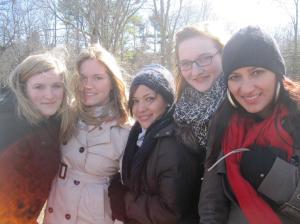


 and bitter cold temperatures did not stop everyone from having some fun.
Category Archives: Kids
Fun Indoor Activities for cold, rainy, snowy afternoons:
Here are some fun activities to do with your host children on these cold, snowy days:
Listen to Music and Dance Day – Don’t let the rain or snow stop you from being active. Put on a lively tape and dance around the house today. Show the children some traditional dance moves from your country!
Tea Party Day – Mix up some warm cocoa or milk and invite the dolls or stuffed animals for a tea party
Art Day – Make today an art day – try drawing, painting, creating with glue or clay.
Make a necklace today– use a licorice “shoelace” (the really long thin ones) and cereal for young children and then they can eat the whole thing. For something less sticky, use string instead of the licorice.
Puzzle Day – Do a puzzle or make one of your own. Find a fun picture in a magazine and glue it to lightweight cardboard. Cut into shapes.
Make a Pie – Pies are popular every day and are easy to make if you buy a prepared crust in the freezer or dairy section of the grocery store. Try this easy recipe:
Chocolate Pie
Purchase pre-made pie shell and Jell-O instant chocolate pudding. Prepare pie shell per directions. Let cool. Prepare pudding, pour into pie shell, let set for an hour and voila! Dessert is served!
Stamping – Rubber stamps and stamp pads are fun, but for a change try sponge and some kitchen utensils or cut shapes into a potato, apple, or orange. You could even let the child dip his or her hand into some water-based paint to make great pictures.
Treasure Hunt! – Pretend you are all on a desert island looking for treasure. Make a map or place clues around the house leading the children through the hunt. This can be done with pictures for non-readers – draw a picture of the television, then at the television place a picture of the stove. At the stove place a picture of a bed, and so on to the end. The “treasure” can be a treat to eat, or a new game to play. Read books about pirates to add to the fun.
Make a fort today – Use blankets and couch cushions to make a fort and play inside. Don’t forget to put everything away!
Make a picture frame – Glue 4 Popsicle sticks (available in craft departments) in a square to make a frame. Decorate the frame with glitter, lace, yarn, feathers, stickers, confetti or whatever you have on hand. Mount a picture from the back and be sure to date it! You can also glue a magnet on from the back so that the picture can hang on the refrigerator. (This activity is suitable for children 3 and older)
Fun Children’s Activities
Scratch Pictures – This is a fun art project for children ages 7 and up. You need paper, crayons (make sure you have a black one), and a paper clip. Take one crayon and rub it over the paper. Use the flat side of the crayon and rub hard. Take another color and do the same to another part of the paper. Cover the whole paper with different colors of crayon. Now, take the black crayon and color over all the other colors until the whole paper is black. With a paper clip or coin, draw a picture by scratching through the black crayon. The other colors will show through where the drawing is scratched.
Driving – Keeping children happy in the car can be challenging. One helpful approach is to engage them in car games in the safety of their car seat or seat belt.
Alphabet Game- ages 3 and up
Children who can identify letters and can easily see out the window of the car can play this game. One child starts with A and has to find a word on a sign visible from the car with the letter A. The next child has to identify the B, and so on.
I Spy: Children spy something out the car window and announce its color by saying “”Ï spy something (color)”” and the rest of the people in the car have to guess what the child saw.
October Posts:
October 11- Columbus Day The day commemorates the landing of Christopher Columbus in the “New World.”
October 15 -National Pizza Month
Pizza is easy and fun to make and can be a nutritious meal for the children and is easy to make at home. You will need a ready-made pizza dough or a ready-made crust, shredded mozzarella cheese and a jar of pizza sauce. Add your favorite toppings – i.e. mushrooms, chicken, onions, or brocoli . First the dough or crust goes on a cookie sheet or pizza pan. Then spread the sauce, add the other toppings, and last of all, sprinkle the cheese. Bake as directed for the crust. Be careful, and keep the children away from the oven as the oven must be very hot to make a nice crusty pizza.
October 17– National Stamp Collecting Month –Collecting stamps is a fun and easy introduction to geography, history, art and nature. Help your children start a stamp collection by sharing stamps from your letters from home. Ask your au pair friends for stamps from their countries.
October 24 – United Nations Day – This is the anniversary of the creation of the United Nations in 1947, which is committed to peace and development, based on the principles of justice, human dignity and the well-being of all people. Teach your children something about your country today – a song, a story, game, a new food or a national tradition.
October 31-Halloween This is the day children dress up in costumes and, in many communities, go door-to-door to ask for candy. Safety on Halloween is extremely important – don’t take our eyes off the children and don’t let them eat unwrapped candy.
Major League Baseball
Baseball is called the “National Pastime” of the United States because it is so popular. There are thirty teams spread across the country, and many people have their own favorite “home team.”
The game is played by two teams. When one team is in the field, the other team takes turns at bat. A baseball player first bats at the ball and then runs around the bases in an effort to score. Points, called “runs,” are scored when a player on the batting team touches all the bases (including home plate) without being tagged or put “out” by a player on the fielding team. The team scoring the greater number of runs in nine “innings” wins the game. Each inning is divided into two halves: top and bottom. Both teams are allowed three outs per half inning.
Each team is part of a league. There are two leagues, the American League and the National League. Each team tries to win the most games in their league. The teams that win each league championship will play each other in the “World Series.”
* note* date may change October 27 – Baseball World Series – In baseball, the World Series is the championship games of Major League Baseball in North America, played in October after the end of the regular season between the pennant winners of the American and National Leagues. The Series winner is determined through a best-of-seven playoff, meaning that the first team to win four games wins the series. The World Series has been an annual event since 1903. It is played at the baseball stadiums of the two teams in the series. Baseball is so popular that it is sometimes called the “national pastime.” The word “ballgame” in the United States almost always refers to a game of baseball, and “ballpark” to a baseball field. The rules of baseball can be found here http://aupairinamerica.com/resources/life_in_the_us/baseball.asp
June Child Fun Focus
Use a Timer to get Children to Complete An Activity
Ask your host parents how much time they think it should take your host kids to complete a certain tasks that you and your host kids struggle with. Then set the timer and have a race against the clock to get things done before the timer beeps. There is no reward, just a high five and a challenge to do it faster the next day. This makes it fun and exciting! Once the behavior has changed and the struggle is over, you will not need the timer as the expectation has been set and met.
Use a timer for things like
- getting dressed
- room cleaning–set the timer for five or ten minutes and challenge your host kids to clean as much of the toys room as possible before the timer beeps
- playtime before doing homework or chores
June is Zoo and Aquarium Month
Visit Westport’s Earthplace, the Norwalk Maritime Aquarium or Beardsley Zoo or set up a pretend zoo with play animals and blocks. Invite the host parents to visit your pretend zoo. Read One Fish Two Fish Red Fish Blue Fish or If I Ran the Zoo, both by Dr. Seuss. Encourage the children to make up their own animals and draw them. Think of all the animal sounds you can and play a game guessing what animal you are. You may find that the same animal says one thing in America and something quite different in your own country!
June 4 – Aesop was born on this date. His stories, all with a lesson at the end are still well known today. Read one to your host children.
June 6 – National Applesauce Cake Day
Here’s a recipe for a healthy and delicious snack to make with the children
1 cup sugar
1/2 cup shortening
2 cup flour
2 teaspoon baking soda
2 teaspoon cinnamon
1 1/2 cups applesauce
1 cup raisins or dried cranberries
Mix first sugar and shortening, then add flour, baking soda and cinnamon. Mix in applesauce and raisins/cranberries. Place in a greased and floured 9 x 13 inch baking pan and bake at 350 degrees for 1 hour.
Try new foods! Are you caring for children who are fussy eaters or are reluctant to try new things? Make a tasting passport. Take several pieces of computer paper and fold in half and staple. On the front write “Tasting Passport” and the child’s name and the date you started. Look for food pictures in magazines that the child can glue into his passport when he tries a new food.
~Dream catchers. Native Americans used dream catchers to keep bad dreams away and let good dreams come in. Simple to make for 5 year olds and older, this is a fun craft activity that can then be hung in the child’s room.
~Take an ordinary paper plate and cut the center out of it leaving just the rim of the plate. Color the rim the child’s favorite color. Next, punch holes with a hole punch every inch or two all the way around the plate. Then, string the yarn back and forth from one side of the rim to the other forming a web like design inside of the paper ring. Decide which is the top and which is the bottom of their dream catcher. At the bottom of the dream catcher attach small feathers.
Easter
| Easter in the USA |
| It’s almost time to get out the paint and brushes to start decorating those Easter eggs. Yes, Easter is just around the corner!Easter is a very important celebration for many people in the USA with different traditions all over the country. Shops and homes will be decorated with Easter Bunnies and little yellow chicks and most families decorate Easter eggs with their children.
An Easter favourite is a game for children called Egg Rolling. It is a race where children push a decorated boiled egg through the grass with a wooden club. Whoever reaches the finish line first, without breaking the egg, wins. This game is so popular that the US president invites families to the White House for a game of Egg Rolling each Easter Monday – this tradition started in 1878. Another common Easter tradition is an Easter egg hunt. The ‘Easter bunny’ hides real and artificial eggs filled with surprises, for children to find. Whoever finds the most eggs is the winner, and everybody gets to keep the treasures and Easter surprises they found. For the Easter egg hunt, children make or buy special baskets to place all the eggs in. This Easter, get out the paint and brushes and join in the fun! |
Baking Dog Biscuits
Prime Time With Kids
Dog Biscuits
Bake a batch of these crunchy dog biscuits with your kids for a great Christmas doggie gift or a snow or rainy day activity. This simple recipe goes together in minutes, and young kids will have an easy and satisfying time rolling out or patting down the pliable dough to create shapes with cute cookie cutters.
Ingredients you’ll need:
2 cups whole-wheat flour
1 tablespoon baking powder
1 cup peanut butter at room temperature
1 cup whole milk
½ teaspoon salt
All purpose flour for rolling the dough
After you set the oven to 375 degrees, here’s how to get the kids involved:
Step 1: Let one child measure and combine the flour, baking powder and salt in a large mixing bowl.
Step 2: Another child may measure and stir the peanut butter and milk together in a smaller mixing bowl. It will take a minute or two until the mixture is smooth. Slowly pour it into the dry ingredients and stir until well-combined.
Step 3: Sprinkle flour on the counter. Knead the dough a few times until it is easy to roll out into a ¼ inch rectangle with a lightly floured rolling pin. Cut with cookie cutters in fun shapes such as a fire hydrant, bone, kitty heart or X’s and O‘s and transfer to greased (or parchment paper covered) cookie sheets.
Step 4: Bake 20 minutes or until edges are lightly browned. Let cool.
Divide into gift bags, tie with red ribbon and a Christmas tag and deliver to neighborhood dog friends for Christmas.
Note: A 1-1/2 inch heart shaped cookie cutter makes six dozen Christmas biscuits.
Making Puppets
Thanks to Etta Rosen for this article.
Puppets
Puppets are a wonderful way to enjoy art and drama and to develop language skills. They can be used with all ages of children. The youngest children can watch you perform and talk to the puppet. Starting at about age 3 the children can help make the puppets and put on simple ‘shows.’ You can make a puppet from almost anything. Here are some ideas to get you started.
Finger puppets:
♦
Draw a face on your fingertip.
♦
Draw on strips of paper and tape them around your fingers to make different characters.
♦Decorate the fingertips of an old glove with felt, yarn for hair and beads or buttons for eyes; make a whole family on one hand.
♦Cut out simple animal or people outlines on cardboard. Do not include legs or feet but leave a wide bottom edge. Cut out two holes near the bottom – large enough to put a finger through each hole. Your fingers can make this kind of puppet dance or walk.
♦Almost anything slipped over your fingertip can make a puppet – try making faces on a paper cup or a ball. Put a cloth napkin over your hand first to give the puppet some clothes.
A toilet paper tube can be used vertically for a soldier or other figure, or horizontally for a dragon or other long animals. Just put the tube over your finger to make it move.
Stick puppets:
♦Make a drawing of an animal or person and glue it to the end of a Popsicle stick. You can draw hair or make the hair more interesting using curled paper.
♦Cut out photographs of members of the family or friends and glue them to sticks. You can act out real family events.
Sock Puppets:
♦A simple puppet can be made from an old sock by adding hair and eyes. Put your thumb in the heel and your fingers in the toe of the sock to make the mouth.
♦For a fancier version cut a plastic lid in half and then tape it together to make a hinge. Glue this mouth in place at the toe end of a sock. This makes a great dragon.
Paper Bag Puppets
♦Take a lunch size paper bag and draw a face on the flap at the bottom of the bag. Glue on hair, ears or other features. Put your hand inside the bag. Move the flap up and down to make the puppet talk.
To make an owl, glue or draw eyes under the flap. Draw eyelids and eyelashes on the flap. Add wings, ears and feet. When you move the flap up and down the owl will blink.
Making a Stage for the Puppets
♦
Hide behind the back of a couch.
♦
Use the edge of a table covered with a tablecloth or turn a table on its side on the floor.
♦
Balance a mop handle or broom stick between two chairs and hang a large towel or blanket over the stick to make a stage.
♦
Make a puppet theatre out of a large cardboard box (appliance size). Cut a window for the
puppets. Operate the puppets from inside.
Enjoy the show!
Enjoy the show!
Fun Activities for Kids
Snow Day Boredom Busters – Indoor Physical Activities
By Christine Connally
It’s difficult when the weather is too snowy, wet or cold for kids to play outside and get all of that great kid energy out.
Here are some indoor physical activity ideas:
- Create an indoor obstacle course in the largest, kid safe room in the house (playroom, basement, family room, etc.) Use large cushions and toys to create places for kids to climb over and under.
- Turn on some music (kid music or other music that is appropriate) and dance.
- Play freeze dance. Tell the kids to dance when you turn the music on and to stop dancing when the music stops. Let the kids take turns being the leader, controlling the music.
- Do the limbo dance. Play music and challenge the kids to go under the limbo pole as it gets lower and lower.
- Make paper airplanes and see how far they can fly. Remind the kids not to throw them at other people.
- Mark small squares on the floor and challenge the kids to see who can stay on their spot the longest. Make it tougher for older kids by having them stand on one foot.
- Play ball toss games with soft items like rolled up socks. The younger the children the larger the container they are tossing into should be. For very young kids, use a laundry basket. For older kids, use something smaller like a box, basket or large plastic mixing bowl.
- Build a fort using blanket and furniture like chairs and tables. Or if the kids have a small play tent put that up.
- Play sports charades. Charades is a game where you act out something while people try to guess. You can do this with sports actions, using no equipment, just making the actions. For example – hitting a golf ball, pitching a baseball, serving a tennis ball, bowling, etc.)
- Jump rope.
- Play with a hula hoop.
- Try juggling, top spinning, or yo-yo contests.
- Play hide and go seek.
- Play “keep the balloon up”. Use one balloon per child or one balloon per small group. The group may add additional balloons as they gain control and awareness. *
* Safety Note – Balloons are a choking hazard, supervise children when playing with balloons and make sure to find and throw away any pieces of popped balloons.
Blog, Kids activity, childcare, fun, indoor, Kids, physical, school closing, snow day
Share on: Facebook, Digg
New Ideas for the Same Old Toys
There are some toys that kids usually play with on their own while you watch on the sidelines. However, you can make those toys feel like something new and fun, by suggesting different ways to play with them. Another thing that will make it more fun is if you become actively involved rather than just watching.
Play Food/Dishes
- Teach your host children how to say the names of some of the food and dishes.
- Using English and/or your language play games where you are ordering food like in a restaurant. Take turns with who will be the waiter and who is the customer.
- Come up with silly food combinations. For example: Who wants pickles on their slice of cake?
- Play a guessing game where the kids have to figure out what food you are talking about. For example: I grow under the ground in the dirt. People eat me fried, mashed and baked. What am I? (a potato)
- Play a game with setting the table using your language to ask for the different items (plate, spoon, etc.)
- Ask the children to divide the foods up into the different food groups (vegetables, meat, dairy, etc)
Block, Lego Blocks and Other Building Toys
- Divide all of the blocks up between the people playing by taking turns for each person to select block by block.
- Suggest specific things to build (robots, house, mountain) and build together.
- Challenge everyone to use all of their blocks.
- Sort the blocks by color or shape and make patterns with them (red, blue, red blue or square, triangle, rectangle.) You can create a pattern and ask the child to fill in what comes next to continue the pattern.
- Make the tallest block tower you can and let them knock it down (over and over again, if like most kids they like destroying things.)
Mr. Potato Head
- Teach your host children the names of the different parts in your language.
- Play a game asking them to put on the body parts by naming them in your language.
- Play the same game above, but using Simon Says. Simon Says is a game where the leader gives commands by saying “Simon Says” first. For example, “Simon Says, put on the nose.” The players are only to follow the commands when the leader says Simon Says. If the leader doesn’t say Simon Says first and just says, “put on the nose,” and the player follows the command they are out of the game. Repeat the game multiple times, so all kids get a