Rosh Hashana in United States
Quick Facts
Rosh Hashana, also spelled Rosh Hashanah, is commonly known as the Jewish New Year. The event begins on the first day of Tishrei (or Tishri), which is the seventh month in the Jewish calendar.
Local names
| Name |
Language |
| Rosh Hashana |
English |
| Rosh Hashaná |
Spanish |
Rosh Hashana 2011
Thursday, September 29, 2011 begins on Wednesday, September 28 at sundown.
Many Jewish Americans celebrate Rosh Hashana (or Rosh Hashanah), which is also known as the Jewish New Year. Rosh Hashana starts on the first day of Tishrei (or Tishri), which is the seventh month in the Jewish calendar, and may last for two days. It is
sometimes called the Day of Remembrance or the Day of Blowing the Shofar.

The shofar is blown at some stage during Rosh Hashana.
What do people do?
Many Jewish Americans observe Rosh Hashanah, known as the New Year in the Jewish calendar, for two days, while others celebrate the event for one day. It is a time of family gatherings, special meals and sweet foods. Many Jewish people celebrate Rosh Hashana by eating challah bread and apples dipped in honey.
Unlike the secular New Year in the Gregorian calendar (January 1), Rosh Hashana is a time of judgment and remembrance, on which God reviews and judges a person’s deeds in the past year. It is a time of prayer and penitence. All debts from the past year are supposed to be settled before Rosh Hashana. Many Jewish people in the United States seek forgiveness from friends and family prior to this event.
Some Jewish people perform the tashlikh. This is the custom of reciting prayers near naturally flowing water, such as a stream or river, and symbolically throwing one’s sins away in the form of small pieces of bread or other food. Many Jewish people perform tashlikh from places such as the Brooklyn and Manhattan bridges in New York. Some people may use a fish pond or mikveh (ritual bath) if there is no local river or stream.
People of Jewish faith may take the day off work or organize time off during this time of the year, to observe the belief that no work is permitted on Rosh Hashanah. Much of the day is spent in synagogue, where the regular daily liturgy is expanded. The story of Abraham is read in synagogues and the shofar (ram’s horn) serves as a reminder that God allowed Abraham to sacrifice a ram instead of Abraham’s son, Isaac. The shofar is blown like a trumpet in the synagogue during this time of the year.
Public life
Rosh Hashana is not a federal public holiday in the United States. However, it can be taken as an optional holiday for state government employees in Texas. A chief judge of any judicial circuit in Florida can designate Rosh Hashana as a legal holiday for court employees within the state’s judicial circuit. Many Jewish organizations may be closed or have restricted opening hours on Rosh Hashana.
Background
Rosh Hashana (or Rosh Hashanah) marks the beginning of the Jewish New Year and covers two of the 10 High Holy days that conclude with Yom Kippur, the Day of Atonement. Some sources say that the early Jewish calendar had four New Years, corresponding the seasons, with Rosh Hashana being one of the New Years.
Festivals to mark the beginning of a new year in the fall have been held since the earliest days of the Israelites. These took the form of prayers of thanks for the grain harvest. The custom of blowing trumpets on the 10th day of the month of Tishrei is first described in the vision of Ezekiel, a prophet who lived sometime around 600–500 BCE. This custom has continued into modern times.
Symbols
The challah bread, which is eaten during Rosh Hashana, symbolizes the continuity of life. The apples that are dipped in honey symbolize sweetness and good health throughout the New Year. Some people also eat fish heads, which symbolize their desire to be on top, not the bottom, of life in the New Year. Pomegranates symbolize an abundance of goodness and happiness.
The shofar reminds people of Jewish faith that God allowed Abraham to sacrifice a ram instead of his Abraham’s son, Isaac. The tashlikh is an act that symbolizes throwing one’s sins in the water, so people believe that they are freed from their sins.


 The theme of the tree is “We Bring the World Together!” The decorations have been made by au pairs from this year’s au pairs, as well as au pairs from previous years.

 Santa Claus arrived at 2 PM on a fire engine. Children lined up for a chance to tell him what they want this year for Christmas. Santa will be available every weekend till Christmas for the children. There is a red mailbox outside the Stony Brook Post Office just for letters to Santa. The trees are on display until January 1st. The APIA tree is right in front of the Brook House Restaurant, just to the right of the Post Office. Hope you visit Stony Brook and visit our tree!!


 Sunday, November 13 the Suffolk Cluster of Au Pair in America began preparing for the upcoming holiday season in the USA.
 The au pairs divided into small groups to discuss childcare challenges by age group. Then they came together to discuss the best ways to deal with these challenges. Cindy emphasized using each other as resources for how to deal with situations. Holiday childcare can bring on tired, over excited behaviors and it is important to minimize stress during this season with their host children.
 We also discussed being homesick at this time of year, best ways to deal with missing family and friends. Cindy encouraged the au pairs to bring some of their holiday traditions into their host families celebrations. Then the au pairs decorated ornaments to be hung on a Au Pair in America Holiday Tree in Stony Brook Village Promenade of Trees. The meeting concluded with pumpkin pie and apple cider. The au pairs enjoyed the Thanksgiving dessert and spending time with each other.
 The new au pair had just arrived.

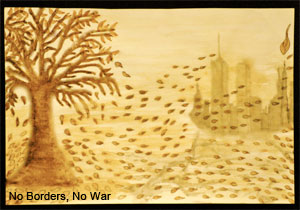
 Tatiana Dulcey from Colombia, an Au Pair for a family in East Hampton, took 3rd place in the Global Awareness for her painting “No Borders, No War.”
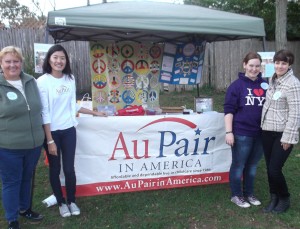 Pair in America Booth fo learn more about the program. The children enjoyed creating their own passports with flag stickers from the countries that the au pairs are from around the world. The kids colored Global Awareness placemats. The globe tattoes were a big hit with all the children!