Author Archives: Kayla Simmons

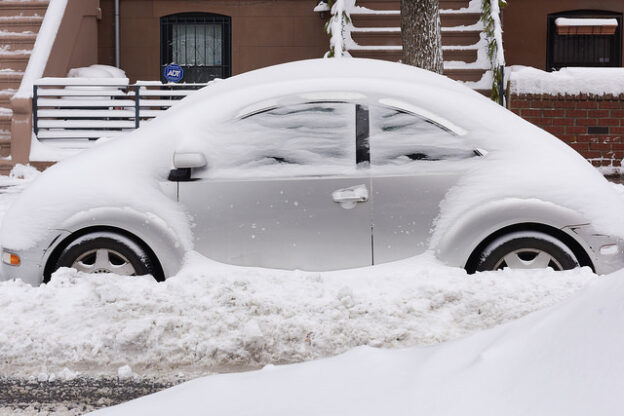
9 Winter Driving Tips to Stay Safe in the Ice & Snow


The best advice for driving in bad winter weather is not to drive at all, if you can avoid it. Don’t go out until the snow plows and sanding trucks have had a chance to do their work, and allow yourself extra time to reach your destination.

If you must drive in snowy conditions, make sure your car is prepared, and that you know how to handle road conditions. It’s a good idea to always keep at least a half tank of gas in your car, especially in winter months when you could get stranded. It’s helpful to practice winter driving techniques in a snowy, open parking lot to familiarize yourself with how your car handles. Consult your owner’s manual for tips specific to your vehicle.

Driving Safely on Icy Roads

1.Decrease your speed and leave yourself plenty of room to stop. You should allow at least three times more space than usual between you and the car in front of you.
2.Brake gently to avoid skidding. If your wheels start to lock up, ease off the brake.
3.Turn on your lights to increase your visibility to other motorists.
4.Keep your lights and windshield clean.
5.Use low gears to keep traction, especially on hills.
6.Don’t use cruise control or overdrive on icy roads.
7.Be especially careful on bridges, overpasses, and infrequently traveled roads, which will freeze first. Even at temperatures above freezing, if the conditions are wet, you might encounter ice in shady areas or on exposed roadways like bridges.
8.Don’t pass snow plows and sanding trucks. The drivers have limited visibility, and you’ll likely find the road in front of them worse than the road behind.
9.Don’t assume your vehicle can handle all conditions. Even four-wheel and front-wheel drive vehicles can encounter trouble on winter roads.

Avoiding Homesickness in the Holiday Season

Homesickness can be a problem during the holidays, even if it hasn’t been at any other time of the year. Au pairs often miss their friends and family, familiar places, and their own traditions and customs. The holiday activities in the United States seem, and may actually be, different just at a time when an au pair would welcome something familiar.

It is common for au pairs’ emotions to be close to the surface during the holidays. Their highs are higher, their lows are lower. The enormity of what they have done–actually living in another country (which is an amazing thing when you think about it!)–hits and throws them into a self-protective mode.

Au Pairs, there are things you can do to reduce homesickness during the holidays. It is important to balance your activities to feel connected to your family back home and your traditions and embrace new customs and experiences here in the U.S.

Share your traditions with your host family and friends. Each country has its own special holiday customs. Being friends with other au pairs, you can not only learn about the U.S. but also how other countries celebrate. When you talk with your family back home, you can share some of the new holiday experiences you are having. That can help lessen the feeling of missing out on moments at home by reminding you that you are here in the U.S. for a short time and you are making memories that will last a lifetime.

Host Parents, you can help your au pair through this unfamiliar territory by talking to them about specific family activities (gifts, meals, visitors, religious services, in-home traditions, or none of these, as the case may be.) In the spirit of cultural exchange, ask if they have any favorite holiday traditions or foods that you might be able to incorporate into your family’s celebration of the season. Let them know what you will be doing and when you will be doing it, so they know what to expect. Talk to them about what has to be accomplished and get them involved and interested. Don’t expect them to just “know” what needs to be done. Give some clear, agreed-upon assignments. Make them feel a part of things. And, let them know their contribution is needed and appreciated.

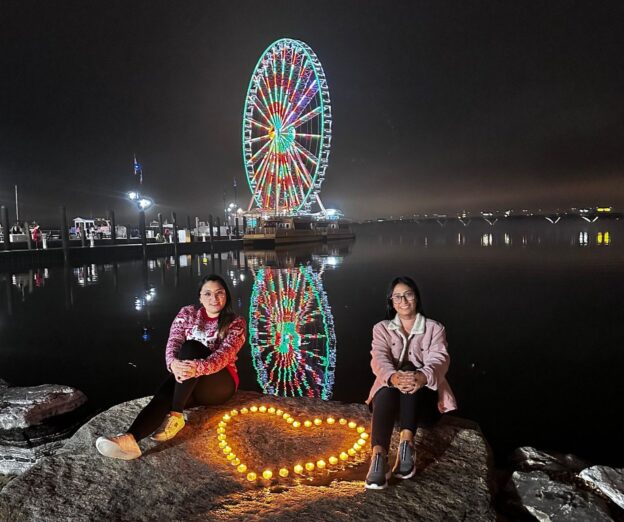
In the photo above Lina and her friend enjoying one of the most popular celebrations of the year in Colombia. “Every December 7, Colombian families get together with close friends to light several candles thinking about wishes for the coming year such as health, prosperity, love, and happiness. It is also very traditional to share typical food from the region, and what can never be missing is wine and cookies.”

What to Do After a Car Accident


Having a car accident is a very upsetting, stressful situation. Being prepared and knowing what to do can make things a little bit easier. Make sure you know which host parent to call in case of an accident.

Make sure you have all the necessary documents in your car glove box. Read this post on What to Keep in the Car Glove Box – Au Pair Chatter.

If you have an accident: (from Edmunds.com)

1.Keep Safety First. Drivers involved in minor accidents with no serious injuries should move cars to the side of the road and out of the way of oncoming traffic. Leaving cars parked in the middle of the road or busy intersection can result in additional accidents and injuries. If a car cannot be moved, drivers and passengers should remain in the cars with seatbelts fastened for everyone’s safety until help arrives. Make sure to turn on hazard lights and set out cones, flares or warning triangles if possible.
2.Exchange Information. After the accident, exchange the following information: name, address, phone number, insurance company, policy number, driver license number and license plate number for the driver and the owner of each vehicle. If the driver’s name is different from the name of the insured, establish what the relationship is and take down the name and address for each individual. Also make a written description of each car, including year, make, model and color — and the exact location of the collision and how it happened. Finally, be polite but don’t tell the other drivers or the police that the accident was your fault, even if you think it was.
3.Photograph and Document the Accident. Use your camera to document the damage to all the vehicles. Keep in mind that you want your photos to show the overall context of the accident so that you can make your case to a claims adjuster. If there were witnesses, try to get their contact information; they may be able to help you if the other drivers dispute your version of what happened.

Surviving & Thriving in the Holiday Season

The fall/winter holiday season is most often a time of joy and excitement. However, it can also be a time of stress and disappointment for both host families and au pairs.

Here are some ideas and insights that will hopefully help you avoid stress and disappointment and share more of the joy and excitement!

Holiday Work Schedules

Miscommunication over the schedule is the #1 issue for host families and au pairs over the holidays. As a reminder to assist with scheduling, program guidelines state an au pair can work up to 45 hours per week and no more than 10 hours per day. Hours cannot be carried from week to week. Please take the time to discuss your schedules and expectations.

The au pair program regulations do not have requirements for au pairs to be given holidays off. However, in the spirit of the program and since most parents will be at home spending time with their children, the majority of host families give au pairs some or all of the winter holidays off Thanksgiving Day, Christmas Day, New Year’s Eve, and New Year’s Day. Please discuss this so that everyone is clear about the schedule when making holiday plans.

Religion

For au pairs with religious beliefs different from your own, you may choose to encourage them to share the associated traditions with your family. If you are not comfortable with this aspect of cultural exchange, your au pair may need your help as well as appropriate time off to participate in their own holiday traditions. Enabling them to do this is very important. Their holiday or time to celebrate the holiday may not be the same as yours; try to take this into consideration if you can when you make their work schedule. You may find that there is no conflict in giving their time off if their traditions are different, and it can relieve a great deal of anxiety to take their preferences into consideration. If you do need your au pair to work during the holiday, please tell them way in advance so that it is not a surprise. Help them to see this as a positive aspect of the cultural exchange if she will be actively sharing in the holiday celebration.

Changes to Routine

The dynamics of established relationships and routines change during the holiday. The high emotions and energy of the children (compared to their more reasonable behavior during the rest of the year) may seem like craziness to the au pair. Assure them that this new set of behaviors is temporary and the household will be back to normal soon. In the meantime, suggest specific things she can do to help. Encourage them to roll with the punches and enjoy the craziness. Also, the number of gifts, food, decorations, etc., can be unfamiliar and overwhelming. Try to include the au pair in some quiet, meaningful time together when the true spirit of the holidays is shared.

These are important days ahead. This is perhaps the greatest opportunity of the year to respect and learn about cultural differences, which is, indeed, one of the basic elements of the Au Pair in America program. There will be fun-filled memories. This should be a time of love and understanding. Please do your part to make that happen.

Wishing you every happiness of the season!

Photo: Sean Hobson

Camp Au Pair – Outer Space

Next week’s Camp Au Pair theme is Outer Space.

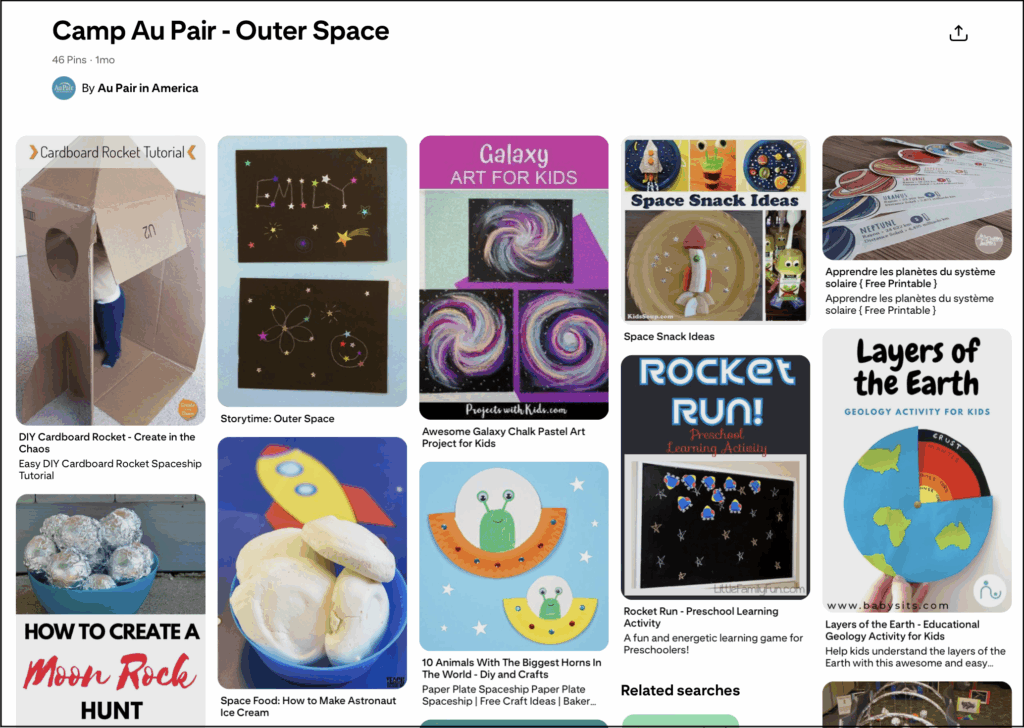
Crafts, recipes, activities, and games related to outer space can all be found here on the Camp Au Pair – Outer Space pinboard.

Here is a fun one that combines a science lesson, art, and snack time.

Field Trips can be a great way for kids to learn and have new experiences. Get permission from your host parents before any outings and be sure to check hours and admission information on the websites before you go. Here are a few places to go, that fit this theme:

  • Air & Space Museum
  • Planetarium
  • Science Center

Webcams – You can do a Google search for websites with webcams that allow you to observe space. Here is one from the International Space Station to get you started.

Online Games – NASA has a gallery of free space games for kids.

Videos – Look for fun videos on YouTube about outer space. Here are a few to get you started.

The Magic School Bus is a television series that follows Ms. Frizzle and her class as they set off on field trips. Most episodes can be found on YouTube. Here are some episodes that fit this week’s theme.

Movies – Here are some movies that fit the space theme.

  • WALL-E
  • Zathura
  • Monsters vs. Aliens
  • Star Wars  

Here are some movies that are PG-13 and may be appropriate for older kids.

  • Hidden Figures
  • The Martian

Books – Stop by your local library and look for books on outer space. You can also find books being read aloud on Youtube.  Me & My Place in SpaceThere Was an Old Astronaut Who Swallowed the Moon, and Mae Among the Stars are a few fun ones to get you started.

Story Time from Space is a YouTube channel with real astronauts reading children’s books aloud.

Photo: alittlepinchofperfect.com