Author Archives: Jennifer Harriss

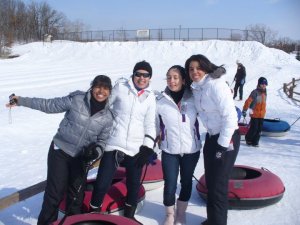
Winter Fun and Safety – Sledding!

Tubing au pairs

SLEDDING SAFETY TIPS from the Minnesota Safety Council
CHOOSING A SLED
Look for solid construction – avoid homemade sleds, inflatable sleds that could be punctured, and equipment with sharp edges. Energy-absorbing seat pads will help cushion jolts to the spine.
Examine sleds to be sure handholds are secure and steering works easily.

FINDING A SAFE SLEDDING LOCATION
Look for an area that has been designated as a safe place to sled. Injuries are most likely to occur on poorly lit, unsupervised hills with obstacles such as rocks, tree trunks, etc. Check for signs posted by local police or parks and recreation departments.
Check that the sledding area has adequate space at the bottom to allow the sled to come to a complete stop. It should be far from traffic and water, and free of obstacles such as rocks and trees.
Be alert to hidden hazards under mounds of snow.
Don’t let children sled on ice.

Provide adult supervision as appropriate for children’s age and abilities.
Before sledding, remind children of the basics: Encourage them to sit up with feet forward (lying flat on the sled increases the chance of head and abdominal injuries), and to roll off the sled if they’re about to collide with a tree or other large or hard object.

Dress children appropriately for the temperature and in multiple layers. Outerwear should be water- and wind-resistant and free of drawstrings, which could pose a strangulation hazard.

It is recommended that kids wear helmets when they sled. Although a helmet has not yet been designed specifically for sledding, until such a helmet exists, wearing a bicycle, skateboard or ski helmet may be preferable to wearing no helmet at all.
Source: Safe Kids Worldwide

Calendar of the Season – January

APIA has a calendar for every month that lists fun things to do with kids, interesting facts, and educational information for many of the days in each month. January’s includes Martin Luther King, Jr. day, Albert Schweitzer’s birthday, activities to learn about hibernation, and recipes to celebrate Pie Day (January 23, not to be confused with Pi day, which is March 14th.) The link to January’s calendar is  here .

Have fun!

Winter Storm Warning and what to do

Now is the time of year when we hear about winter storm warnings, blizzard warnings, etc. What are you supposed to do about that?

A winter storm is a snowstorm that has a lot of snow and/or winds that blow the snow around so you can’t see. A winter storm watch means the conditions are right for a storm, and a winter storm warning means there is a storm on the way. A blizzard warning means that there will be a BAD winter storm. An ice warning means that there will be ice on the roads, on the cars, everywhere.

Many people try to stock up so they can just stay in the house for a few days – watch the weather reports and grab a gallon of milk and a loaf of bread before the storm is supposed to hit. People can get lost in falling, blowing snow. Even just going to the mailbox! The storms never last that long, so most likely you will be able to wait until it’s over before going outside.

Driving in the snow is a lot like any winter driving – take everything, every single thing, slower than normal. Start slower, give yourself more time to stop, slow way down before you turn. Don’t panic if you slide or even spin – try to steer where you want to go because eventually you will be able to control the car again. Watch out for other drivers! Even if your light has turned green, make sure the cross traffic is able to stop before you go out in front of them.

Carry things like gloves or mittens, blankets, ice scrapers, and windshield washer fluid in the car. I always stick a pair of those $1.00 stretchy gloves in the pocket of any coat I might want to wear in case I forget my real gloves – they are way better than nothing. (But try not to get them wet.)

Dress in layers and dress kids in several layers. That way if they get too warm, they can take off their hoodie and still wear their coat. Au pairs need to get instructions from host parents on exactly how to dress the kids for winter, and they need to follow those instructions!

Winter in Minnesota is something everyone here has to deal with. Most of the time it can be fun! But when there’s a storm coming, please take care of yourself and your kids.


Winter Driving Safety Tips

Tubing au pairs

Winter Driving Safety Tips from the Minnesota Safety Council – Long but worth it!
WINTER DRIVING TIPS

In addition to the basic safe driving habits we practice all year long – buckling up, driving alert and sober, and driving at a safe and legal speed – be aware of extra steps you can take during the winter months.

Make sure your car is ready for the season and that the brakes, battery, exhaust and cooling systems, headlights, fluids, windshield wipers and washers are all in proper working order. Throughout the winter, keep your gas tank at least half full to avoid gas line freeze.

Keep close tabs on the weather. Avoid traveling, especially alone, if severe weather is forecast. Before taking a trip, inform someone at your destination of your expected arrival time and your route.

Keep an emergency survival kit in the car. It should include:
a working flashlight and road flares
an ice scraper, snow brush and shovel
jumper cables, tow chain and a toolkit
a blanket, warm clothes, boots, hat and gloves
a metal bucket or coffee can, small candle and matches or a disposable lighter
a brightly colored square of cloth such as a bandanna
basic first aid kit
a large plastic garbage bag (can be used to insulate feet, legs and torso)
a bag of sand, salt or cat litter to use for traction when tire is stuck
high energy, non-perishable foods (granola bars, unsalted nuts, dried fruits)

If your car has been outside during a snowfall, brush all the snow off before setting out. Snow left on the front hood will blow into the front vent and cause defrosting problems, and can also melt and re-freeze on the windshield. Snow on the roof will cover the rear window and snow on the rear deck will blow onto tail lights. Pay particular attention to cleaning off headlights and tail lights so that other motorists can see you.

Adjust your speed to the conditions and increase following distances. Remember that bridges and overpasses can be more slippery than other parts of the road. If you begin to skid, remain calm, ease your foot off the gas and gently turn the wheel in the direction you want the car to go. If you have an anti-lock braking system (ABS) apply a steady firm pressure to the brake pedal. Never pump ABS brakes.

Check that your cell phone is fully charged for use during emergencies. Because driving requires your full attention, be sure to find a safe place to pull over when you need to make a call.

If You Get Stranded While Traveling…
Stay with your vehicle. Don’t try to walk to safety – you’re safer staying in your vehicle.
Call for help on your cell phone
Make yourself visible. Tie a brightly colored (preferably red) banner or cloth on your antenna or hang it out a window. After the snowfall ends, raise the hood of your engine to indicate trouble.
Run vehicle for ten minutes every hour.Operate the heater and keep your overhead light on to remain visible for rescuers. Keep the exhaust pipe clear to prevent fumes from entering the vehicle, and always leave a down-wind window open slightly to avoid carbon monoxide poisoning. Also, keep the radiator free of snow to prevent overheating.
Keep moving. From time to time vigorously move your arms, fingers, legs and toes to keep blood circulating and to stay warm. Avoid over-doing it. It is important not to get hot and sweaty because wet clothing loses its insulating ability. If you are with others, huddle together for warmth and sleep in shifts.
Acknowledgments:
National Safety Council
Cultural Calendar

APIA offers many services to our families. One that I haven’t yet mentioned is our Cultural Calendar. This handy calendar shows the special days and times of year in a easy-to-read visual calendar. It will help your au pair better understand seasons and celebrations in America as well as provide a calendar for possible fun activities. We try to include activities that families an au pairs can use with all different ages of kids. For example, the October calendar includes everything from recipes to celebrate Cookie Month, to Le Courbusier’s birthday.

Take a minute every month, or just when you’re looking for things to do with kids, to check out our Cultural Calendar!

http://www.aupairinamerica.com/resources/calendars/index.asp

Infant and Child First Aid/CPR scholarship

Au Pair in America includes first aid training in our orientation, which all of our au pairs attend when they first arrive in the U.S. We also offer a scholarship which will pay for Infant and Child First Aid and CPR training through the Red Cross. We want all of our au pairs to be the most highly qualified in the industry, and we provide ongoing training to help meet that goal.

We also offer ongoing training quarterly during our au pair cluster meetings, and we have regular webinars for the au pairs on a variety of topics.

If you have any questions about this, please feel free to reach out!

Fall in Minnesota

There are so many fun things to do with kids in Minnesota! We have apple orchards, pumpkin patches, haunted houses (some of which aren’t too scary, but some are, so be careful!) beautiful drives through changing trees, football games, and all kinds of Halloween activities.

It’s also a great time for au pairs and families to talk about fall in other countries. Some places don’t even have fall! So this could be the only chance she has to see leaves change from green to red, orange, yellow, or brown.

Take a look around your community and see what kinds of things you can do, that you haven’t taken advantage of in years past. I bet everyone can find something new. Comment on your best idea of how to celebrate this amazing season!

State Fair Time!

I love the fair! I go (almost) every year. I go on the rafting ride, eat at least one ear of corn, go on the giant slide, get some honey lemonade, pick up a bunch of swag in the Education Building, pet a few animals, listen to live music — I know I’m forgetting something. Oh, yeah, Sweet Martha! Mini-donuts! Rides! Corn dogs!

If you haven’t been to our State Fair, you’re in for a treat. We have the biggest (in terms of daily attendance) and best fairs in the country. Minnesota has such a proud agricultural tradition that we in the metro might take for granted, but when you see 4H kids sleeping with their lambs, then crying when the lamb is sold, you understand how important this lifestyle is to all of us.

But it’s not all educational. Every kind of food you can imagine is sold at the fair.  They have live music on three different stages all the time. There is a parade every single day at 2. The art exhibit has some amazing stuff, and the home ec quilts blow my mind.

I hope every au pair gets a chance to experience the Great Minnesota Get-Together. It runs from August 25th to September 5th. Park and ride at area malls and wear comfortable shoes.

See you at the Fair!!

Back to School (cue ominous music)

August means back to school for many of us! Shopping, organizing, waiting to see what friends are in your class — it’s all a lot of kids can think about as August marches on. My kids always wanted to get their school supplies the day they hit Target so they could rearrange their backpacks over and over.

But it can be stressful for kids, too. They don’t want to waste any summer, and of course they’ve already wasted a lot of it. They don’t know if their new teacher will like them, if they’ll make any friends, what if it’s too hard…

The change in schedule can also throw everyone off. Even though families try to keep routines in place over break, let’s face it, my kids were always up later in the evening and getting up later in the morning. They recommend that you make kids get up at school time for a week or so before school starts so they aren’t too groggy to learn in class. Good luck with that….

It is a good idea to discuss all the changes with the family before they happen. This especially includes your au pair, who may not be familiar with your before-school routines, packing lunches, etc. Everyone should sit down and talk about what will be different and what will be the same in September. Particularly if the au pair’s schedule will be changing – give it to her in writing so she definitely understands!

I hope everyone has a fantastic year in school!

APIA ongoing au pair training

Au Pair in America is committed to providing the best possible childcare to your family. Au pairs get ongoing training in childcare and related topics throughout their year, both at their monthly cluster meetings and in online webinars.

Webinars are scheduled roughly every week throughout the year. Recent topics have included things like:

  • Toilet Training 101
  • Activities to develop speech and language in young children
  • Managing play with more than one child

Recent cluster meeting child care focuses have included:

  • Severe weather safety
  • Swimming safety
  • Getting ready for back to school

Au Pair in America has a scholarship for any au pair who wishes to get certified in Infant and Child First Aid and CPR. This is in addition to a thorough training in first aid and CPR at our Orientation program, which is the gold standard in the industry.