
Author Archives: Jolanta Tipler

Welcoming Au Pair to Your Home

After you match with your new au pair and arrange her travel from orientation to your community, it’s very important to keep in touch with her prior to her arrival. Please keep in mind that you have opened your home to someone else’s daughter. There are many things you can do that will help her to feel welcome in your home. An email to check in every so often is reassuring and builds the bonds you started to form when you offered her a home for a year. Sending photos of the children or pictures they have drawn is also a welcome form of connection.

Once your au pair arrives at orientation, please call her to welcome her. It makes the au pair feel much more comfortable to hear from you while she is at orientation.

Some families send flowers or small packages with personalized stationery or homemade cookies. Ask your counselor for other suggestions if you want to send something, but keep in mind that your au pair will have to transport whatever it is to your house. Faxes can be received by the hotel and are also a nice way to say hello.

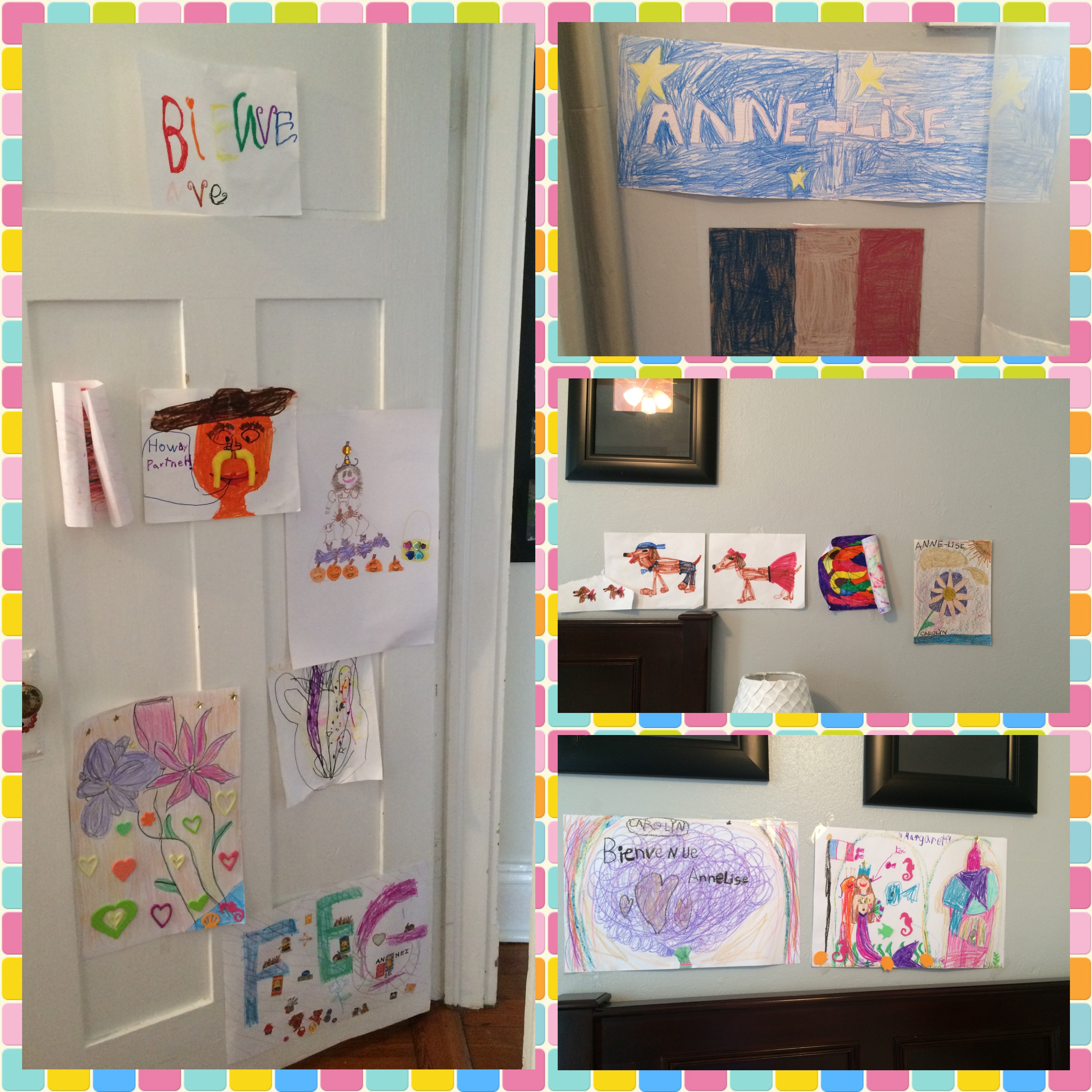
Before she travels to your home, prepare a welcome sign made by the children. You can display it at home or use it at the airport or train station. Make sure her room is clean and ready for her. Mark the au pair’s birthday on the family calendar.

When she arrives at your home, she will be tired, excited and probably anxious. Keep in mind the fatigue that being in a new culture causes, particularly if your au pair is not a native English speaker. The au pair needs time to recover from jet lag.

It’s important to give her a few days to unpack, rest and become acclimated to the host family’s home, family and neighborhood before expecting her to assume full child care responsibilities. She should be allowed to find ways to make her space her own; mounting a bulletin board on the wall is one easy way to do this.

According to Department of State regulations, au pairs are not allowed to assume sole responsibility for the children until after she has been in the home three days. Giving her the opportunity to bond with the children one at a time is helpful in building relationships. Those first few days can be used to complete the child care questionnaire for each of your children, to conduct a tour of the neighborhood, to go to the grocery store to determine her food preferences and for her to see the variety of foods available in the US, and to share information about the house and her chores. Many families also use this time to have the au pair drive for the first time.

The Community Counselor will call and/or visit within the first forty-eight hours after the au pair’s arrival.

Some other adjustment issues to keep in mind:

  • The au pair may be confused by directions with so many new things to learn, especially as she works to adapt to a new language and surroundings.
  • She may be homesick, possibly suffering from stomach indigestion as she tries to adapt to new foods, diet and a different time zone.
  • Children may be both excited and apprehensive about the au pair’s arrival, and their behavior patterns may be different from how they generally behave. With patience they will weather the transition.
  • Host parents may need to adapt to sharing living space with a young adult.

Putting time and effort into a positive welcome experience and being prepared for what typically happens in the first few days will give your match a strong foundation to build on.

http://www.aupairinamerica.com/resources/host_family_tips/welcome.asp


Anne Lise arrived from France recently and was very happy with the welcome by her host family. She was touched to see that her host children drew not one but a whole gallery of pictures to decorate her room.
Processed with Moldiv

Processed with Moldiv

“I was very well received by the family! I arrived at night and in the morning the girls came to see how I was. After when I went to say hello, they all made me a kiss and a hug.” (Anne Lise)




Getting School Age Host Children To Talk About Their Day

1.

Allow the child some time to wind down from his/her day. You

may be tempted to ask your host child about their day as soon

as you see them. Children may need some time to pass before

they want to open up about their day. They may be more willing

to share stories if you give them some time to get out of school

mode.

2.

Ask your host child specific questions. If you ask “how was your

day” you may find you get the same response every day. Here are

some examples of questions to stimulate conversation:

“Who did you eat lunch with?”

“What did you play at recess?”

“Tell me one new thing your teacher taught you today?”

“What was the best thing that happened at school today?”

3.

Tell your host child about your day. Talking about what you did

may start conversation and encourage your host child to share.

4.

Be silly. If you have young host children do not be afraid to act a

little silly. You can start a conversation by telling them how you

think their day went and mentioning silly things. For example,

“Let me guess something fun that happened today. Did a hot air

balloon land at recess and everyone took a hot air balloon ride?”

5.

Be patient. All children are different and some are more willing to

share stories. If you are consistent with your communication, your

host child will follow your cues and open up


Happy Labor Day!

NOLhappy-labor-day-pictures-4
Dear au pairs, here is some information about Labor Day in the United States:
The Workman’s Holiday ~ Dedicated in honor of the worker, Labor Day is also known as the “workingman’s holiday”. The holiday is dedicated to all workers in the United States in respect and appreciation for the work they do in or outside of the home, union or non-union, big companies and small companies and au pairs too. As long as you work somewhere at something, this holiday is for you! It is a day to celebrate your contribution to American working life and the work you do.
The First Labor Day ~ The first Labor Day was celebrated in New York City on September 5, 1882 and was started by the Central Labor Union in New York City. In 1884, it was moved to the first Monday in September where it is celebrated today. Labor Day quickly became popular and one state after another voted it as a holiday. On June 28, 1894, the U.S. congress voted it a national holiday.
The End of Summer ~ Labor Day is also viewed as the official end of summer. While the Fall Equinox is still a couple of weeks away, kids go back to school and summer vacations are over. This day is celebrated with a long weekend off from work and union sponsored parades. Many people celebrate this weekend with one last picnic. It is also the date that many people close up the swimming pool, and put away the boats.
Was it McGuire or Maguire? Either Peter McGuire or Matthew Maguire is the Creator of Labor Day. Peter J. McGuire, was an active labor organizer. He was also general secretary of the Brotherhood of Carpenters and Joiners and a co-founder of the American Federation of Labor. He was believed to be the first to suggest a day be dedicated to American workers and their accomplishments. Matthew Maguire however, was secretary of the Central Labor Union in New York in 1882 and many believed that he proposed the holiday in 1882.
So What do Americans eat on Labor Day? Picnics and barbecues are popular ways  to celebrate Labor Day.  Old standards are hamburgers, corn dogs, coleslaw, potato salad  corn on the cob, baked beans and sliced tomatoes. Finish up with sliced watermelon, apple or blueberry  pie and freshly churned ice cream.  Sound good?  Want to try a recipe? 
 
What can you do with the kids on Labor Day?  Schools are usually closed on labor day so the children are home for the day.  Generally Americans love long weekends and it is an extra special time for families to be together.  Join in and be part of the family activities.  Enjoy your first Labor Day Weekend in the United States.  If you recently arrived this is a great weekend to bond with the kids and get to know them.  Go for a bike ride, play in the back yard, go to the park or enjoy the beach and the pool before the fall weather arrives.  For indoor quiet activities try these:
 
Click here for Labor Day coloring pages: 
Click here for Labor Day short stories for children:

Importance of Play

Play. Play. Play. Have you ever seen a child who wanted to stop playing? Play is an important childhood activity and a natural part of a child’s life. Young children do not differentiate between play, work and learning. Children learn about the world around them through play. They enjoy playing and will do it whenever they can.

Do you remember playing as a young child? You may remember riding your bike, sliding down a hill, playing games or playing with your friends. Play is an integral part of children’s lives. Children love to play and they should – it is essential for their overall growth and development!

Play contributes to all areas of a child’s development: physical, cognitive (mental), social and emotional. Playing contributes to the physical development of children by giving them opportunities to explore, discover and master physical skills. Children practice large motor skills by running, jumping, swinging, riding bikes, and kicking balls. They practice fine motor development when drawing with markers or crayons, cutting scissors, or playing with playdough.

Play contributes to children’s cognitive growth and development. By playing children learn concepts, sort and classify information, build their vocabulary, probe for answers, problem-solve, and develop critical thinking skills. Play offers children opportunities to gain more information that sets the foundation for additional learning. For example, when playing with blocks a child may learn that two small blocks equals one large block. Block play can become the foundation for learning math skills and fractions as children get older, and is one example of the endless learning opportunities that exist through play.

Play is vital to a child’s social development. Children learn social skills as they relate to each other while playing. Play helps children learn to get along with others, to share, to take turns, to negotiate, and to compromise. While playing children also discover that not everyone behaves the same way and that some behaviors are not acceptable.

Finally, play contributes to the emotional development of children. Playing provides a way for children to express their feelings and to learn about the feelings of others. Play can help children reduce anxieties, fears and stress. When playing, children develop self-confidence and learn to control their emotional reactions and impulses.

Children at different ages will play differently. Very young children such as infants and toddlers tend to play alone in what is called solitary play. Near age three, children become very interested in pretend or imaginative play. Four-year-olds tend to be more aggressive in their play, while five-year-olds can separate the real world from imaginary play. The older children become, the more they are interested in playing with their friends and peers.

Children should have sufficient time and space for play every day. Children do not necessarily need many playthings – sometimes just their imagination is enough. Accept the playfulness in yourself and have fun with the children. Play is what childhood is all about!


Volunteering at Katrina 10

NOLVolunteer1NOLVolunteer2

Au pairs jumped at the opportunity to support their “home for a year” city.

Desiree from South Africa, Nadine, Johanna and Anastasia from Germany joined volunteers at Citywide Day of Service – Katrina 10: Resilient New Orleans.

They spent Saturday, August 29th (the 10th anniversary of Katrina’s strike) working hard at Gentilly Terrace Charter School. They said it was fun and rewarding experience.


Caring for Two or More Children

Everybody likes attention. Children particularly enjoy the attention of adults, and they often want undivided when it is least possible to receive it. The adult needs to have appropriate expectations, set reasonable limits, and problem-solve in creative ways when there is more than one child to care for.

The goal is to find activities that both children can enjoy together. When they are of different ages and abilities, their attention span and understanding of the game or project may be different as well, but still the tasks can be adjusted to suit different children. For example, if two children are involved in cooking, one may be able to carefully measure ingredients, and the other child can be in charge of pouring the ingredients into the bowl. If an older child is carefully working on a coloring project, give a younger child his own sheet of paper and crayons, making it clear that everyone is working on their own. Keep the tasks age-appropriate, and save the ‘grown up’ activities involving small pieces or sustained concentration for the younger child’s nap time.

It is important to remember that children of different ages will play with the same toys in different ways, depending on their age and ability. The adult may need to work to keep the younger child engaged with the activity longer, so as not to interfere with the older child’s efforts. For example, they could both play with blocks, but it may take adult intervention to keep a younger child from disturbing what the older child has built. The older child may be interested in creating an elaborate building or a city with cars, people or animals. Perhaps the younger child can play with it after it is built.

When playing a game with two children of different abilities, it may be necessary to change the rules to accommodate everybody. Try enlisting the understanding of the older child; remind her that she wasn’t always able to do all the things she does now. An older child can take pleasure in helping a younger brother or sister learn new skills. Have the children take turns playing “follow the leader” or “hide and seek.” Games of imagination work well, with the children taking different roles, or a scavenger hunt, with the adult giving necessary assistance to the younger child.

An older child may not always like this attention-sharing. You can give him the choice of doing the activity with you and the younger child in the way you have described, or to play by himself. Try planning ahead for the younger child’s nap time and arrange to do a special activity with the older child then, but don’t be disappointed if the older child turns you down. Children sometimes only want attention when they can’t have it.

The adult must be sure that each child does get appropriate attention, and that one child is not always being sacrificed for the other. It is easy to give a baby more attention, but babies can learn at an early age to watch and participate with others too. It may even be possible to hold a younger child on your lap while you do more grown up things with the older child. Babies can also be left to play by themselves in a playpen or a crib for short periods of time to enable the older child to have some one-on-one attention.

Remember that whatever the activity, you must be able to see both (or all) the children to be sure they are safe.

Thanks to Etta Rosen for this article.