Category Archives: Au Pair Tips

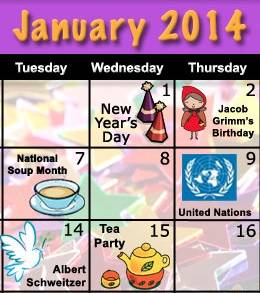
APIA Seasonal Calendar

NOLAPIAcalendar

Although au pairs are clever and resourceful ladies with plenty of ideas on how to amuse and educate their host kids, there are days when they scratch their heads and wonder what else they can do to keep things interesting.

One place to turn to for inspiration is APIA CALENDAR

http://www.aupairinamerica.com/resources/calendars/

which is chock-full of colorful tidbits about world events, famous people, fun games, recipes, etcetera… etcetera.

JANUARY 2014 alone offers info and additional links to subjects as varied as:
National Soup Month
United Nations
Pineapples (and Pineapple Upside Down Cake)
Winnie the Pooh
and Benjamin Franklin

“If you would not be forgotten, as soon as you are dead and rotten, either write things worth reading, or do things worth the writing.” ~ B. Franklin

Check it out and, as always, have fun!

Happy Thanksgiving Day!

NOLturkeyTHANKSGIVING falls on the fourth Thursday of November. It is as a legal holiday in the United States and commemorates the feast held at Plymouth in 1621 by the Pilgrim colonists and members of the Wampanoag people. The feast was held to honor God and give him thanks for harvest and health.

Thanksgiving has religious and cultural origins but is also celebrated in a secular fashion.

The most common dishes on a Thanksgiving table are: TURKEY, sweet potato casserole, collard greens, squash, cornbread stuffing, cranberry sauce and in New Orleans – shrimp and grits.

During a traditional ceremony at the White House, the president of the United States “pardons the turkey” which means the bird can spend the rest of its days back on the farm rather than on a Thanksgiving table.

The day after Thanksgiving, on BLACK FRIDAY people rush to the stores to buy highly discounted merchandise. Black Friday is considered the beginning of the Christmas shopping season.

Thanksgiving Fun For Kids

Here are some activities you can do with the children to celebrate Thanksgiving.  Click here to find crafts, coloring sheets, spelling worksheets, math puzzles,  nametags and more.

http://www.enchantedlearning.com/crafts/thanksgiving/

http://www.parenting.com/gallery/thanksgiving-crafts-ideas

http://www.buzzfeed.com/mikespohr/23-clever-crafts-to-keep-the-kids-busy-on-thanksgiving

Creative Outdoor Play

Outdoor play is more than merely supervising children – it is an interactive learning experience with endless possibilities, and is essential to a child’s development.

Researchers have found movement to be crucial to children’s development and are concerned with the amount of inactive time children spend watching television, playing video games or working with computers. An excellent resource on this topic is Jane Healy’s book Endangered Minds. It is shown that children need to have large amounts of unstructured playtime in order to develop well- rounded personalities, to build self-esteem and self-confidence, develop healthy social skills by participating in group activities, and to stimulate their intellectual development.

Playing outdoors allows children the physical freedom that is not always possible indoors. The more children move, the more they learn, and children can play outdoors year-round with appropriate clothing.

Children of all ages need to explore the outdoor environment and learn from their experiences. Children are able to learn about the four basic elements of nature — air, fire, earth and water. They can find places to pretend they are whoever they want to be, such as a firefighter a super-hero or an animal. There are places for creativity, such as drawing on the sidewalk with chalk or painting the driveway with water. Children can look for something heavy or light, something smooth or rough, something bright or dark, something man-made or natural, something huge or tiny, the possibilities are endless.

Creative outdoor play takes what is already on this earth and uses it in a way which is unique to a child: digging in the dirt or sand, making ditches and rivers where toy boats can float, or creating roads for toy trucks and cars. It means giving children the freedom for exploration and discovery. Children grow by daring, risking, failing, redoing and succeeding. Help children grow mentally and physically by playing outdoors whenever possible, giving them the opportunity to learn from the world around them.

New Process for I-94 Cards

Information Document – I-94 card

A new automated arrival/departure process for foreign visitors (au pairs) involving the I-94 card has been implemented at all air and sea ports of entry.

What is the I-94 card?
The I-94 card was formerly a paper document stapled into an au pair’s passport used as evidence of a non-immigrant’s lawful admission to the United States and to document legal status while in the United States for the length of her approved stay. See below for an example.

What is the new process?

  • · Creation of an electronic arrival I-94 record during admission process at air or sea ports of entry.
  • · No more paper I-94 card issued.
  • · CBP official (Customs and Border Control) will scan passport, creating an electronic I-94 record using the name appearing on the J-1 visa in the passport.
  • · CBP official will place a stamp in the au pair’s passport indicating date of admission, class of admission (J-1) and the date that the traveler is admitted until (D/S).
  • · DS 2019 form will no longer be stamped at immigration. Only the passport will be stamped.
  • · Au pairs will receive an information sheet telling them how they can access their I-94 card information online (www.cbp.gov/I94). I-94 card information will immediately be uploaded to the immigration database. No more waiting time. Information from the electronic I-94 will be available no more than 24 hours after the au pair’s arrival in the U.S. Au pairs can go to CBP website (www.cbp.gov/I94) to print down a paper document showing their I-94 card number or access their I-94 card number which can be used for social security cards, I-9 verification form and driver’s licenses.

CBP official will stamp and annotate the au pair’s passport with the date of admission, class of admission (J-1) and admitted until date (D/S – duration of stay). All stakeholders (DMV, social security offices) have been notified of this new process.

Additional Information

  • · Currently au pairs must still wait at least 12 business days before going to apply for a social security card. This process will change shortly, and we will notify you as soon as the change goes into effect. Once the change goes into effect, au pairs will be able to go and apply for a social security card the day after they arrive at their host family home. They must have the print-out of their I-94 card number.
  • · To print out I-94 card information from the www.cbp.gov/I94 website, au pairs will need biographical information, their passport number, country of issuance, date of entry, class of admission. The name should be spelled exactly as it appears on the J-1 visa in the passport. If it is a name with multiple last names, there should not be any space between the names.

Automatic visa revalidation–

  • · If au pair arrived after 5/20/2013, the Customs and Border Patrol officer will have the admission record available and will use that electronic record for readmission.
  • · If au pair arrived prior to 5/20/2013, she needs to show I-94 card upon reentry into the United States.

Arrival process

  • · Will stay the same with the exception of the electronic I-94 card. CBP officer will review documents, including passport, visa and DS 2019. Change will be that au pairs will receive a stamp in their passports and no paper I-94 card.

Stakeholders have been involved and engaged in the process. Social security offices will accept the entry stamp in the passport and DMV has been provided with all the information through the SAVE system. Every office should be aware of change in process. It is still recommended that au pairs print out their electronic I-94 card number for social security and DMV offices.

If, when leaving the US at the end of the year, the au pair has the paper I-94 card stapled into her passport, she will turn it in upon departure. After automation, there will be no form to turn in.

Revalidation process for au pairs will not change. If the au pair entered on a paper I-94, she will continue to use the paper I-94.

If an au pair is having problems printing out the electronic I-94 card number, please contact Evelyn Blum at eblum@aifs.com.

Toys, Toys, Toys!

Most American children seem to have more toys than children in any other country. Toys are in the children’s bedrooms, the family room, the garage, the basement and even in kitchen cupboards. And during the holiday season and at birthdays, most children will receive more toys as gifts. Do children really need all these toys? Are they necessary for their development? Are some toys better than other? These are a few questions to be answered.

Toys are materials that facilitate play. Toys can be store-bought or homemade, and do not need to be expensive. Children can create toys out of empty boxes, fabric pieces, masking tape, toilet paper tubes, plastic bottle caps, or whatever they choose. Years ago, there were no big stores with rows and rows of toys. Children played with toy dolls made out of corncobs and used their imagination.

Children do not need lots and lots of toys to play with. In fact, children can become overwhelmed by the amount of toys to choose from. Sometimes, it is better to sort through the toys and store some away for a a couple of weeks.

Criteria for selecting appropriate toys include: Is the toy safe? Is it fun? Can the toy be used with little adult supervision? Is the toy durable and versatile? Does it encourage large or small muscle development and eye-hand coordination? Does the toy encourage imagination, creativity or intellectual development? Is the toy developmentally appropriate for the child? Does the toy have more than one use?

The more ways a toy can be used, the better. Open-ended toys encourage creativity and stimulate intellectual development, and include blocks, and other building sets, markers and crayons, baby dolls, pots & pans, and playdough. Wind-up toys, talking dolls and coloring books are generally considered inappropriate because there is only one correct way to play with them.

Suggested toys for infants include nesting blocks, busy boards, shape sorters, balls and books. Infants learn through their senses so as they roll, reach, grasp and crawl, they need a variety of objects to see, hear and touch.

Toddlers seem to prefer pots, pans and containers in the cupboards rather than shiny new toys. Children of this age have a high energy level and are struggling to become independent. Therefore, toddlers explore and get into everything. They prefer toys that can be taken apart and put back together, dump trucks, blocks, sorting materials, toys that make sounds or movements, and toys that stimulate make-believe play. Both infants and toddlers only need a few toys to play with at one time.

Preschoolers and kindergartners enjoy dress-up clothes, blocks, manipulative toys that can be built into something, books, puzzles and wheeled vehicles for their motor development. School-age children are ready for board games, other games with rules, puppets, puppet stage, books, construction toys or toys that can be built into things, such as model kits and crafts.

The toys provided for children reflect our social and cultural issues and can influence a child’s knowledge of the world. Toys that promote violence should be limited. Some say the best toys for children are those that have been around for 30 or more years such as baby dolls and blocks.  The best toys stimulate a child’s imagination, promote self esteem, have no right or wrong uses, and are process-oriented rather than product-oriented.
Louisiana Driver’s License for Au Pairs

The Louisiana Department of Motor Vehicles has reopened its location at 100 Veterans Memorial Boulevard and closed the office at Airline Highway. In order to obtain Louisiana Driver’s License, au pairs can visit any of the DMV offices listed below.


2150 Westbank Expressway
Harvey, LA 70058
(225) 925-6146

419 Avenue A
Westwego, LA 70094
(225) 925-6146

1914 E. Judge Perez Drive
Chalmette, LA 70043
(225) 925-6146

100 Veterans Blvd.
Metairie, LA 70003
(225) 925-6146


12690 Perkins Road
Baton Rouge, LA 70810

1715 N. Causeway Blvd.
Mandeville, LA 70448
(225) 925-6146

220 Highway 51 N. Suite 2
Covington, TN 38019
(901) 476-0207

220 Highway 51 N. Suite 1
Covington, TN 38019
(901) 475-2517

To be eligible for Louisiana driver’s license au pairs must have 6 months left on their American visa. It is advised that au pairs get their Louisiana driving license within the first 3 months of their match to make sure they don’t miss eligibility deadline.

Television, Videos and Children

Television may be either an enemy or a best friend in American homes. To gain the potential value from television, it should be used carefully and intelligently with clear and consistent limits. Every family has different rules and expectations regarding the use of television, and these must be respected at any time children of any age are present.

When children watch television there are some things they are NOT doing simply because they are watching television. Most importantly, they are not getting exercise and they are not interacting. Television watching is a passive activity, it is one way, the children only receive. There are no opportunities for developing social skills. Many children enter an almost trance-like state when they are watching television; they don’t hear when they are spoken to and their eyes glaze over. If children are left to watch television for prolonged periods of time they may be cranky and misbehave when they stop watching television. This is similar to early-morning crankiness: it takes a few minutes for some children to readjust to their normal state.

Although television may offer a welcome break in the day, and keep children occupied when the adults need to tend to someone or something else, the inactivity of television watching can actually lead to irritability and boredom, and make children feel more tired. Some experts say that it can help develop language skills or teach information, but the best way of learning is by doing. Television is not a substitute for conversation, or for games and activities involving imagination and creativity.

Nonetheless, television is part of life in America in almost every home. The adult supervising the child must pay attention to the show(s) children watch to be sure that they are appropriate. Even some cartoons may be too violent or socially inappropriate for young children. When adults watch television with children it is a good idea to discuss what is being watched. Ask what and why questions about what you have seen. Is it realistic? How do the characters treat each other? Why? What would the child do in a similar situation (if it is realistic)? What did they learn from the program? If it is an educational, show such as a science or reading program, try following it up with a related activity at home. Even very young children can pickup cues from adult programs such as soap operas and MTV- these should not be on if any children are in the room. Some families prefer that children limit themselves to videos, or television shows on “public television” (PBS) where there are no commercials. Television advertising encourages children to ask for food that may not be part of a healthy diet, and toys that might appear to perform better than they actually do. For older children commercials may suggest or encourage behaviors or physical appearance that may be inappropriate or confusing for children, such as beer commercials, or advertisements with very thin models.

There is wide-spread interest in improving and monitoring the quality of programming for children, but there is still much debate about this issue.

St. Patrick's Day

“May your thoughts be as glad as shamrocks,
May your heart be as light as song,
May each day bring you bright, happy hours,
That stay with you all the year long.”

St. Patrick’s Day celebrates the Roman Catholic feast day of the patron saint of Ireland. St. Patrick died on March 17, 461. He was born in Roman Britain. He was kidnapped into slavery and brought to Ireland.  He escaped to a monastery in Gaul (France) and converted to Christianity. He went back to Ireland in 432 as a missionary. While Christianity had already taken hold in the country, tradition has it that Patrick confronted the Druids at Tara and abolished their pagan rites, making Christianity more widespread.

Patrick became a bishop and after his death was named Ireland’s patron saint. Celebrations in Ireland were understated though. When the Irish emigrated to the U.S., they created the bigger celebrations and parades known today.  Eighteenth century Irish soldiers who fought in the Revolutionary War held the first St. Patrick Day parades. The celebrations became a way for the Irish to connect with their roots after they moved to America.

Fun Facts:

· The shamrock: According to legend St. Patrick used the three leaf clover (or shamrock) to explain the Trinity.

· Dyeing the river green: The practice of dyeing the river green started in Chicago in 1962, when city officials decided to dye a portion of the Chicago River green.

· Corn beef and cabbage: This is an Irish American dish. Irish Americans were so poor they could not afford certain meals. On St. Patrick’s Day, the best meal they could afford was beef and cabbage. It became a staple for the holiday.

Kids activities including crafts, printable bookmarks and coloring pages:

http://www.activityvillage.co.uk/st_patricks_day.htm

Flu Season – Helpful Tips

Dear host families and au pairs,

See below helpful tips from the Center for Disease Control on preventing the spread of germs and dealing with flu-like symptoms.

Since some of the recommendations are open to interpretation (ex. avoid contact with sick people), it is recommended that host families and au pairs discuss the proper procedures in sufficient detail to make it clear what is appropriate and expected in a given household.

Helpful Tips

The Center for Disease Control (CDC) has helpful tips on everyday preventive actions to STOP the spread of germs:

1. Try to avoid close contact with sick people.

2.  If you are sick with flu-like illness, CDC recommends that you stay home for at least 24 hours after your fever is gone except to get medical care or for other necessities. (Your fever should be gone without the use of a fever-reducing medicine.)

3. While sick, limit contact with others as much as possible to keep from infecting them.

4. Cover your nose and mouth with a tissue when you cough or sneeze. Throw the tissue in the trash after you use it.

5. Wash your hands often with soap and water. If soap and water are not available, use an alcohol based rub.

6.  Avoid touching your eyes, nose and mouth. Germs spread this way.

7. Clean and disinfect surfaces and objects that may be contaminated with germs like the flu.

8. To find out more information about the flu and how it may affect you visit the CDC website at cdc.gov

Puppets

PUPPETS are a wonderful way to enjoy art and drama and to develop language skills.
They can be used with all ages of children.  The youngest children can watch you perform and talk to the puppet.  Starting at about age 3 the children can help make the puppets and put on simple ‘shows.’  You can make a puppet from almost anything.  Here are some ideas to get you started.

Finger puppets:
♦ Draw a face on your fingertip.
♦ Draw on strips of paper and tape them around your fingers to make different characters.
♦ Decorate the fingertips of an old glove with felt, yarn for hair and beads or buttons for eyes;
make a whole family on one hand.
♦ Cut out simple animal or people outlines on cardboard.  Do not include legs or feet but leave a wide bottom edge.  Cut out two holes near the bottom – large enough to put a finger through each hole.  Your fingers can make this kind of puppet dance or walk.
♦ Almost anything slipped over your fingertip can make a puppet – try making faces on a paper cup, or a ball.  Put a cloth napkin over your hand first to give the puppet some clothes.
♦ A toilet paper tube can be used vertically for a soldier or other figure, or horizontally for a dragon or other long animals.  Just put the tube over your finger to make it move.
Stick puppets:
♦ Make a drawing of an animal or person and glue it to the end of a Popsicle stick.  You can drawhair or make the hair more interesting using curled paper.
♦ Cut out photographs of members of the family or friends and glue them to sticks.  You can act out real family events.
Sock Puppets:
♦ A simple puppet can be made from an old sock by adding hair and eyes.  Put your thumb in the heel and your fingers in the toe of the sock to make the mouth.
♦ For a fancier version cut a plastic lid in half and then tape it together to make a hinge.  Glue this mouth in place at the toe end of a sock.  This makes a great dragon.
Paper Bag Puppets:
♦ Take a lunch size paper bag and draw a face on the flap at the bottom of the bag.  Glue on hair, ears or other features.  Put your hand inside the bag.  Move the flap up and down to make the puppet talk.
♦ To make an owl glue or draw eyes under the flap.  Draw eyelids and eyelashes on the flap.  Add wings, ears and feet.  When you move the flap up and down the owl will blink.
Making a Stage for the Puppets
♦ Hide behind the back of a couch.
♦ Use the edge of a table covered with a tablecloth or turn a table on its side on the floor.
♦ Balance a mop handle or broom stick between two chairs and hang a large towel or blanket over the stick to make a stage.
♦ Make a puppet theatre out of a large cardboard box (appliance size).  Cut a window for the
puppets.  Operate the puppets from inside.

Enjoy the show!