
 Au Pairs from Glen Ridge, Montclair, West Orange and other Essex County towns recently gathered recently for an outdoor concert and fireworks at Brookdale Park. Although originally scheduled for July1st, the upbeat sounds of AM Gold and lively fireworks display were worth the wait! Everyone had a great time!
Tag Archives: Essex Fells
June Cluster Meeting Focuses on Water Safety
 Au Pairs from Glen Ridge, Verona, West Orange, and Essex Fells met recently to discuss a very important topic — water safety. With the warm weather now here, many Au Pairs will find themselves in pools or at the beach with their host children. As a result, the most recent cluster meeting for Au Pair in America Au Pairs focused on how to keep children safe with visiting the beach or pool and reviewed tips each Au Pair could implement in her own family situation. The goal is to allow everyone to have fun, but keep everyone safe at the same time!
14 MYTHS ABOUT HOSTING AN AU PAIR
Written by Natasha Wrobel on Mar 13, 2014
The au pair program is an enriching cultural exchange program for families and au pairs. Au pairs learn about American culture by living with an American host family. Host family children learn about other countries, cultures and languages. There a lot of misconceptions associated with au pairs. These range from assuming that au pairs are on a similar footing as nannies in terms of their responsibilities, and also includes the myth that au pairs are expensive, and out of the range of most families. These, and other myths, overlook the fact that au pairs are between the ages of 18 to 26 years old and are young people that participate in a cultural exchange with a family, whereby they provide light help around the house and with childcare for bed, board, and a small allowance. Before discussing common myths, below is a brief explanation about au pairs.
Au pairs are a child care alternative for families who want:
• In-home child care
• Bi-lingual child care
• Flexible child care
• Quality child care
• Intercultural child care
• Affordable child care
Au pairs are young adults from over 60 foreign countries participating in a cultural exchange program. They live with American host families for one year or longer. In exchange for room, board and a weekly wage of $195.75, au pairs provide up to 45 hours of flexible child care weekly, up to 10 hours daily. Agency program fees cover screening, travel fare to the U.S., medical insurance for one year, background checks, au pair attendance at 3 day workshop on child development and safety, and much more. Au Pair in America also offers host families in Anne Arundel County with children in school full time the option to select an EduCare companion who provides the family with 30 hours of child care per week at a cost of $286 per week. These costs are per family and not per child.
1 – MYTH: Au Pairs Are Expensive and reserved for the rich and famous
FACT: Au pairs are not just for the wealthy. Our families come from all walks of life and have a wide range of occupations. We have firefighters, teachers, nurses, doctors, lawyers, and pilots in our program. Our service is a tremendous help for families with twins or triplets, single parents and families with non-traditional work schedules. Au pairs are not paid a salary in the same way as a nanny, but instead receive their bed and board, and pocket money to cover expenses. On average a host family will pay an au pair $361.00 a week for 45 hours of care and $286 a week for 30 hours of care with the EduCare program. Our program is an economical option in comparison to hiring a nanny. Au Pair in America offers one flat rate per family not per child.
2 – MYTH: Au Pairs Don’t Work Weekends or Evenings
FACT: Au pairs have to follow the family schedule, so they may work on weekends and evenings. Au Pairs have one full weekend off each month, but they can work three other weekends. Au pairs are carefully screened and understand that flexibility and working full time is a requirement of the program. A family has the ability to customize the use of an au pairs hour per week according to their schedule, and unlike using a nanny or daycare, whose service is typically based on a set schedule, an au pair works when you need them.
3 – MYTH: Support is Not Available
FACT: Au Pair in America is part of the American Institute for Foreign Study and has received an A+ Rating with the Better Business Bureau. Check out the report here. Support is available from Au Pair in America, which covers everything from selecting the right au pairs, through to helping in the event of personal problems and disputes. Our business is all about personalized service and support. Our community counselors maintain monthly contact with host families and provide a social outlet for the au pairs in the area by hosting monthly cluster meetings to engage the au pairs in the local community. We pride ourselves on our excellent customer service and receive high marks on our customer satisfaction surveys. We rely on word of mouth referrals from our customers to make our business grow and many of our host families are repeat customers. All community counselors are within a one hour drive from their host families and there is always someone on staff 24/7 for emergencies at 1-800-927-7247. We also offer a monthly digital newsletter for our host families filled with the most recent up to date information.
4- MYTH: Au Pairs Will Have Poor English Skills
FACT: Au pairs must have a conversational level of English before they begin to work with a family. Au pairs are interviewed in their home country and their English is assessed using an International Test for English Proficiency developed exclusively for Au Pair in America by the Boston Educational Services measuring grammar, vocabulary, reading comprehension and written expression. However, the au pair may need assistance with verbal comprehension.
5 – MYTH: Au Pairs Will Be in the House Too Much & we will lose our privacy
FACT: Many families fear that having an au pair in the house will mean that they’ll lose their privacy, or that the au pair will take up too much personal space. In most cases, an au pair gains a social network outside of the house, and is often away during their personal days visiting friends. Au pairs take classes, make friends and develop a healthy social network.
6- MYTH: Au Pairs Act Only as a Babysitter
FACT: Unlike daycare or a babysitter, an au pair can perform all household duties associated with children, so they can vacuum a playroom, prepare and clean up after meals, do children’s laundry, make the children’s beds and organize their toys/closets/playrooms. An au pairs’ assistance with these day-to-day tasks allows you to spend quality time with your children and spouse after a long day at the office.
7 – MYTH: They let anyone into the au pair program.
FACT: Au Pair in America was the first legal au pair agency approved by the State Department in 1986. We recruit young ladies from over 60 countries worldwide. Because we care about providing the best childcare for our customers, we use our own staff overseas for recruitment, screening and orientation, instead of relying on third-party agents. During our screening process, the potential candidate is personally interviewed, tested on English competency, takes a personality profile, and submits to a criminal background check as well as personal and professional reference checks. Acceptance into our program is highly competitive.
8 – MYTH: Not having a native speaker will affect my child’s language development
FACT: Studies have shown that exposing your child to a second language enhances a child’s language and cognitive development and does not impede their ability to learn English. With an au pair you can have someone who speaks English and is also willing to teach their native language and share their culture with your family. Having this exposure can reinforce the language learning that your child has at school. Furthermore, foreign language taught in school can be reinforced at home with the au pair’s assistance!
9 – MYTH: Au pairs want to party, not care for children
FACT: Young adults need a healthy social life. Au Pair in America has a Code of Conduct that establishes au pair behavior guidelines. A Handbook and Guidelines for a successful year is provided to the au pairs that covers many topics and helpful tips for families and au pairs.
10 – MYTH: Au pairs don’t drive
FACT: Au Pair in America requires au pairs have a minimum of six months driving experience. Driving varies greatly among countries. Individual driving habits vary greatly among au pairs – from extreme overconfidence to extreme careful. All au pairs are to arrive to the United States with an international driver’s license. Au Pair in America has partnered with AAA, the nation’s most trusted name in driver safety and instruction to offer a custom classroom course specifically designed for au pairs. Exclusive to Au Pair in America, the AAA driving course is one of a kind, tailored to the needs of the international driver and specific to the safety needs of driving children in a car.
11 – MYTH: Au Pairs need a private bathroom.
FACT: Au Pairs do need a private bedroom but they may share a bathroom
12 – MYTH: Families who rent cannot have au pairs
FACT: Families who rent may host au pairs. However, au pairs must have a private bedroom.
13- MYTH: Single parents cannot host au pairs –
FACT: Single parent families may host au pairs.
14 – MYTH: Au Pair in America charges hidden costs and hidden fees
FACT: Au Pair In America program fees are transparent and flexible. The au pair program fess found on our website displays our fees, transparently detailing the total annual and average weekly costs. Au Pair in America also offers an Extended Payment Plan to help make program costs financially manageable.
Essex Fells Au Pair Wins Volunteer Award
 Elena (Eli), a second year Au Pair from Macedonia, recently won third prize in the Au Pair in America Volunteer of the Year contest. Eli, who donated her time to a local nursery school, wrote a lovely essay about the experience and the contribution it has made to her time here in the US as part of the contest entry.Eli is pictured here at a recent cluster meeting, where her fellow Au Pairs celebrated the accomplishment with her!
Meeting and Greeting at the September Cluster Meeting
Over 50 young women from around the world, who are all participants in the Au Pair In America cultural exchange program, met recently at the Glen Ridge Community Center. Many of these Au Pairs are newly arrived to New Jersey and were excited to meet the other participants in the program, both new and established, for fun and refreshments. The Au Pairs are living in Glen Ridge, Montclair, Verona, Essex Fells, the Caldwells, and West Orange and will stay one year, providing childcare, taking classes and learning about American life.
Au Pairs Visit 9-11 Memorial in West Orange
Participants of the Au Pair in America Program in Essex County met recently at the 9-11 Memorial in West Orange. More than 60 women from around the world learned the history of the Eagle Rock Reservation and the 9-11 Memorial site. Additionally, the au pairs were place into teams and challenged to a NYC trivia quiz; the winning team had over 80% of the answers correct! It was fun and informative eveining set against the stunning backdrop of the New York City skyline!
National Community Service Month
April is National Community Service Month. Au Pairs in the West Orange, Verona, Glen Ridge, Essex Fells, Little Falls and Nutley area contributed by making 240 brown bag lunches for St. John’s Soup Kitchen in Newark. Every community needs volunteers. Everyone can make a difference. Next time you are at the park or walking in the neighborhood, bring a garbage bag and a pair of gloves and pick up any trash you find while there.
Community Service featured at April Cluster Meeting
Au Pairs from Glen Ridge, West Orange, Essex Fells and Montclair joined forces the April Cluster Meeting and performed a meaningful community service project. 30 hard working au pairs made over 240 brown bag lunches for the clients of St. John’s Soup Kitchen in Newark. It took alot of teamwork to assemble the lunches, but these young women were happy to give back to the less fortune of Essex County.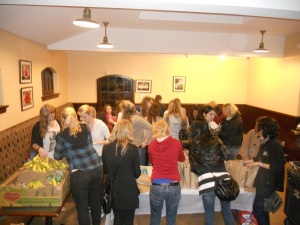
Au Pairs Hit the Lanes!
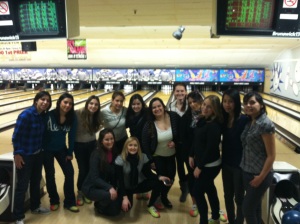 Au Pairs from West Orange, Verona, Glen Ridge and Essex Fells spent a recent afternoon bowling at Eagle Rock Lanes in West Orange. For some, it was the first time to try this favorite American pastime, for others, it was a chance to show off their skills. There were many new faces to meet at this Cluster meeting too as we were welcomed three new Au Pairs to the group this month. Everyone had a great time and a lot of laughs!
Au Pairs Learn about Water Safety
 This month, some of the Au Pairs in the NJG Cluster learned the essentials of water safety. This is an important topic given most Au Pairs will accompany their host families to the beach or pool frequently this summer. Among the topics discussed were the use of barriers to prevent small children from entering a pool or other water hazard, the establishment of pool or beach “rules”, the importance of lifeguards, the need for constant supervision and oversight of children near water, and emergency procedures in the event of a problem. It was a fun and informative session designed to help ensure safe visits to the pool and beach this summer!