
Category Archives: Uncategorized

Camp Au Pair – Science (STEM)

Next week’s Camp Au Pair theme is Science (STEM). This includes science, technology, engineering, and math.
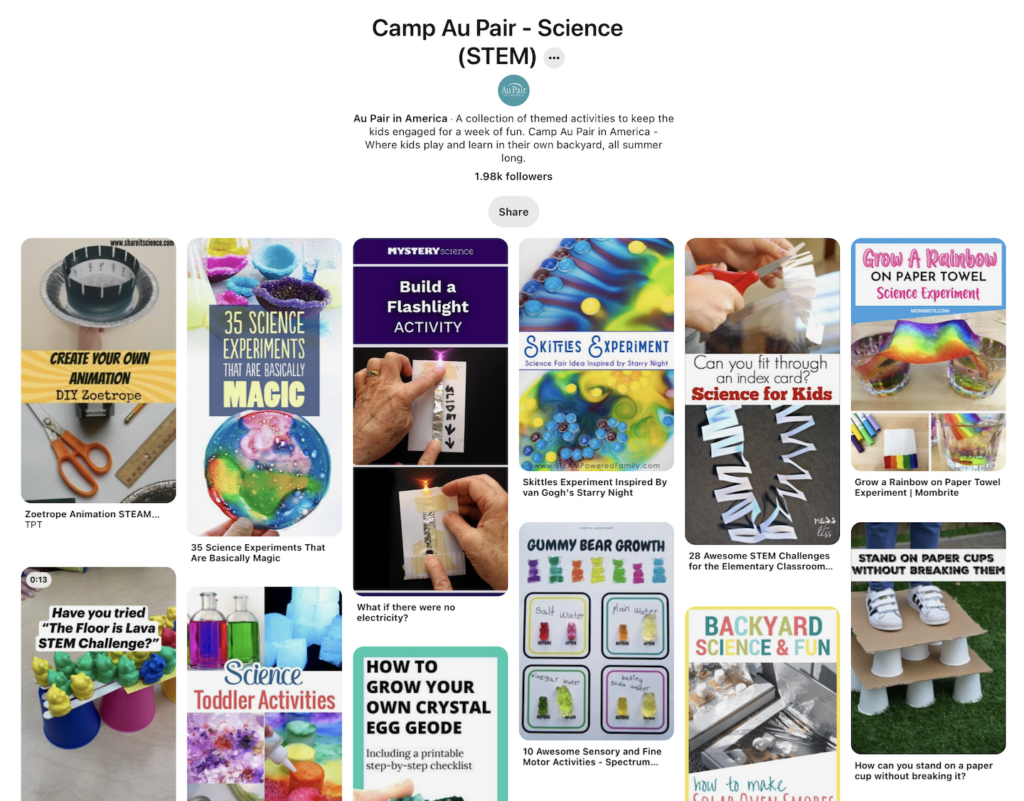
Crafts, recipes, activities, and games related to all things science, technology, engineering, and math can be found here on the Camp Au Pair – Science (STEM) pinboard.
Field Trips can be a great way for kids to learn and have new experiences. Get permission from your host parents before any outings. Here are a few places to go, that fit this theme:
    • Airport Observation Area
    • Aquarium
    • Factory Tour
    • Farm
    • Krispy Kreme Doughnuts – Some locations have a viewing area where you can watch the machines used to make them.
    • Museums
    • Nature Centers
    • Planetarium
Virtual Field Trips Videos – On YouTube, you can find many great videos of science experiments to do with kids.
The Magic School Bus is a cartoon series with episodes on lots of great science topics. You can find some episodes on YouTube and the full series on Paramount Plus.
Bill Nye the Science Guy is science TV series for kids. There is an episode guide on his website with clips and explanations on a wide variety of science topics. Movies – The Lego Movie, Big Hero 6, Wall-E, Hidden Figures, Robots, Cloudy with a Chance of Meatballs, Flubber, Honey I Shrunk the Kids, and Meet the Robinsons all fit the STEM theme. Webcams – You can do a Google search for science websites with webcams. Here is a collection of 22 science webcams from around the world. Books – Stop by your local library and look for books on science, technology, engineering, and math. You can also find many read aloud book videos on YouTube. Here are a few to get you started.

Remember… Science is learning about how things work through observation and experimentation. Every day is full of opportunities to encourage children’s natural curiosity about the world!

Image: sweetpaulmag.com

Camp Au Pair – Nature Exploration

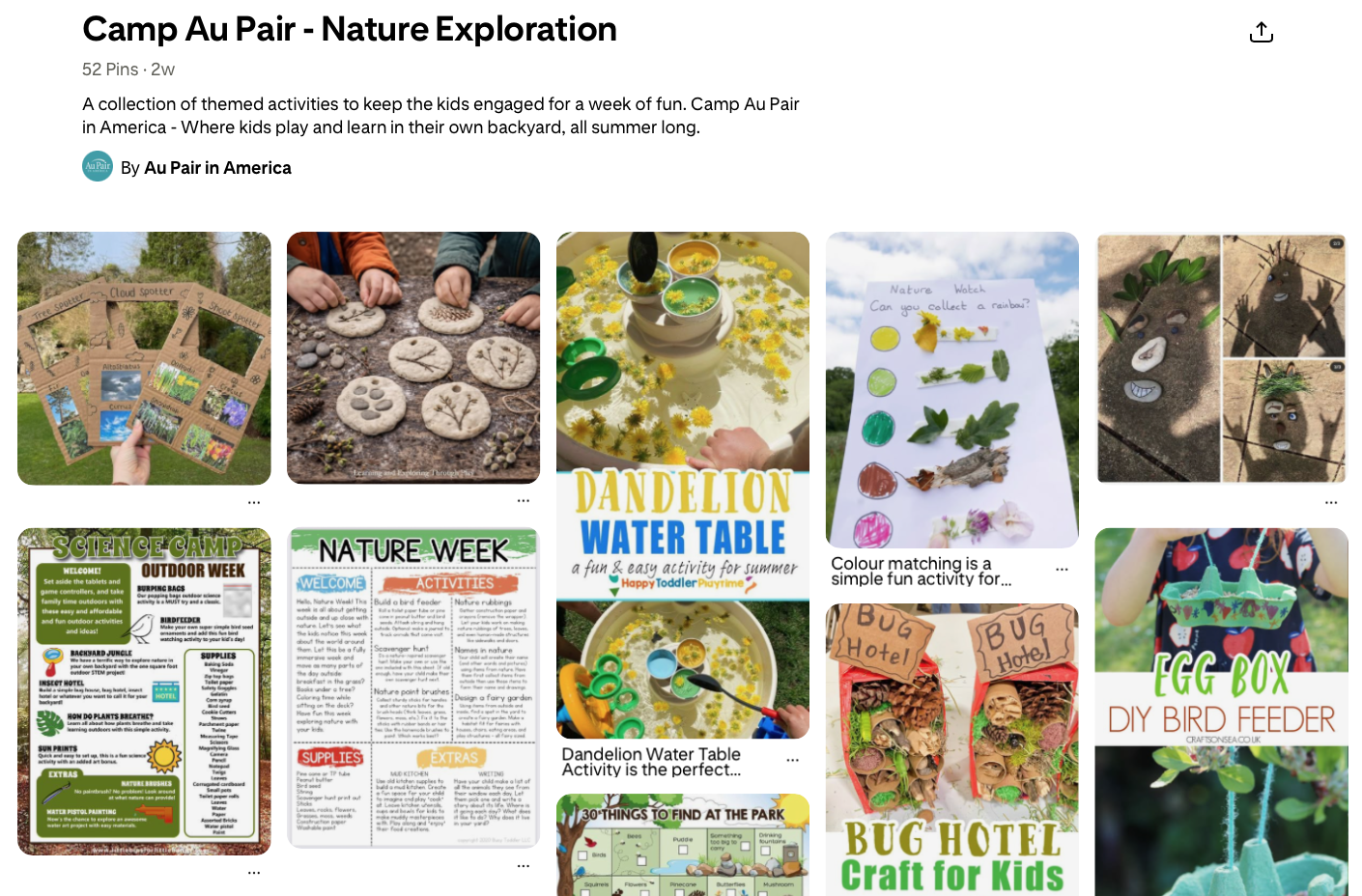
Our next Camp Au Pair theme is Nature Exploration.
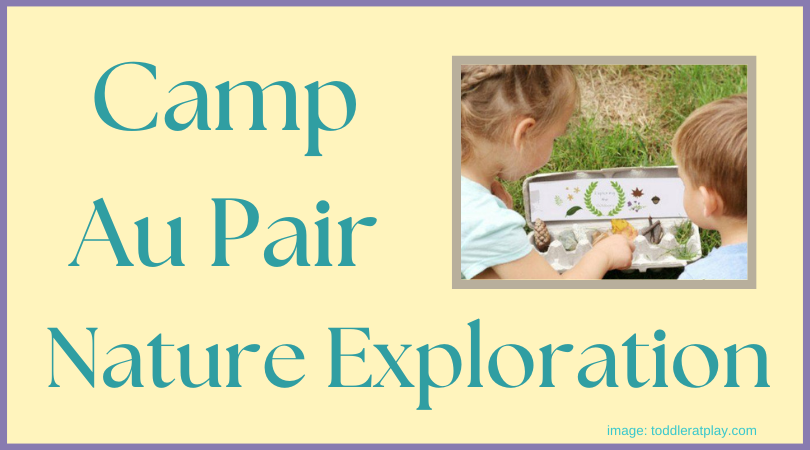
Crafts, recipes, activities, and games can all be found here on the Camp Au Pair – Nature Exploration pinboard. Field Trips can be a great way for kids to learn and have new experiences. You can start observing nature at any local park or in your own backyard. If you want to take it a step further,  Below is a list of other local places to go explore nature. Get permission from your host parents before any outings and check websites before you go for hours and information. Safety note: When coming inside after you have been outside exploring nature, it’s always a good idea to check the children and yourself for ticks. For more information, take a look at this post.
  • Aviary
  • Farms
  • Nature Preserve
  • Parks
  • Consider joining the Free Forest School to find outings near you.
Virtual Field Trips: Webcams – You can do a Google search for websites with webcams that allow you to observe nature. Videos – Look for fun videos on YouTube about nature.
Books – Check your bookshelves and/or stop by your local library and look for books on nature.  You can also find many read aloud book videos on YouTube. Here are a few to get you started.

Image: toddleratplay.com

Camp Au Pair – Under the Sea

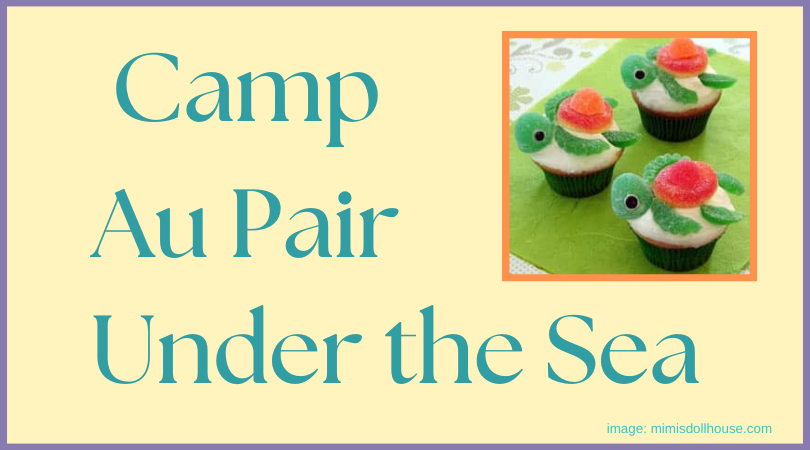
Next week’s Camp Au Pair theme is Under the Sea.

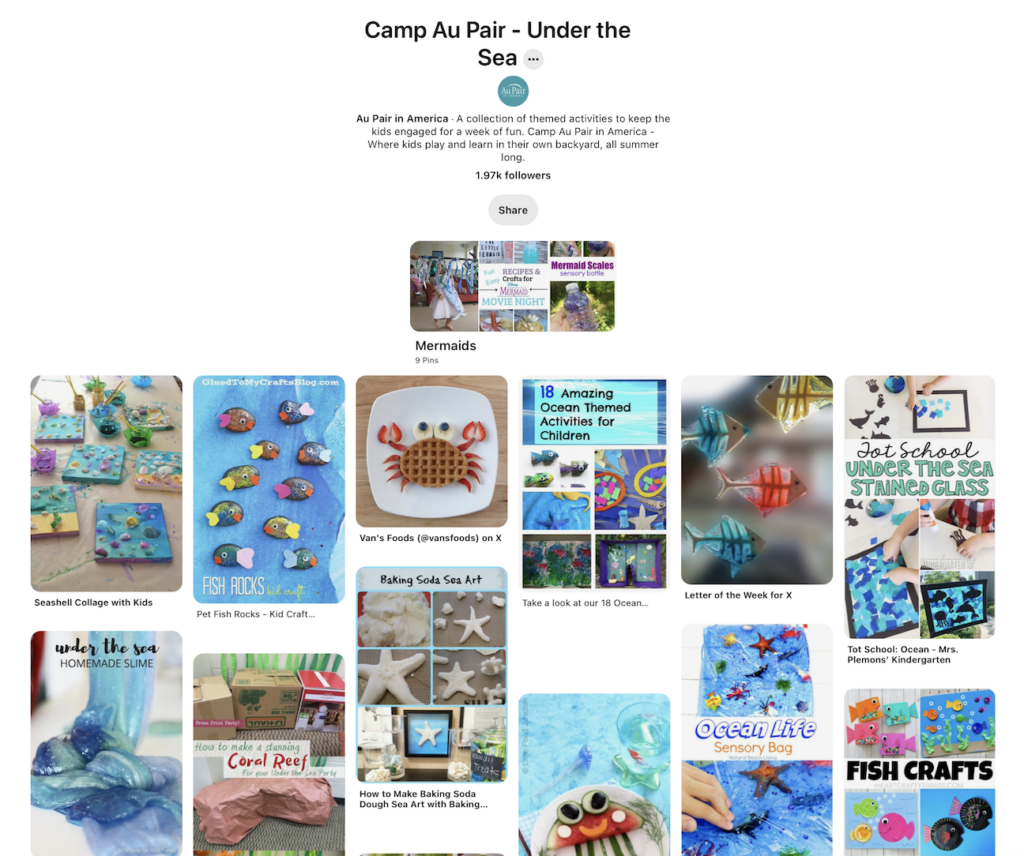
Crafts, recipes, activities, and games related to creatures who live under the sea can all be found here on the Camp Au Pair – Under the Sea pinboard.

Field Trips can be a great way for kids to learn and have new experiences. Get permission from your host parents before any outings. Check the websites before you go to be sure you understand the hours, costs, and whether advance tickets/reservations are required. Search online to see if your area has any of the following:

  • Pet or outdoor store (Bass Pro Shop) with fish tanks
  • Aquarium
  • Zoo
  • Nature Center

National Oceanic & Atmospheric Administration (NOAA) – NOAA has a lot of fun, interactive and educational activities on their website. They focus on whales, sharks, sea turtles, sea lions and more.

  • Virtual Underwater Dive
  • Online Games
  • Puzzle, Activity & Coloring Sheets

Webcams – You can do a google search for aquariums and zoos across the country (and the world) with webcams that allow you to observe sea creatures. Here are a few to get you started.

Videos – Look for fun videos on YouTube about sea creatures. There’s more to see than Baby Shark. Movies like Finding Nemo, Dolphin Tale, and The Little Mermaid also go well with this theme.

Books – Stop by your local library and look for books on sea creatures. The Rainbow Fish is a classic children’s book, your kids may already own. If not, you can find videos like this of it being read aloud.

Movies – There are lots of movies with under the sea themes.

  • A Dolphin Tale 
  • Finding Dory
  • Finding Nemo
  • Little Mermaid
  • Moana
  • Moana 2
  • Shark Tale 
  • Song of the Sea

Television – There are some episodes of children’s television shows that talk about life under the sea.

The Magic School Bus is a television series that follows Ms. Frizzle and her class as they set off on field trips. Most episodes can be found on YouTube. Here are some episodes that fit this week’s theme.

Bill Nye the Science Guy has episodes on FishMarine Animals and more on YouTube.

The Discovery Channel has an annual Shark Week coming up on July 20. Check out 15 JAW-some Activities for Shark Week with lots of fun ideas for kids in grades 5 and up, but a few for younger kids too.

Photo: mimisdollhouse.com

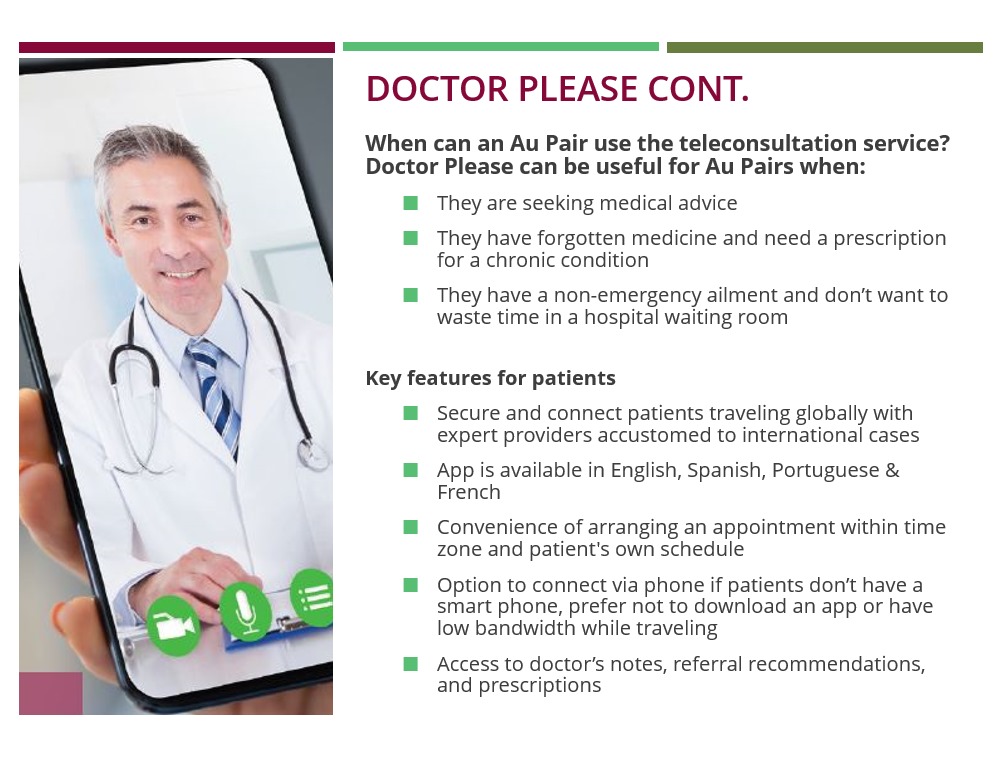
A FREE medical resource for Au Pair in America Au Pairs!!

CISI has made it even easier for au pairs to access medical care through Doctor Please!no more requesting individual access codes.

Now, with the universal access code US0233, any au pair can quickly and easily connect with a doctor.

As a reminder Doctor Please! offers:

  • 24/7 virtual medical care via app or phone
  • Licensed, multilingual doctors experienced in global care
  • Prescriptions managed worldwide
  • Appointments scheduled around your time zone and availability

How to use Doctor Please!:

  1. Download the Doctor Please! app from the App Store or Google Play.
  2. Register using the universal code US0223.
  3. Enter your information and request a video consult or call back.

This service is ideal for non-emergency issues like minor illnesses, prescription renewals for chronic conditions, or general medical advice, without the need to visit a clinic or hospital. *For life-threatening issues, au pairs should seek nearby emergency room care.

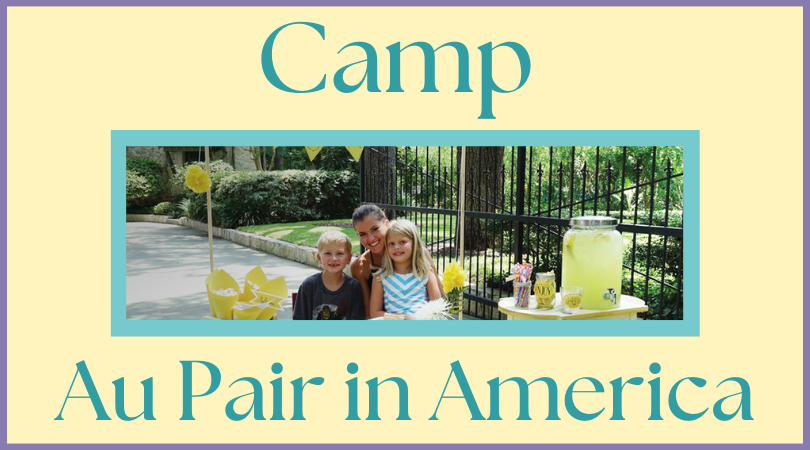
Welcome to Camp Au Pair in America!

When kids are out of school for the summer, it doesn’t take long for them to become bored and sometimes that leads to sibling squabbles and mischief. Even though they don’t realize it, they are usually missing routine and predictability in their daily schedule. One solution is to make fun plans to keep them busy!

Each week this summer we will share a different Camp Au Pair theme. These weekly themes are designed to give you ideas to keep your host kids occupied and engaged all summer long. They will also be learning. (But shhhh, don’t tell them that part.) Check back each Friday, for the next week’s theme. This gives you a chance to make plans and gather materials for the next week. For each theme there will be crafts, games, snacks and activities. You can just use these ideas or add your own and customize the themes to fit the ages and interests of your host children.

Here are the themes you can look forward to:

  • Under the Sea
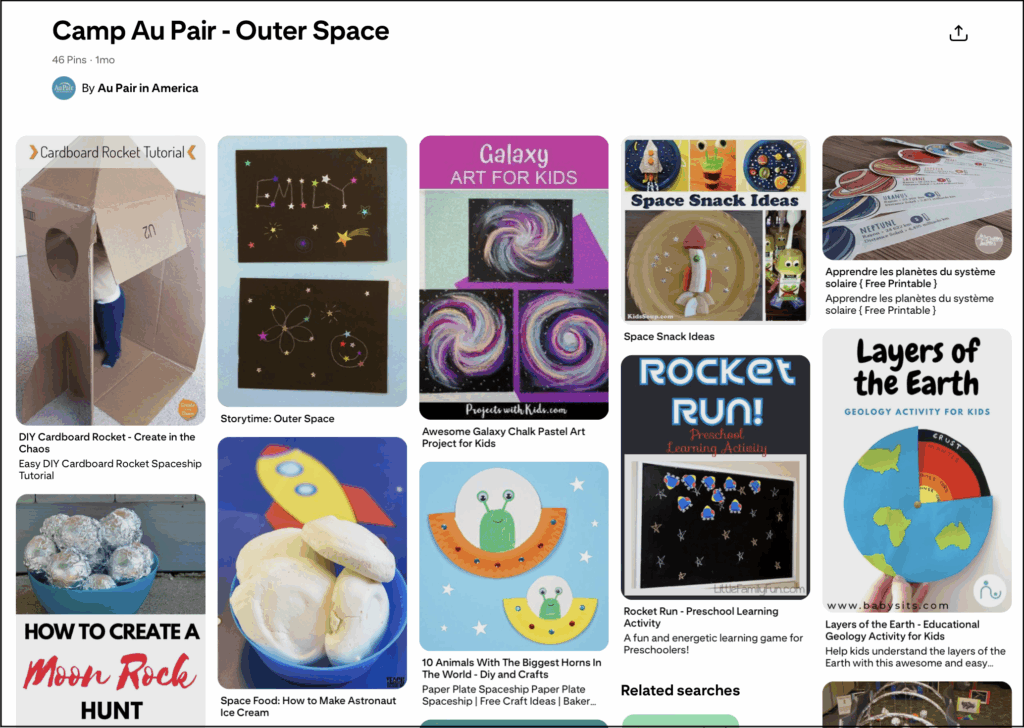
  • Outer Space
  • Nature Exploration
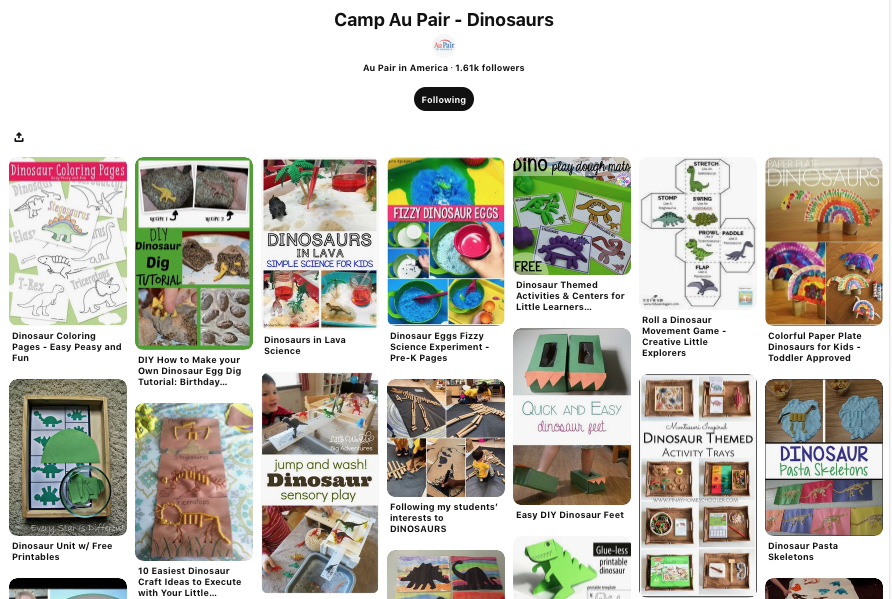
  • Dinosaurs
  • Cars and Trucks
  • Bugs & Butterflies
  • Science (STEM)
  • Backyard Safari
  • Art Experiences

Check out Summer Fun & Summer Holidays pin boards for even more ideas.

If you get some great pictures doing these activities with your host kids, please send those to your community counselor. We love to share your accomplishments and inspire other au pairs!

Let’s make this an amazing summer!

Halloween in the USA!

Halloween in the USA!            Happy_halloween_design_background

Halloween, the last day of October, has a special significance for children, who dress in funny or ghostly costumes and knock on neighborhood doors shouting “Trick or Treat!” Pirates and princesses, ghosts and witches all hold bags open to catch the candy or other goodies that the neighbors drop in.

Since the 800’s November 1st is a religious holiday known as All Saints’ Day. The Mass that was said on this day was called Allhallowmas. The evening before became known as All Hallow e’en, or Halloween. Like some other American celebrations, its origins lie in both pre-Christian and Christian customs.

Today school dances and neighborhood parties called “block parties” are popular among young and old alike. More and more adults celebrate Halloween. They dress up as historical or political figures and go to masquerade parties. In larger cities, costumed children and their parents gather at shopping malls early in the evening. Stores and businesses give parties with games and treats for the children. Teenagers enjoy costume dances at their schools and the more outrageous the costume the better! Certain pranks such as soaping car windows and tipping over garbage cans are expected. But partying and pranks are not the only things that Halloweeners enjoy doing. Some collect money to buy food and medicine for needy children around the world.

Symbols of Halloween

Halloween originated as a celebration connected with evil spirits. Witches flying on broomsticks with black cats, ghosts, goblins and skeletons have all evolved as symbols of Halloween. They are popular trick-or-treat costumes and decorations for greeting cards and windows. Black is one of the traditional Halloween colors, probably because Halloween festivals and traditions took place at night. In the weeks before October 31, Americans decorate windows of houses and schools with silhouettes of witches and black cats.


Pumpkins are also a symbol of Halloween. The pumpkin is an orange-colored squash, and orange has become the other traditional Halloween color. Carving pumpkins into jack-o’-lanterns is a Halloween custom also dating back to Ireland. A legend grew up about a man named Jack who was so stingy that he was not allowed into heaven when he died, because he was a miser. He couldn’t enter hell either because he had played jokes on the devil. As a result, Jack had to walk the earth with his lantern until Judgment Day. The Irish people carved scary faces out of turnips, beets or potatoes representing “Jack of the Lantern,” or jack-o’-lantern. When the Irish brought their customs to the United States, they carved faces on pumpkins because in the autumn they were more plentiful than turnips. Today jack-o’-lanterns in the windows of a house on Halloween night let costumed children know that there are

goodies waiting if they knock and say “Trick or Treat!”   halloween buckets        

Information obtained: http://usa.usembassy.de/holidays-halloween.htm

Coursera can be a great resource for your educational requirements.

In-person classes are the BEST way to achieve your State Department Mandated Educational hours. However, if you cannot find a course that fits your schedule or is affordable, an online class could be helpful. Special consideration can be given in some situations. Talk to your community counselor before registering for any online class.

Tips for using Coursera to obtain your educational requirement

You can take any online course from a USA-accredited college, university or technical school.

Google, Academy of Sports Medicine, IBM and Meta are examples of companies and institutions that are NOT accredited in the University system and cannot be used for your educational requirements. Many private companies will call themselves a ” college”. Please verify with your LCC that the school is accredited in the University system and accepted by the State Dept.

If you are interested in a Coursera course you can search through the options of the subject you are interested in. Each course will offer a different number of hours.

You must obtain 72 hours. Scroll to see the hours the class provides. Coursera charges a small fee per month OR for the “free” classes the certificate will cost approximately 49.00.

A certificate is necessary. Make an account with Coursera to have access to your certificate.

This should be emailed as a PDF to your LCC. Please don’t include in the body of the email. No texts will be accepted.

Most Au Pair will finish the course much quicker than is designated by Coursera. The Coursera classes are self-paced. This means that you can take them any time you have time.

You must get 72 hours.

You can only take one online course per semester. If the course doesn’t offer all 72 hours, you will need to wait to take another course in the next semester after 3 months. There is a spring, summer, fall, and winter semester. If you submit two certificates dated in the same semester, only one can be used!!!!!!

Your education must be finished 6 weeks before your term ends.

BE CAREFUL TO LOOK at the name of the college. Not all on Coursera are from USA colleges. BEFORE starting a class—send the link to your LCC to confirm it will meet the requirements.

Personal Enrichment:

Don’t know what career you want to have? 67 hours https://www.coursera.org/specializations/career-discovery

Want to be more successful?

70 hours https://www.coursera.org/specializations/professional-success-skills

Marketing:

Social Media Marketing: 40 hours https://www.coursera.org/specializations/social-media-marketing

160 hours Digital Marketing: https://www.coursera.org/specializations/digital-marketing?

Business:

Business Foundations Specialization 65 hours https://www.coursera.org/specializations/wharton-business-foundations

120 hours Innovation: From Creativity to Entrepreneurship Specialization

https://www.coursera.org/specializations/innovation-creativity-entrepreneurship

Human Resources 80 hours https://www.coursera.org/specializations/human-resource-management

Spanish:

80 hours https://www.coursera.org/specializations/learn-spanish

Psychology:

82 hours Foundations of Positive Psychology https://www.coursera.org/specializations/positivepsychology?

37 hours Social Psychology https://www.coursera.org/learn/social-psychology

40 hours Abnormal Psychology https://www.coursera.org/specializations/abnormal-psychology

English Language:

160 hours Teaching English to non-English speakers. https://www.coursera.org/professional-certificates/arizona-state-university-tesol

60 hours Introduction to Teaching English Learners Specialization https://www.coursera.org/specializations/intro-to-teaching-english-learners

80 hours Advanced Grammar and Punctuation https://www.coursera.org/specializations/advanced-grammar-punctuation

120 hours Business English Communication Skills https://www.coursera.org/specializations/english-for-business?

Health and Nutrition:

24 hours- Food Sustainability and Mindful Eating. https://www.coursera.org/specializations/food-sustainability-mindful-eating-healthy-cooking

80 hours Heathy Sustainable food and products. https://www.coursera.org/specializations/healthy-sustainable-foods-products

70 hours Essentials of Global Health. https://www.coursera.org/learn/essentials-global-health

20 hours Feeding the World https://www.coursera.org/learn/feedingtheworld

53 hours Engineering Health intro to Yoga and physiology https://www.coursera.org/learn/engineering-health-yoga-physiology?

80 hours Integrative Health and Medicine. https://www.coursera.org/specializations/integrative-health-and-medicine

Music 40 hours each course. Can only take one per semester!! https://www.coursera.org/specializations/songwriting#courses https://www.coursera.org/specializations/music-business https://www.coursera.org/specializations/musicianship-specialization

Southern Traditions for Fourth of July Celebrations!


Happy Fourth of July!

No other holiday can provide such a uniquely American experience. Being in the USA on Fourth of July can be wonderful and exciting anywhere in the USA. Search out experiences that you can remember long after this Fourth of July is over.

Here in the south, experience The Fourth with our southern traditions!!

Here are a couple of things you will want to accomplish:

Follow the Peachtree Road Racepeachtree race

Eat Watermelon outside and don’t worry if it drips down your arm!eating watermelon

See fireworks. Google closest Fourth of July fireworks to me. There will be HUGE fireworks in every city. Google, “Fourth of July fireworks” near me.”

fireworks

Hold a sparkler.

sparkler

Have a picnic with lots of friends.

picnic

Sit on a porch decorated with red, white and blue bunting and drink lemonade.

house with bunting

Grill something good to eat in the backyard!

https://www.loveandlemons.com/grilled-corn-on-the-cob

the Ask an American what the Fourth of July means to them.

natiospridethankyousoldiers2

Fourth of July celebrates our pride in the USA and our respect for the men and women who have fought and given of themselves to protect what we value most, our freedom.

Enjoy the Fourth of July!

What to do if an Au Pair is pulled over by a Police Officer

Pull over as soon as possible. As soon as you even think that you might be the one that the highway patrol car is after, pull over. This shows that you have proper respect for emergency vehicles and understand the law. Pulling over doesn’t necessarily mean to the officer that you’re admitting guilt. Police officers in the USA will be in marked cars and will have the proper uniform on. The officer will not ask for money at the time you are pulled over. You will receive a ticket with the information about how to pay this through the mail. An Office can decide to not issue a ticket with a fine and could instead give a “warning” ticket.DO NOT GET OUT OF THE CAR.  Roll your window down and wait for the officer to walk to the window.

Always pull over to the right. Always pull over on the right side of the roadway. On divided highways, signal and safely move over to the far right lane, and then to the shoulder. When you come to a complete stop, choose a section of roadway that has a full shoulder, without guardrails if possible. Pulling over on the left may obstruct traffic, and pulling over next to a guardrail may make it difficult for the officer to safely approach your car. It’s ok to drive a little distance to find a good, safe place to pull over. SLOW DOWN, put your right blinker on, and SLOWLY move to next safe place.

Know where your paperwork is. Normally, when a police officer first pulls you over, he/she will ask for your license, registration, and insurance. Keep these and the following documents in all of the cars you will be driving. Let the police office know that your documents are in the glove compartment. Ask for permission to get them or ask the police office to get them if he would prefer to do it himself. An au pair will need the following items handy at all times in every glove compartment in every car driven.

1. You need a copy of your passport, not the original.

2. You need a copy of your current DS-2019 document. This is especially important if you are a Year 2 au pair.

3. Your international Driver’s license if you have one.

5. Your medical insurance card information with host family’s address.

6. Your host family car insurance information. It is illegal to drive without proof of car insurance in the USA.

7. YOUR Participation letter printed from your AP portal. Be prepared to explain your role as an Au Pair and that you are here on a J-1 visa for your first year or for an extension term.

Make the officer feel safe. Turn your dome light on at night. Always keep your hands in plain sight. Don’t make any sudden movements. Roll your window down all the way. STAY in the car. Use common sense and don’t put the officer in an uncomfortable situation.

Let the officer talk first. Don’t blurt out things that could incriminate you. Keep your calm, even if you’re upset about being stopped. Don’t volunteer information, like how fast you thought you were going. The officer may not be pulling you over for what you think he is. Let him talk to you first. React kindly and you may have more of a chance to be sent on your way without a ticket.

Don’t argue with the officer. Challenging the officer is a recipe for disaster and likely means that you will be written up for the full offense, and the officer will be less likely to opt for a compromise in court. If you are issued a ticket and wish to contest it, set a date in court.

If you are ticketed: Tell your host family immediately. Not telling your host family could result in a rematch. Call the number on the ticket and find out if you will need to appear in person in court or if you should send a check through the mail. Make copies of the ticket and save any future receipts of payment. Ask for assistance from your host family to properly send the payment in the mail.

adapted from :

TCC Tip: Hints for Speeders

What to do when you’re pulled over for speeding

by Bengt Halvorson (2006-06-26)

More tips and information about driving can be found at www.thecarconnection.com/shoppers/drivintipsS172.html

Are You Thinking Of Extending Your Au pair Year?

Extension Year Tips

Choosing to extend is a great choice! It does require some planning and thought before you decide. These facts will be helpful in your decision-making process. Call or email your counselor, if you need help making the right choice.

The process begins with the Au Pair and host family receiving an email at the 8th month. The link to extend together will be on the host family portal. Once the host family presses the link to match, the link will appear on the Au Pair portal. If the decision to extend with a different family is made, the Au Pair will hit the link on the Au Pair portal to extend with a different family. The current family will receive an email with a request to give a reference that will appear on the extension application. This reference provides info about how many children and how many hours of childcare is week was provided, and if the Au Pair received a ticket or had an accident while driving.  This link and email cannot arrive earlier than exactly your 8th month.

  • 72 hours of education must be completed at the time of the request to extend.
  • Certificates or documents showing the completed hours must be emailed to the community counselor.
  • Please do not text pictures. Email the completion letter or certificate as a PDF attachment to your CC.
  • All education hours must be completed 30 days before the end of the first term.    The request to extend and all documents will be filed one month before the end of the first year. THIS IS FIRM. THE STATE DEPARTMENT WILL NOT ACCEPT ANY EXTENSION REQUEST IF THE EDUCATION REQUIREMENT HAS NOT BEEN MET.
  • To extend with a different family, the education hours must be finished by the 8th month to ensure enough time to interview and find a new family. The interview process cannot start until proof of education is provided. 
  • The options for extension are for  6, 9 or 12 months.
  • It is more difficult to find a second-year match with a 6 month extension. 
  • Once the extension begins. it is not possible stay longer. An Au Pair who chooses 6 months cannot request to extend for a longer period. 
  • It is possible to leave earlier than the DS end date, If at least one month’s notice is given to the host family and CC. For example, if the extension time was 12 months, but the Au Pair decided to leave at 10 months, the family would need to know at the 9th month, and the Au Pair would receive the free flight home.
  • If at least one month’s notice is not given, The Au Pair would be required to purchase their own flight home.
  • If the second term is not fully completed, the Au Pair is not eligible for a travel month. The Au Pair will be expected to return home at the end of the one-month notice.
  • Vacation time should be completed at the time a request to return home is made.
  • Vacation time can be discussed on a case by case basis with the CC. 
  • Au Pairs who successfully complete the amount of time on the DS designated for the second year are eligible for a travel month. 
  • The travel month will be moved to the end of the second term. The extension term will begin the day after the first year ends.
  • In the second year there are 11 days of vacation for 12 months, and a 9-month extension. For 6 months the vacation is 5.5 days.
  • There is no guarantee that a match will be made for a second term. Many au pairs do not make a match and return home.
  • Au Pairs who request special consideration for the schedule or stipend, or limit the number of children, including to not work on the weekend, may find it more difficult to make a match. 
  • Au Pairs who only want a specific location may find it difficult to make a match. 
  • If the Au Pair experienced a rematch in the first term, It’s a good idea to write about the reason in the extension application.
  • If the Au Pair had an accident or traffic ticket, it is a good idea to write about what happened and to note that full responsibility was taken by the Au Pair to complete this process.
  • Once the Au Pair accepts a match with a second-term family, this decision should be honored. It is not possible to cannot change the mind and choose another family that calls later. Honor the commitment that is made.
  • Deciding to stay with the current family can work well. Sometimes, there are some things that an Au Pair will want to change about their experience. Talk with the host family to see if they are willing to make the changes needed to stay a second term!
  • It is possible to negotiate for a different experience in the second year with the current family. 
  • Many au pairs underestimate the difficulty of getting re-adjusted in a new city. It is starting over in a new place with a new family and new host kids.  They will not have friends. They will not know the way around. The host family will be new and strange at first. The host children will be new. The host kids may not accept the new Au Pair warmly at first.  All the comforts of the current situation will be gone. The Au Pair will be starting over!
  • Staying in the same family and location enables an Au Pair to quickly achieve goals that may have been missed in the first term. It’s possible to take an in-person class or improve English or to travel more. Without the issue of getting acclimated, goals can quickly be addressed.  
  • The second term in a new city can be exciting. There is an opportunity to make new friends, see a new city and learn another way of life here in the USA!
  • The education requirement still applies in the second year. Standard au pairs will have a $250.00 education allowance towards completing 36 hours of education in a 6 month extension.   $500.00 education allowance is given towards a nine and twelve-month extension to achieve least 72 hours of education.
  •  Education requirements are a mandatory Department of State rule. If the education requirement is not made, a completion certificate will not be provided. And, APIA must explain why the Au Pair did not meet this important rule. 
  • The transfer to the new second-term family is on the last day of your contract. You may not join them earlier or later than this date. This is very strictly followed. NO EXCEPTIONS.
  • APIA will pay for the flight to the new host family’s location. Transfers to the airport and the cost of luggage are the responsibility of the Au Pair. 
  • If an Au Pair had the upgraded insurance policy, they must pay the fee to upgrade the policy in their second term. The insurance has to be the same. 
  • The USA driver’s license will need to be renewed after a new DS-2019 form is issued with the extended dates on it. 
  • An Au Pair will need to get the license for the State where the new host lives. The new CC can best explain the process to exchange the driver’s  license for the new State’s license with your new address.
  • The address on the DS must be the place that the Au Pair lives. The new family’s address will not be able to appear on the DS until the Au pair takes residence in the new location. A link will be provided to request a new DS with the updated address on it. 
  • Travel outside the country is not be possible in your second term. Some islands around the USA may be allowed. There is a process that must be completed in order to travel outside the USA in the second term (with or without a host family)
  • 1. Read the travel information about second term travel outside the USA on the APIA website and follow the instructions for a travel signature. A visa may be needed to enter another country. The Passport should be valid for any travel. 
  • 2. Email Fiorella at fciralli@aifs.com, if there are questions about travel in the second term. http://www.aupairinamerica./resources/travel_and_flights/travel_visa.asp#3
  • The actual visa will expire at the end of your one-year term. However, the white paper in the passport ( the DS-2019 form) is the document that gives a legal reason to be in the USA.  A new DS-2019 form will be issued  from the State Department. It is not necessary to return home to renew the visa, This is risky and may prevent an Au pair from re-entering the USA. 
  • Some Au Pairs want to renew their visa, due to the travel plans of their host family. Renewing the visa is risky because the home government may not agree to grant another visa. IN THIS CASE, the Au Pair would not be allowed to return to the USA to finish the first term. The visa must be valid to re-enter. It takes a lot of planning and organization to save vacation days until the end of the term in a plan to return home to get a new visa. This process may take 2-3 weeks or longer in busy travel seasons. An Au Pair would need to return to the USA at least four weeks before their current visa expires. The host family is responsible for paying the Au pair stipend each week, even if   the Au pair goes home on vacation. Because of this, they may not agree to have an absent for several weeks. The Au Pair must also pay for the flight back home.
  • There is a lot to think about before returning home to renew a visa ! Ask your counselor for advice.
  • Ask your counselor for advice before making the important decision to extend the Au Pair term!