Author Archives: Christine Connally

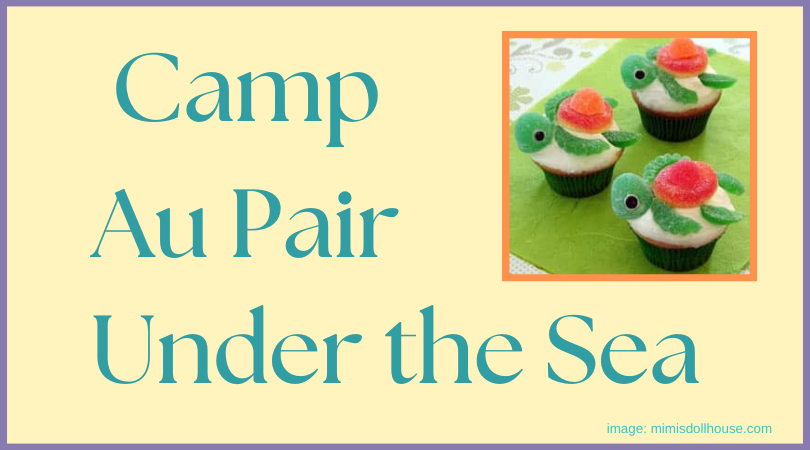
Camp Au Pair – Under the Sea

Next week’s Camp Au Pair theme is Under the Sea.

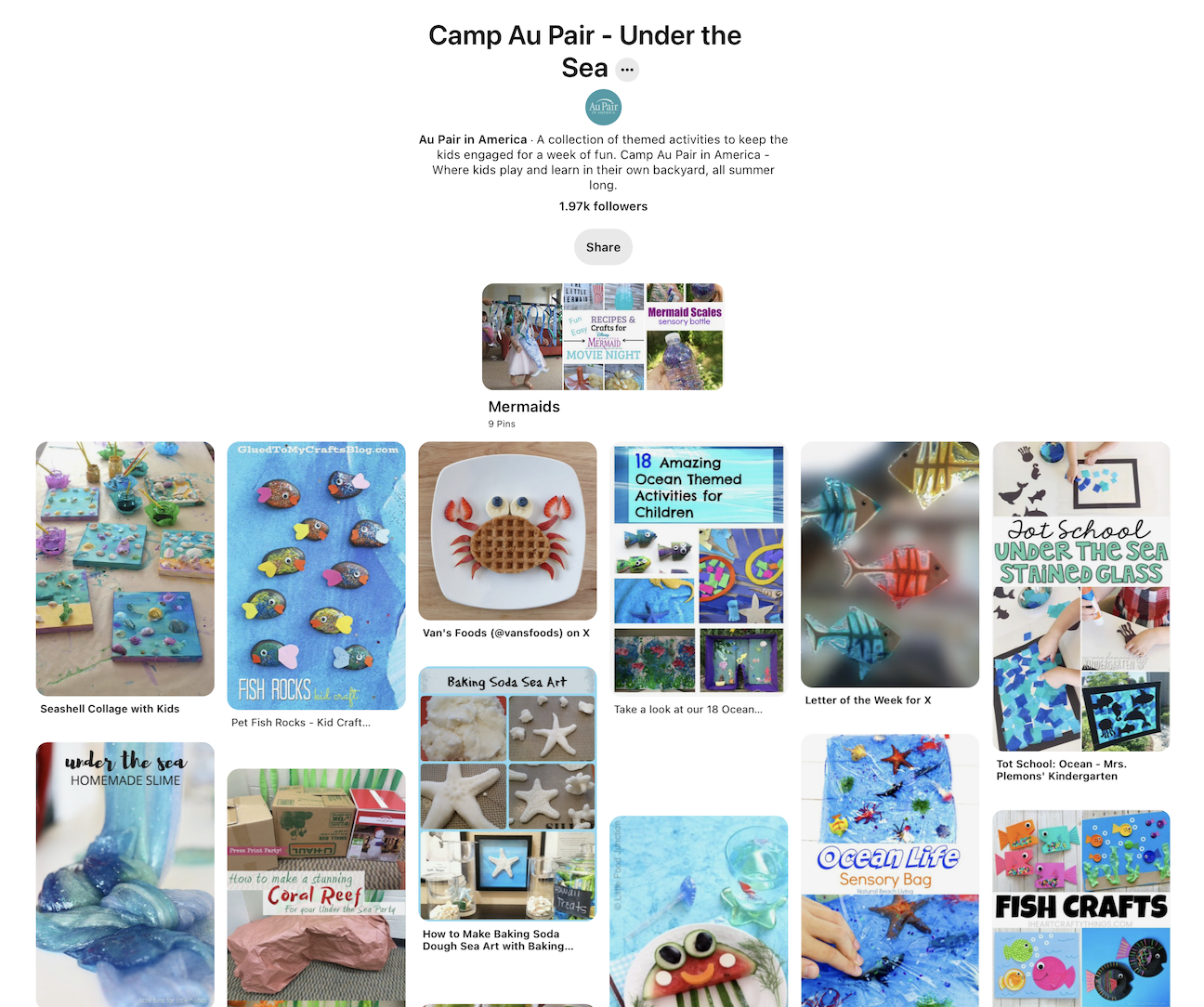
Crafts, recipes, activities, and games related to creatures who live under the sea can all be found here on the Camp Au Pair – Under the Sea pinboard.

Field Trips can be a great way for kids to learn and have new experiences. Get permission from your host parents before any outings. Check the websites before you go to be sure you understand the hours, costs, and whether advance tickets/reservations are required. Search online to see if your area has any of the following:

  • Pet or outdoor store (Bass Pro Shop) with fish tanks
  • Aquarium
  • Zoo
  • Nature Center

Online Games – NOAA has fun interactive games that help kids learn about sea turtle survival.

Webcams – You can do a google search for aquariums and zoos across the country (and the world) with webcams that allow you to observe sea creatures. Here are a few to get you started.

Videos – Look for fun videos on YouTube about sea creatures. There’s more to see than Baby Shark. Movies like Finding Nemo, Dolphin Tale, and The Little Mermaid also go well with this theme.

Books – Stop by your local library and look for books on sea creatures. The Rainbow Fish is a classic children’s book, your kids may already own. If not, you can find videos like this of it being read aloud.

Movies – There are lots of movies with under the sea themes.

  • A Dolphin Tale 
  • Finding Dory
  • Finding Nemo
  • Little Mermaid
  • Moana
  • Shark Tale 
  • Song of the Sea

Television – There are some episodes of children’s television shows that talk about life under the sea.

The Magic School Bus is a television series that follows Ms. Frizzle and her class as they set off on field trips. Most episodes can be found on YouTube. Here are some episodes that fit this week’s theme.

Bill Nye the Science Guy has episodes on FishMarine Animals and more on YouTube.

The Discovery Channel has an annual Shark Week. Check out 15 JAW-some Activities for Shark Week with lots of fun ideas for kids in grades 5 and up, but a few for younger kids too.

Photo: mimisdollhouse.com

Camp Au Pair: Art Experiences

This week’s Camp Au Pair theme is Art Experiences.

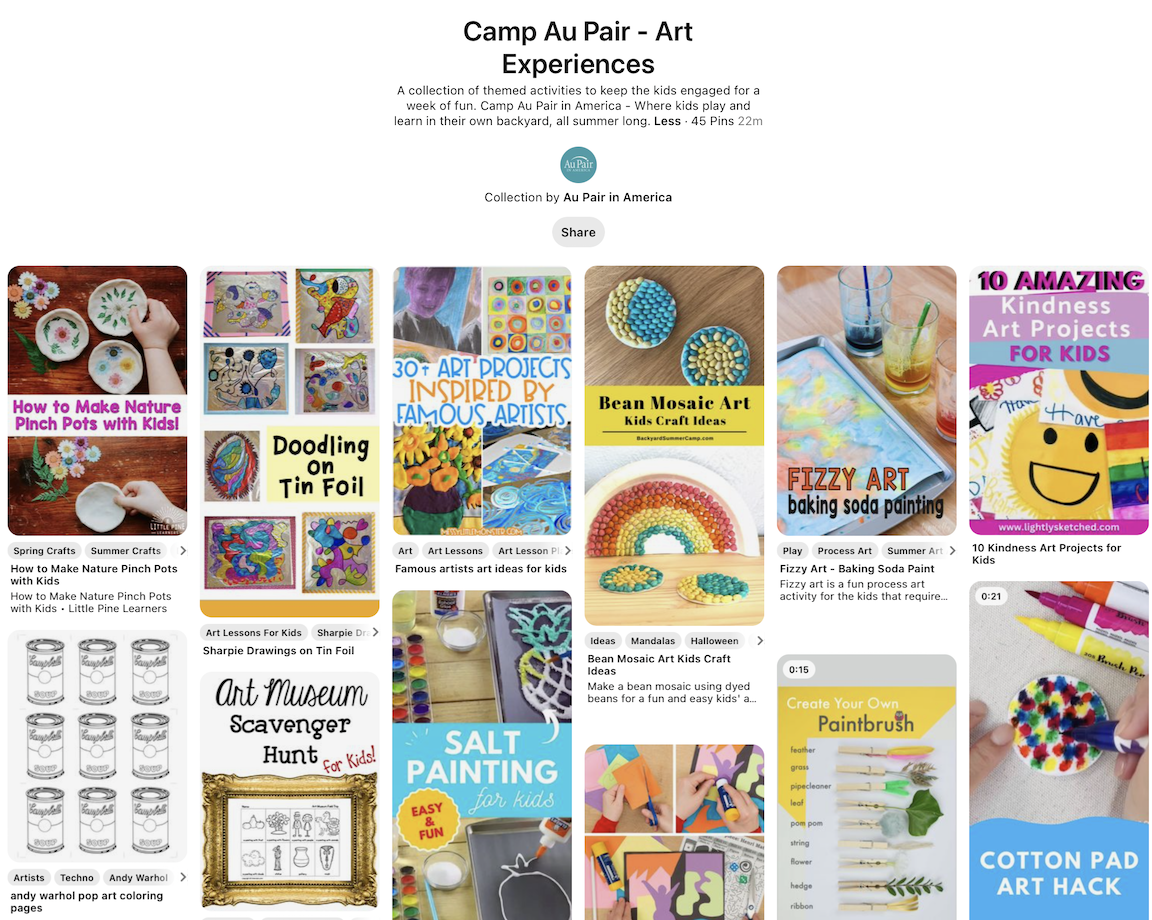
Crafts, recipes, activities, and games related to art can all be found here on the Camp Au Pair – Art Experiences pinboard.

Culture Sharing – Share any specific forms of art that are popular in your home country (mosaics, origami, murals, fabric dying, etc.) Are there any famous artists from your country that you could share their works with your host kids?

Field Trips can be a great way for kids to learn and have new experiences. Get permission from your host parents before any outings. Check the websites before you go to be sure you understand the hours, costs, and whether advance tickets/reservations are required.

Online Art Fun – Here is a great website with lots of art activities including ones for older kids.

Webcams – You can do a google search for art websites with webcams. Here are a few to get you started:

Videos – Look for fun videos on YouTube about drawing and all kinds of art.

Books – Stop by your local library and look for books on famous artists and art.

Check YouTube for books on art being read aloud:

Image: teachkidsart.com

Camp Au Pair – Nature Exploration

This week’s Camp Au Pair theme is Nature Exploration.

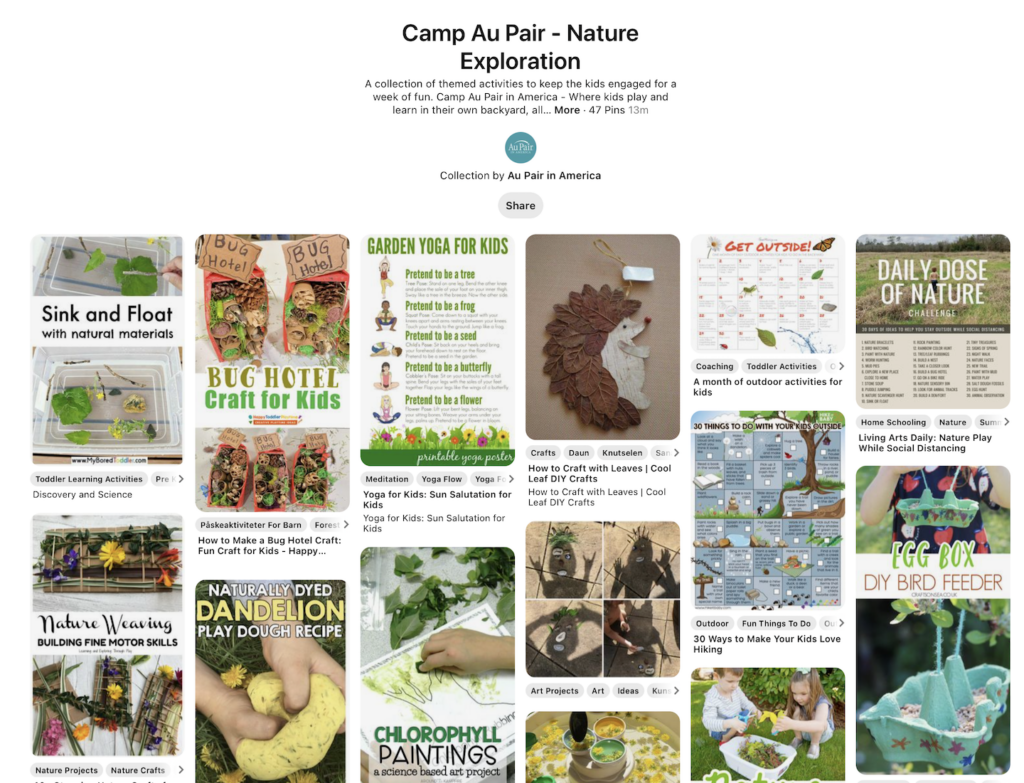
Crafts, recipes, activities, and games can all be found here on the Camp Au Pair – Nature Exploration pinboard.

Field Trips can be a great way for kids to learn and have new experiences. You can start observing nature at any local park or in your own backyard. If you want to take it a step further,  Below is a list of other local places to go explore nature. Get permission from your host parents before any outings and check websites before you go for hours and information.

Safety note: When coming inside after you have been outside exploring nature, it’s always a good idea to check the children and yourself for ticks. For more information, take a look at this post.

  • Aviary
  • Farms
  • Nature Preserve
  • Parks
  • Consider joining the Free Forest School to find outings near you.

Virtual Field Trips:

Webcams – You can do a Google search for websites with webcams that allow you to observe nature.

Videos – Look for fun videos on YouTube about nature.

Books – Check your bookshelves and/or stop by your local library and look for books on nature.  You can also find many read aloud book videos on YouTube. Here are a few to get you started.

Image: toddleratplay.com

Welcome to Camp Au Pair in America!

When kids are out of school for the summer, it doesn’t take long for them to become bored and sometimes that leads to sibling squabbles and mischief. Even though they don’t realize it, they are usually missing routine and predictability in their daily schedule. One solution is to make fun plans to keep them busy! 

Each week this summer we will share a different Camp Au Pair theme. These weekly themes are designed to give you ideas to keep your host kids occupied and engaged all summer long. They will also be learning. (But shhhh, don’t tell them that part.) Check back each Friday, for the next week’s theme. This gives you a chance to make plans and gather materials for the next week. For each theme there will be crafts, games, snacks and activities. You can just use these ideas or add your own and customize the themes to fit the ages and interests of your host children.

Here are the themes you can look forward to:

  • Nature Exploration
  • Art Experiences
  • Under the Sea
  • Science (STEM)
  • Bugs & Butterflies
  • Cars and Trucks
  • Backyard Safari
  • Dinosaurs
  • Explore the World
  • Outer Space
  • Pirate Adventures
  • Princesses & Knights

Check out Summer Fun & Summer Holidays pin boards for even more ideas.

If you get some great pictures doing these activities with your host kids, please send those to your community counselor. We love to share your accomplishments and inspire other au pairs!

Let’s make this an amazing summer!

Snow Days are Here!

Looking for ideas to keep the kids busy on a snow day (when they are home from school for winter weather?)

Here is a simple snow day game plan…

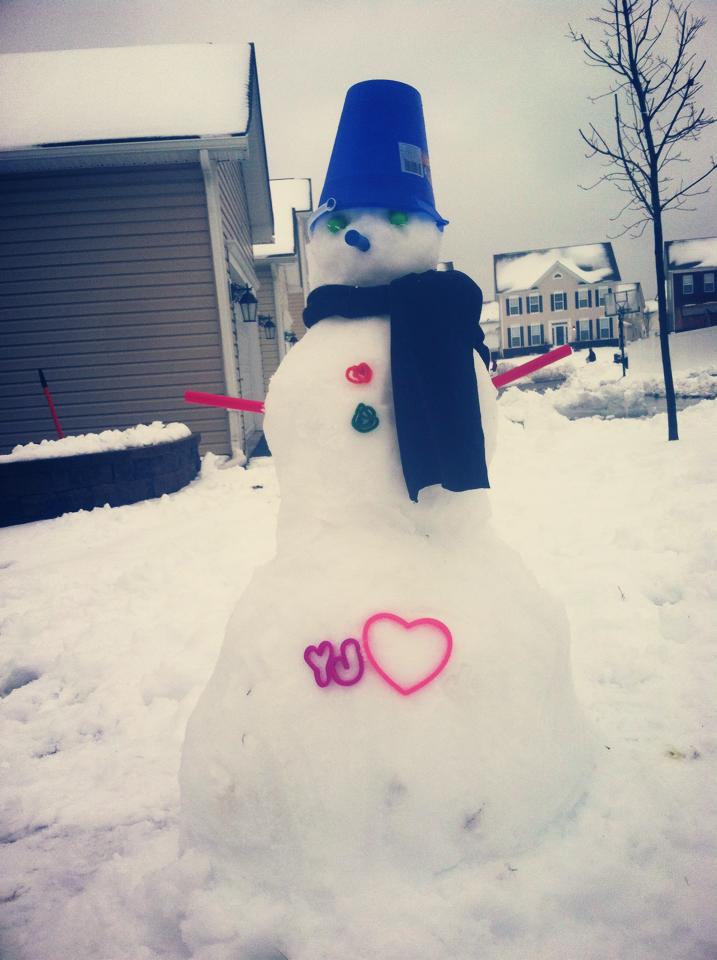
  1. Play in the snow. Do you wanna build a snowman? Here’s a great how-to video.
  2. Come inside and warm up with hot chocolate (don’t forget the marshmallows.)
  3. Make your own play dough.
  4. Play board games or legos together.
  5. Try some Winter Science experiments.
  6. Look for more fun things to do on the APIA Pinterest Boards:
  7. Bake cookies together or make some other fun recipe.
  8. Play in the snow again.
  9. Warm up inside taking turns on the Make a Snowflake Website.
  10. Make a blanket fort.

Stay warm & have fun!

Photo: Yuli Salinas

9 Winter Driving Tips to Stay Safe in the Ice & Snow

The best advice for driving in bad winter weather is not to drive at all, if you can avoid it. Don’t go out until the snow plows and sanding trucks have had a chance to do their work, and allow yourself extra time to reach your destination.

If you must drive in snowy conditions, make sure your car is prepared, and that you know how to handle road conditions. It’s a good idea to always keep at least a half tank of gas in your car, especially in winter months where you could get stranded. It’s helpful to practice winter driving techniques in a snowy, open parking lot, so you’re familiar with how your car handles. Consult your owner’s manual for tips specific to your vehicle.

Driving Safely on Icy Roads

  1. Decrease your speed and leave yourself plenty of room to stop. You should allow at least three times more space than usual between you and the car in front of you.
  2. Brake gently to avoid skidding. If your wheels start to lock up, ease off the brake.
  3. Turn on your lights to increase your visibility to other motorists.
  4. Keep your lights and windshield clean.
  5. Use low gears to keep traction, especially on hills.
  6. Don’t use cruise control or overdrive on icy roads.
  7. Be especially careful on bridges, overpasses and infrequently traveled roads, which will freeze first. Even at temperatures above freezing, if the conditions are wet, you might encounter ice in shady areas or on exposed roadways like bridges.
  8. Don’t pass snow plows and sanding trucks. The drivers have limited visibility, and you’re likely to find the road in front of them worse than the road behind.
  9. Don’t assume your vehicle can handle all conditions. Even four-wheel and front-wheel drive vehicles can encounter trouble on winter roads.

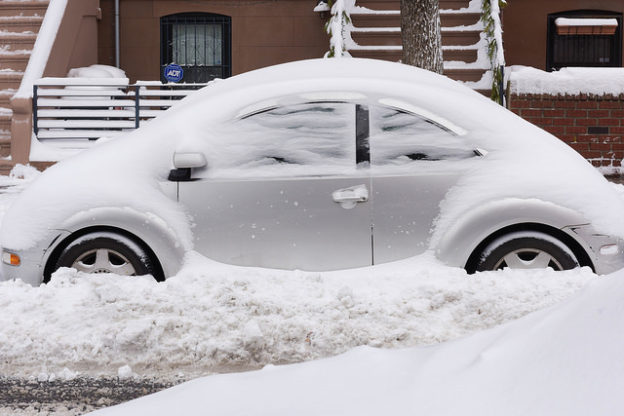
Photo: Steve Pisano (Flickr)

Winter Sports & Sports Insurance

Trying out winter sports like ice skating, skiing, and snowboarding can be very exciting, especially if this is your first time experiencing winter weather. However, you should also know the risks and be prepared.
Is it risky to do winter sports without sports insurance?

Yes. If you have to pay your own hospital bills for a broken bone, you might be shocked at how much that would cost. I checked this website for some cost estimates.

Here are a couple examples:

  • Without medical coverage, treating a broken arm or leg (that does not require surgery) could cost up to $2,500.
  • Without medical coverage, treating a broken arm or leg (requiring surgery) could cost $16,000 or more.

You must understand how your medical coverage works for sports-related injuries. There is a list of “high-risk sports/activities” that are not covered by basic or upgrade medical insurance plans. Those activities are only covered by the Sports Insurance Package. (Snowtubing is the only snow sport that you already have coverage for without the sports insurance package.)

The Sports Insurance was available pre-departure and may also be purchased at any time during your year. It takes effect within 48 hours of your enrollment and is good for 12 months. The cost will be the same ($110 as of this posting) whether you have a month left or your whole year ahead of you. I recommend you pay for it early on if you haven’t already purchased it. You never know when an opportunity might present itself and you don’t want to miss out on an adventure. You also don’t want to risk getting injured and being responsible for the bill on your own.

Below is a partial list of sports that are only covered by the sports insurance package:
Football, Rugby, Scuba diving, Ski-doo,  Wakeboarding, Skydiving, Parachuting, Rock climbing, Zipline, Skateboarding, Rollerblading, Roller skating,  Ice Skating, SkiingSnowboardingSnowmobiles and Snowshoeing.  View the full list on your insurance brochure.

Note: Injuries sustained while partaking in these sports are ONLY covered with the purchase of Sports Insurance.

How to register for the Sports Insurance

To enroll in sports insurance, use the link found in the email sent to you with the subject “Au Pair in America Sports Insurance Upgrade Option”. Ask your community counselor if you are having trouble finding the email with the sports insurance enrollment link.

If you think you will be doing any of these sports, you should get it now.

Planning Ahead for Future Snow Days

Looking for ideas to keep the kids busy on a snow day (when they are home from school for winter weather?)

Here is a simple snow day game plan…

  • Play in the snow.  Pro Tip:  Remind your kids go to the bathroom before you get them all bundled up to go outside. 

  • Come inside and warm up with hot chocolate (don’t forget the marshmallows.) Pro Tip: Shake the snow off of the kids boots and snow clothes. Hang them up to dry or put them in the dryer, so they are ready for round 2 out in the snow. 
  • Make your own play dough.

  • Play board games or legos together.
  • Play in the snow again.

  • Warm up inside and make paper snowflakes.

  • Bake cookies together or make some other fun recipe.
  • Make a blanket fort.

Stay warm & have fun!

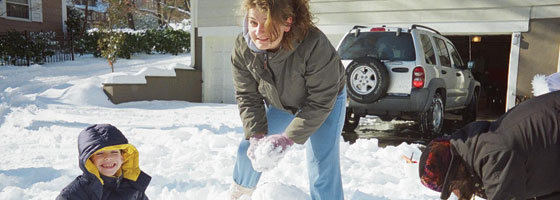
Photo: Tony Crider (Flickr)

Welcome to Camp Au Pair in America!

When kids are out of school for the summer, it doesn’t take long for them to become bored and  sometimes that leads to sibling squabbles and mischief. Even though they don’t realize it, they are usually missing routine and predictability in their daily schedule. One solution is to make fun plans to keep them busy! 

Each week this summer we will share a different Camp Au Pair theme. These weekly themes are designed to give you ideas to keep your host kids occupied and engaged all summer long. They will also be learning. (But shhhh, don’t tell them that part.) Check back each Friday, for the next week’s theme. This gives you a chance to make plans and gather materials for the next week. For each theme there will be crafts, games, snacks and activities. You can just use these ideas or add your own and customize the themes to fit the ages and interests of your host children.

Here are the themes you can look forward to:

  • Art Experiences
  • Backyard Safari
  • Bugs & Butterflies
  • Cars and Trucks
  • Dinosaurs
  • Explore the World
  • Nature Explorations
  • Outer Space
  • Pirate Adventures
  • Princesses & Knights
  • Science (STEM)
  • Under the Sea

Check out Summer Fun & Summer Holidays pin boards for even more ideas.

If you get some great pictures doing these activities with your host kids, please send those to your counselor. We love to share your accomplishments and inspire other au pairs!

Let’s make this an amazing summer!


Avoid Falling Victim to Scammers

There are always people out there who are looking for ways to trick people out of their money and personal information. There have been several new scams recently, so we are going to explain ways to identify scams and how to protect yourself.

SCAM #1 – A caller says they are a contact tracer and you may have been exposed to COVID-19 and asks you to pay for a test kit.

  • Contact tracers will not ask you for payment.

What to do? Do not give any payment information to someone who calls you on the phone.

SCAM #2 – Calls asking for your PIN, password, personal information or a payment.

  • Your bank will not call you and ask you for your PIN number or password.
  • IRS and Social Security Administration will not ask you for payment or personal info over the phone. Government agencies usually handle issues like this by sending a letter.
  • The number shown on caller ID can be manipulated, don’t take that as a sign that a call is legitimate.

What to do? Whenever you are in doubt, hang up and call the bank (or company) directly using a number you already have for them.

SCAM #3 – Email asking you to click a link to verify your personal information or share your password or PIN.

  • Be very suspicious of emails asking you to click links.
  • Scammers are very good at creating official looking emails and webpages.

What to do? Whenever you are in doubt, go directly to the website (not using the link in the email).

SCAM #4 – You see an offer online telling you to send them some money and they will double it or a pop-up ad says that you have won a great prize and just need to give them your information.

  • When something sounds too good to be true, it usually is.

What to do? Do not give your personal information or any money to people you don’t know.

SCAM #5 – You receive a call and you are told to stay on the phone while you go transfer or withdraw money from the bank and if you don’t you will be arrested or your bank account seized.

  • They are using the idea that this is an urgent situation to make you act quickly without thinking to avoid the consequence they have told you.

What to do? Do not follow their instructions.

Whenever you are in doubt, do not do as the caller or email asks. Check with your host parents or community counselor.

One other note: It is very important to keep your social security number private. There are very few situations where you will need to share this (bank, IRS, motor vehicles). Those are times you are taking an action and need to provide it. There is not a legitimate time where someone would be calling you on the phone or emailing you asking for that number.

Image: Canva.com