
Category Archives: Uncategorized

BEACH AND SWIMMING POOL SAFETY TIPS

Here are some good tips for kids, au pairs and host families to follow :

Swim safely.

  • Take swim lessons if you don’t know how to swim. Sign your kids up for lessons as soon as they are old enough.
  • Swim near a lifeguard and never swim alone.
  • Don’t drink alcohol if you are swimming or watching children.
  • Use floating toys like water wings and noodles for fun – not for safety. Don’t use them in place of life jackets.
  • Watch out for rip currents. A rip current is when the water pulls you away from shore. If you get caught in a rip current, swim along the shoreline until you are out of the current, then swim to shore.

Watch children carefully.

  • Make sure at least one adult is watching when children are near or in the water.
  • Don’t read or use the phone while you are watching young children.
  • Watch all children in the water, even if they know how to swim.
  • If you have a pool, install 4-sided fencing that’s at least 4 feet high and separates the pool from the house or yard. Use self-closing and self-latching gates that open outward and are out of reach of children.

Check water and weather conditions before going swimming.

  • Don’t swim in lakes, rivers, or the ocean after heavy rain. Water is more likely to be polluted after a rain storm.
  • Check for signs or warnings about bacteria or other pollution in the water.
  • Get out of the water right away if you hear thunder or see lightning. Strong winds can also be dangerous.

Protect yourself and others from germs in the water.

  • Try not to get water in your mouth.
  • Make sure everyone is clean before swimming. Shower with soap. Wash your hands after using the bathroom or changing diapers.
  • Take your kids on bathroom breaks or check diapers often. Change diapers in a bathroom or a diaper-changing area.

Protect your skin from the sun.

  • Wear plenty of sunscreen with a minimum SPF of 15.
  • Put on more sunscreen every couple of hours and after swimming

This information was provide by the U.S. Department of Health and Human Services

Smithsonian Folklife Festival

The Folklife Festival will take place June 27-July 1 and July 4-8. 

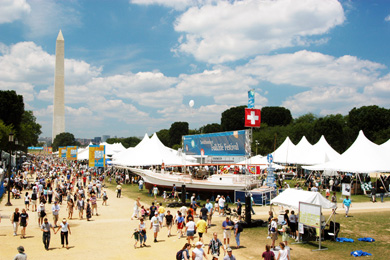
The annual Smithsonian Folklife Festival is an international exhibition of living cultural heritage. Attracting more than one million visitors yearly, the two-week long celebration is the largest annual cultural event in the United States.

The Festival is held outdoors on the National Mall in Washington, D.C., between the Smithsonian museums. There is no admission charge. Visitors should dress for hot and humid weather. Parking around the Mall is extremely limited, so visitors are advised to use public transportation. L’Enfant Plaza is the closest Metro station to the Festival site. National Archives, Smithsonian, and Federal Center stations are within a half-mile. For assistance planning how to get around, visit www.goDCgo.com. For general Smithsonian visitor information, http://www.si.edu/Visit or call 202.633.1000 (voice).

Festival hours are 11:30 a.m. to 6 p.m., with special events taking place most evenings beginning at 6:30 p.m. View the schedule here.

I highly recommend that you visit their website to plan your visit http://www.festival.si.edu/

VALENTINE’S DAY IN THE USA

hearts-1474

Valentine’s day is celebrated in the United States every year on February 14th. There are many stories and legends behind who the real St. Valentine was, but most scholars agree that he was a martyr who was killed by Roman soldiers because he was marrying people in secret at a time when marriage was outlawed.  Later in the Middle Ages, a great writer named Geoffrey Chaucer wrote a poem as a present to King Richard II, who was going to be married soon. In it, he mentioned St. Valentine, and over time, the idea of Valentine’s Day became associated with the idea of love.

During the Victorian times (in the 1800s), Valentine’s Day became extremely popular! Men and women spent a lot of time making beautiful Valentine’s cards with ribbon, fancy paper and even lace. In those days, people were very reserved and they did not often say what they were feeling. Valentine’s day gave them a way to express their feelings to someone they were in love with anonymously.  The sender would remain a mystery until they could speak more freely.

In the last few decades, Valentine’s day has changed a lot! Today we still exchange cards, but many people buy ready-made cards instead. We also give flowers or chocolates as a gift to remind people of our friendship and love for them. Most Valentine’s gifts and cards make use of the colors red and pink, and are decorated with images of hearts or roses. Another common symbol of love on this day is Cupid, the Roman god of love. He is usually shown as a little angel with a bow and arrow. According to legend, anyone who is struck by his arrows will fall in love.

Here are some links with ideas about how you can celebrate and have fun with the children you care for over the next couple of weeks!

Click here for Valentine’s Day Cards, coloring pages, recipes, crafts, games and puzzles: http://www.dltk-holidays.com/valentines/


Check out our Au Pair in America Pinterest page for Valentine’s Day for more ideas: https://www.pinterest.com/aupairinamerica/valentines-day/

-1

Have fun!

A traditional American Holiday

Thanksgiving is a public holiday celebrated on the fourth Thursday in November every year in the United States. It started as a harvest festival and has been celebrated nationally on and off since 1789.  The most important part of Thanksgiving for American families is to spend family time together.  Here are some fun facts about this special holiday:

·         The first Thanksgiving was held in the autumn of 1621 and included 50 Pilgrims and 90 Wampanoag Indians and lasted three days.

·         The first Thanksgiving was eaten with spoons and knives — but no forks! Forks weren’t even introduced to the Pilgrims until 10 years later and weren’t a popular utensil until the 18th century

·         Thanksgiving is the reason for TV dinners! In 1953, Swanson had so much extra turkey (260 tons) that a salesman told them they should package it onto aluminum trays with other sides like sweet potatoes — and the first TV dinner was invented

·         Presidential pardon of a turkey: Each year, the president pardons a turkey and spares it from being eaten for Thanksgiving dinner. The first turkey pardon ceremony started with President Truman in 1947. President Obama pardoned a 45-pound turkey named Courage, who has flown to Disneyland and served as Grand Marshal of the park’s Thanksgiving Day parade!

·         Why is Thanksgiving the fourth Thursday in November? President Abe Lincoln said Thanksgiving would be the fourth Thursday in November, but in 1939 President Roosevelt moved it up a week hoping it would help the shopping season during the Depression era. It never caught on and it was changed back two years later

·         How did the tradition of watching football on Thanksgiving start? The NFL started the Thanksgiving Classic games in 1920 and since then the Detroit Lions and the Dallas Cowboys have hosted games on Turkey Day. In 2006, a third game was added with different teams hosting

·         About 90 % of Americans eat turkey on Thanksgiving Day

·         The ‘wishbone’ of the turkey is used in a good luck ritual on Thanksgiving Day.

Wishing you all a very Happy Thanksgiving!

 Image result for happy thanksgiving clip art

History of Voting In America

A Barnesville, Maryland man enters a voting booth at the community hall in November 1944 to vote using a recently installed voting machine. If you think about the history of voting in America, you may picture the Civil Rights era, the women’s suffrage movement, and the Constitutional amendments that grant people’s right to vote. But the story is not just about laws and protests.

How Technology Has Changed Voting and Elections

The methods used to vote and to count ballots have changed over the years. From the wooden ballot box, to the curtained-off voting machine, to the modern touch-screen, advances in technology have played a big role in voting. And since states run elections, procedures vary from place to place.

You can learn how voting methods have changed in the U.S. in Vote: The Machinery of Democracy, an online interactive exhibit from the Smithsonian Institution’s National Museum of American History.

Americans’ Voting Habits

Demographics play a huge part in how America votes. The U.S. Census Bureau collects and releases information on who votes in Congressional and Presidential elections.

Credit: www.usa.gov

2016 APIA Scavenger Hunt DC

Freedom Plaza in Washington DC was the meeting place for this year’s Au Pair In America Scavenger Hunt. Over 200 au pairs for the local clusters participated and enjoyed a beautiful sunny day in Washington DC. They even run into 2 unexpected guests. See if you can spot them in the pictures;-)


img_2723img_2728img_2730img_2729

Celebrating Labor Day

What is Labor Day and when is it celebrated?


Labor day


The Workman’s Holiday ~ Dedicated in honor of the worker, Labor Day is also known as the “workingman’s holiday”. The holiday is dedicated to all workers in the United States in respect and appreciation for the work they do in or outside of the home, union or non-union, big companies and small companies and au pairs too. As long as you work somewhere at something, this holiday is for you! It is a day to celebrate your contribution to American working life and the work you do.

The First Labor Day ~ The first Labor Day was celebrated in New York City on September 5, 1882 and was started by the Central Labor Union in New York City. In 1884, it was moved to the first Monday in September where it is celebrated today. Labor Day quickly became popular and one state after another voted it as a holiday. On June 28, 1894, the U.S. congress voted it a national holiday.

The End of Summer ~ Labor Day is also viewed as the official end of summer. While the Fall Equinox is still a couple of weeks away, kids go back to school and summer vacations are over. This day is celebrated with a long weekend off from work and union sponsored parades. Many people celebrate this weekend with one last picnic. It is also the date that many people close up the swimming pool, and put away the boats.

Was it McGuire or Maguire? Either Peter McGuire or Matthew Maguire is the Creator of Labor Day. Peter J. McGuire, was an active labor organizer. He was also general secretary of the Brotherhood of Carpenters and Joiners and a co-founder of the American Federation of Labor. He was believed to be the first to suggest a day be dedicated to American workers and their accomplishments. Matthew Maguire however, was secretary of the Central Labor Union in New York in 1882 and many believed that he proposed the holiday in 1882.

So What do Americans eat on Labor Day? Picnics and barbecues are popular ways  to celebrate Labor Day.  Old standards are hamburgers, corn dogs, coleslaw, potato salad  corn on the cob, baked beans and sliced tomatoes. Finish up with sliced watermelon, apple or blueberry  pie and freshly churned ice cream.  Sound good?  Want to try a recipe?


http://www.whats4eats.com/salads/potato-salad-recipe


http://www.whats4eats.com/salads/sweet-coleslaw-recipe


http://www.whats4eats.com/desserts/blueberry-pie-recipe


What can you do with the kids on Labor Day?  Schools are usually closed on labor day so the children are home for the day.  Generally Americans love long weekends and it is an extra special time for families to be together.  Join in and be part of the family activities.  Enjoy your first Labor Day Weekend in the United States.  If you recently arrived this is a great weekend to bond with the kids and get to know them.  Go for a bike ride, play in the back yard, go to the park or enjoy the beach and the pool before the fall weather arrives.  For indoor quiet activities try these:


Click here for Labor Day coloring pages: 


http://www.apples4theteacher.com/coloring-pages/labor-day/


Click here for Labor Day short stories for children:


http://www.apples4theteacher.com/holidays/labor-day/short-stories/