Yearly Archives: 2018

Do you have the desire to teach English?

If you have the desire to teach English to speakers of other languages, enhance your career with Global TESOL Certificate program

Teacher

The Global TESOL (Teaching English to Speakers of Other Languages) Certificate is a training program designed for individuals who want to teach English in a non-public school setting within or outside of the United States. Unlike basic TESOL courses available online, this is an in-depth program that includes observing TESOL classrooms and practicing with other students.

The course modules in this classroom program will give you a solid theoretical foundation for teaching English, as well as hands-on classroom experience and job-searching skills. You will learn about intercultural communication, linguistics, and curriculum and lesson plan development. Successful completion of the program will prepare you to work as a teacher, trainer, tutor or cross-cultural communicator both at home and abroad.

Many au pairs have used the TESOL certificate to enhance their future careers or to begin a career once returning home. picture of teacher

Learn more about TESOL by going to the continuing education menu of the college or university closest to your host family.

Kennesaw College has a classroom format that is taught on 16 Saturdays from 9am to 4pm

https://kennesaw.augusoft.net/index.cfm?method=course.classinformation&coursenumber=QLAN3102


This is what au pair Danni has said about her experience earning her TESOL Certificate:

Danni T.jpg revised for blog

“I have been taking the TESOL course from the UGA university since last November and it has been wonderful for me. I think the program encourages students to think about practical application of learning not just about understanding of course materials by doing case studies or analysis on target subjects. Throughout the program the assignments involve both individual and group study so that it prepares the students not only work alone but also work together. I also appreciate the fact that the program teaches technical aspects of teaching English as a second language but also ethical aspects which cannot be ignored. The program is well organized with all requirements made clear from the start and it is evident that a great deal of thought and energy are put into the instruction of each course. I really recommend this course to all girls that wish to have more knowledge in the teaching field.

Besides, the professors within the TESOL program are extremely knowledgeable professionals within the field who offer students a well-rounded education through their various areas of interest. Currently, I am taking my last module on Saturdays and I have found the TESOL course to be both informative and fun. This course gives you all the tools needed to become an effective teacher plus you’ll have a lot of fun at the same time.”

Danni T. fromBrazil

Au pair In America

Daylight Saving Time Begins March 11

What is Daylight Saving Time?

During Daylight Saving Time, clocks are turned forward one hour, effectively moving an hour of daylight from the morning to the evening. Today, approximately 70 countries worldwide utilize Daylight Saving Time, in at least some portion of the country. The U.S. started observing it in 1918, so it celebrates it’s 100th birthday, this year.

In March, we move the clock forward one hour, losing an hour of sleep. In November, we move the clock back one hour, regaining that extra hour of sleep.

An easy way to remember it is: Spring forward, Fall back.

Before you go to bed on March 10, be sure to set the clocks forward one hour!

Photo: Mark Lee

Focus on Play: New Ideas for Some Classic Toys

It is good to offer kids a balance of independent play time and play where you are actively engaging with them. You can make toys they may be bored with, feel new and exciting, by suggesting different ways to play with them. Try some of the ideas below as a starting point.

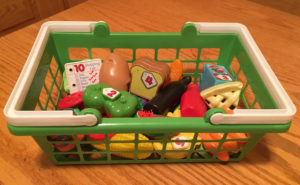
Play Food/Dishes

  • Teach your host children how to say the names of some of the food and dishes in your language.
  • Using English and/or your language play games where you are ordering food like in a restaurant. Take turns with who will be the waiter and who is the customer.
  • Come up with silly food combinations.  For example: Who wants pickles on their slice of cake?
  • Play a guessing game where the children have to figure out what food you are talking about.  For example: I grow under the ground in the dirt.  People eat me fried, mashed and baked.  What am I? (a potato)
  • Play a game with setting the table using your language to ask for the different items (plate, spoon, etc.)
  • Ask the children to divide the foods up into the different food groups (vegetables, meat, dairy, etc.)

Lego Blocks and Other Building Toys

  • Divide up all of the blocks between the people playing, by taking turns for each person to select block by block.
  • Suggest specific things to build (robots, houses, mountains etc.) and build together.
  • Challenge everyone to use all of their blocks.
  • Sort the blocks by color or shape and make patterns with them (red, blue, red, blue or square, triangle, rectangle.)  You can create a pattern and ask the child to fill in what comes next to continue the pattern.
  • Make the tallest block tower you can and let them knock it down (over and over again, if like most kids, they like destroying things.)

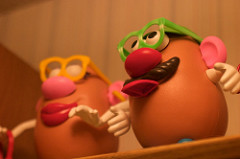
Mr. Potato Head

  • Teach your host children the names of the different parts in your language and play a game asking them to put on the body parts by name.
  • Play Hide and Seek with Mr. Potato Head. Have the children cover their eyes and count, while you hide Mr. Potato Head, then they go looking for him. Switch things up by letting them hide Mr. Potato Head and then you are the one to locate him.
  • Play the same game above, but using Simon Says.  Simon Says is a game where the leader gives commands by saying “Simon says” first. For example, “Simon says, put on the nose.”  The players are only to follow the commands when the leader says “Simon says.”  If the leader doesn’t say “Simon says” first and just says, “put on the nose,”  and the player follows the command, they are out of the game.  Repeat the game multiple times, so all kids get a turn to be the leader at least once.

Photos:  Lisa Maxwell (top) & Tom Smalls (bottom)