Category Archives: Host Family Tips

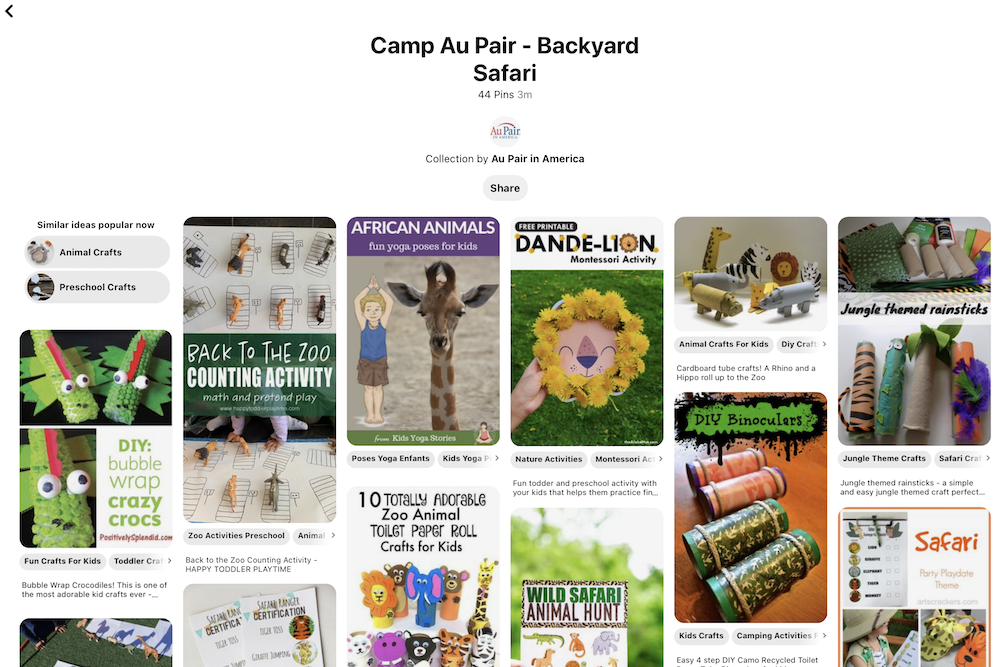
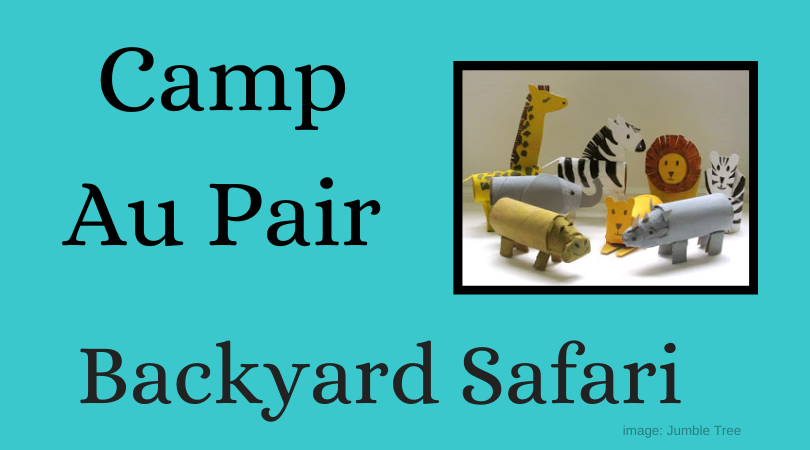
Camp Au Pair – Backyard Safari

Next week’s Camp Au Pair theme is Backyard Safari  These activities focus on animals you might find in the a variety of environments: jungles, savannahs, safari parks and zoos.

Crafts, recipes, activities, and games can all be found here on the Camp Au Pair – Backyard Safari pinboard

Field Trips can be an excellent way for kids to learn and have new experiences. Get permission from your host parents before any outings. Check the websites before you go to be sure you understand the hours, costs, and whether advance tickets/reservations are required. Search online to see if your area has any of the following:

  • Local Zoo
  • Animal Rescue Park
  • Drive Thru Safari

Webcams – You can do a Google search for websites with webcams that allow you to observe nature.

Books – Stop by your local library and look for books on animals you might find on a safari or in the zoo. You can also check YouTube for some books on this subject being read aloud.

Movies – There are lots of movies with animal themes.

  • Back to the Outback 
  • Madagascar 1, 2 & 3
  • The Jungle Book
  • The Lion King
  • The Wild
  • Zootopia

Videos – Look for fun videos about animals on YouTube. Here are some to get you started.

Image: Jumble Tree

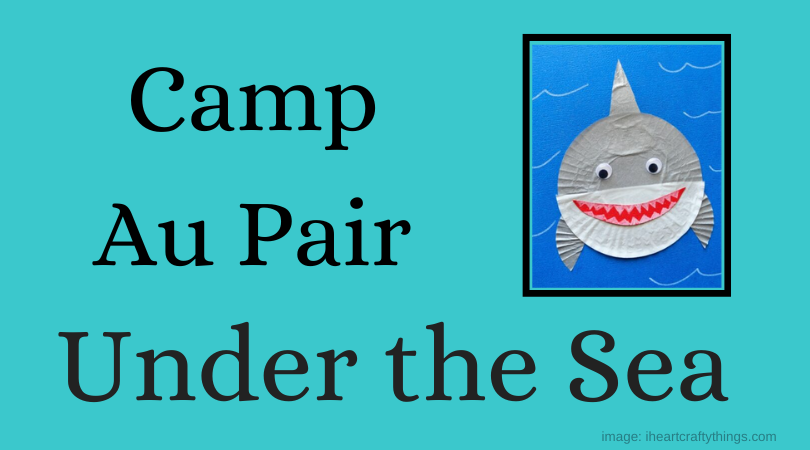
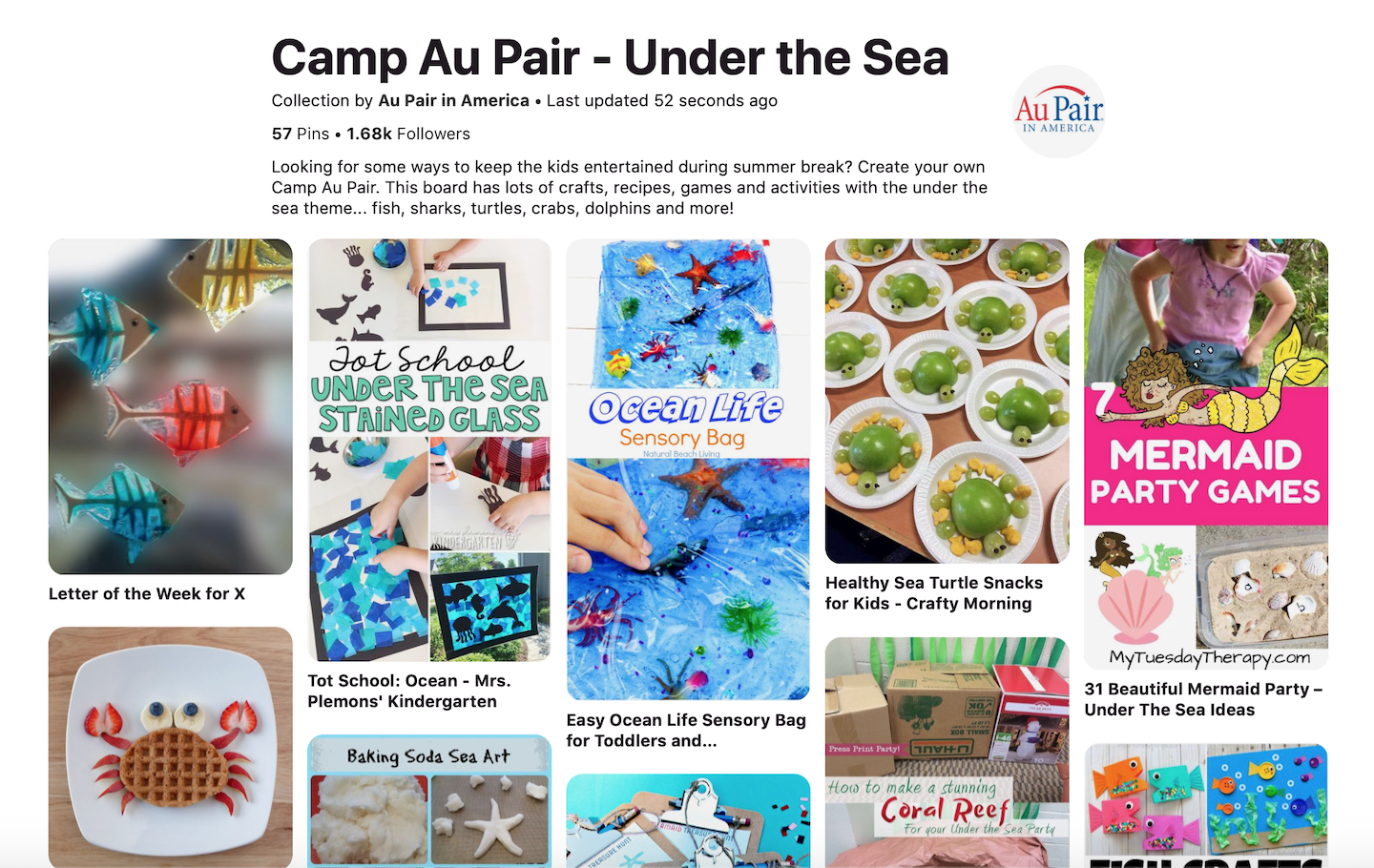
Camp Au Pair – Under the Sea

Next week’s Camp Au Pair theme is Under the Sea.

Crafts, recipes, activities, and games related to creatures who live under the sea can all be found here on the Camp Au Pair – Under the Sea pinboard.


Field Trips can be a great way for kids to learn and have new experiences. Get permission from your host parents before any outings. Check the websites before you go to be sure you understand the hours, costs, and whether advance tickets/reservations are required. Search online to see if your area has any of the following:

  • Pet or outdoor store (Bass Pro Shop) with fish tanks
  • Aquarium
  • Zoo
  • Nature Center

Online Games – NOAA has fun interactive games that help kids learn about sea turtle survival.

Webcams – You can do a google search for aquariums and zoos across the country (and the world) with webcams that allow you to observe sea creatures. Here are a few to get you started.


Videos – Look for fun videos on YouTube about sea creatures. There’s more to see than Baby Shark. Movies like Finding Nemo, Dolphin Tale, and the Little Mermaid also go well with this theme.

Books – Stop by your local library and look for books on sea creatures. The Rainbow Fish is a classic children’s book, your kids may already own. If not, you can find videos like this of it being read aloud.

Movies – There are lots of movies with under the sea themes.

  • A Dolphin Tale
  • Finding Dory
  • Finding Nemo
  • Little Mermaid
  • Moana
  • Shark Tale 
  • Song of the Sea

Television – There are some episodes of children’s television shows that talk about life under the sea.

The Magic School Bus is a television series that follows Ms. Frizzle and her class as they set off on field trips. Most episodes can be found on YouTube. Here are some episodes that fit this week’s theme.

Bill Nye the Science Guy has episodes on Fish, Marine Animals and more on YouTube.

The Discovery Channel has an annual Shark Week. Check out 15 JAW-some Activities for Shark Week with lots of fun ideas for kids in grades 5 and up, but a few for younger kids too.

Photo: mimisdollhouse.com

Camp Au Pair: Art Experiences

Next week’s Camp Au Pair theme is Art Experiences.

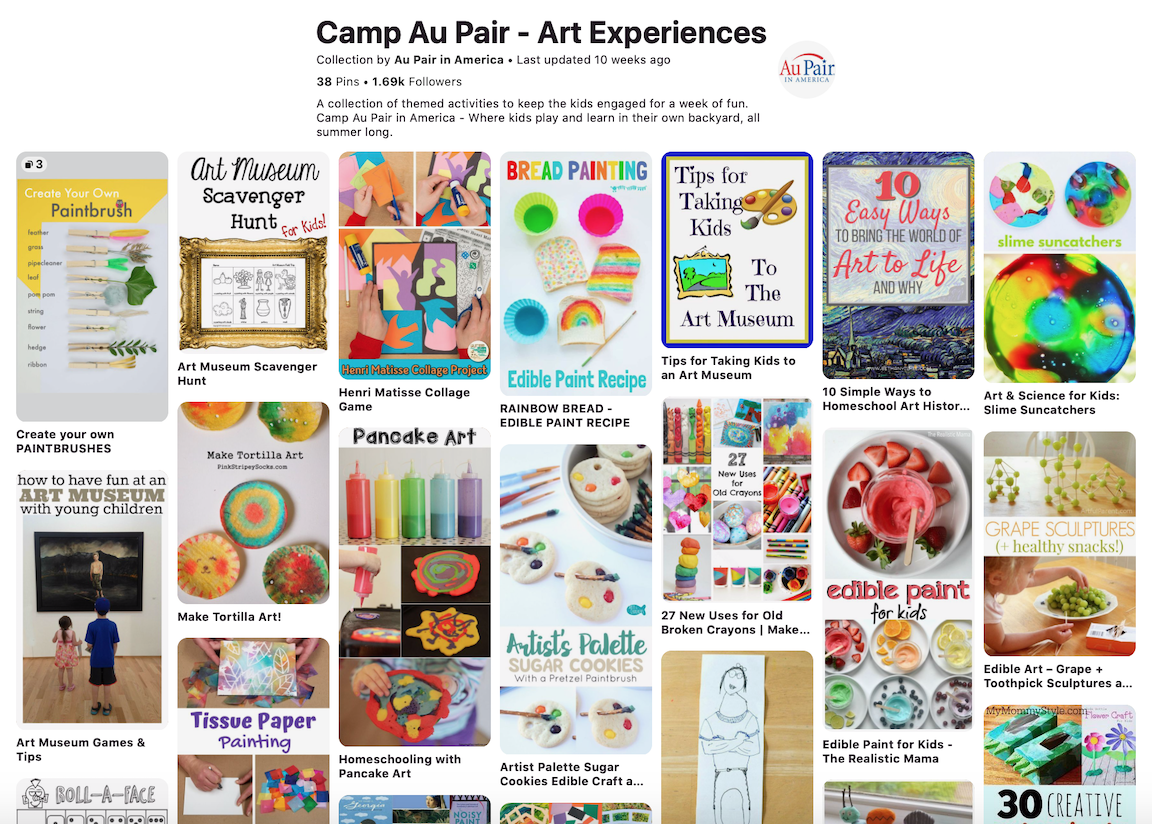
Crafts, recipes, activities, and games related to art can all be found here on the Camp Au Pair – Art Experiences pinboard.


Culture Sharing – Share any specific forms of art that are popular in your home country (mosaics, origami, murals, fabric dying, etc.) Are there any famous artists from your country that you could share their works with your host kids?

Field Trips can be a great way for kids to learn and have new experiences. Get permission from your host parents before any outings. Check the websites before you go to be sure you understand the hours, costs, and whether advance tickets/reservations are required.

Online Art FunHere is a great website with lots of art activities including ones for older kids.

Webcams – You can do a google search for art websites with webcams. Here are a few to get you started:

Videos – Look for fun videos on YouTube about drawing and all kinds of art.

Books – Stop by your local library and look for books on famous artists and art.

Check YouTube for books on art being read aloud:

Image: teachkidsart.com

Top 10 Tips – Host Family Guide to a Successful Vacation with your Au Pair.

Top 10 Tips – Host Family Guide to a Successful Working Vacation with your Au Pair.

As a host family, it is great to have your Au Pair along on a vacation. However, there are pitfalls that can happen One of the biggest issues is the danger that can be involved when no-one is clear about whose job it is to oversee the kids.

Here are 10 Tips for Vacationing with your Au Pair so that everyone has a great time, and the kids are safe!

  1.  Tag, your it!                                                                                                                                             I had a host family with 3 small children tell me that when it was the au pair’s turn to be
    responsible for the children (and vice versa) they would tap hands so that there was no
    misunderstanding who was in charge. What a great idea!
  2. Yes, a schedule is needed!                                                                                                                   A few summers ago, I received 2 calls on the same day. One was from a host mother saying that they just returned from vacation and their Au Pair did not work at all and one was from the Au Pair in this family saying she worked all day every day! How interesting is that? Be sure to give your Au Pair a schedule of when she is working so that she knows when she is off – just like home. It is important for her to know when she can go relax at the beach – without having to ask if she is free. Make a tentative schedule and discuss your expectations ahead of the vacation. It is always possible to readjust when you are there.
  3. Travel time/Work time?
    Do you consider travel time to be your au pair’s work time, or can she put her earbuds in and take a nap? This is something you want to define ahead of time.
  4. Lazy days!                                                                                                                                                  Vacation can bring different behaviors from children – especially children that
    will not do well when there is no routine. Talk to your Au Pair about your children and the things you found have worked on past vacations. If you like to have a routine on vacation let her know that, too.
  5. Pool Safety!                                                                                                                                              If vacationing at the beach or around a pool be sure to talk to your Au Pair about
    how long they can stay at the pool, how often should sunscreen be reapplied, do you want your Au Pair in the water or is it okay to sit on the side of the pool? Please do not assume your au pair knows your expectations.
  6. Who is the Boss?
    Often summer vacation includes extended family. Can Grandma and Grandpa change the
    schedule for the day? Make sure your Au Pair knows who gives her responsibilities for the day and communicate that to all parties involved.
  7. Where did all these kids come from?!
    Are you vacationing with your kids, your brother’s kids, and your sister’s kids, and do they expect your Au Pair to watch them, too? The Au pair can decide that this is too much for her. If playdates during the trip will be arranged, parents may need to assist the Au pair with childcare during times with large numbers of kids, especially around water.
  8. Traveling internationally?
    The DS-2019 form must be signed for any international travel ( if to the Au pair’s home country). This process takes 3-4 weeks. See the Travel Validation form on our blog for how to do this. Plan ahead! It is the Aupair and Host family’s responsibility to research what visa will be needed to enter the country you will be traveling to. Any costs related to a  delayed return to the USA are not paid by APIA.
  9. Roomies? Will your Au Pair have a private space on vacation? Make sure you discuss ahead of time what the accommodations will be on the trip so that you eliminate any surprises (your Au pair should have a private bedroom).
  10. Safety First!
    Communication with your Au Pair is paramount on vacation. When you are all in unfamiliar
    surroundings with different schedules and different expectations – things can go wrong. Be sure that the safety of your children is number one in everyone’s mind. Take a tour of your surroundings and discuss any concerning issues. Making sure everyone knows whose turn it is to watch for the kids and what they are watching out for. These tips can ensure a  successful vacation with memories to last!


Taking An Education Course Is Important!

picture of teacherThe education component of the Au Pair program is a requirement of the State Department of the United States. The State Department gives authorization for all Au Pair programs to exist.  When an Au Pair does not achieve her requirement, this puts all Au Pair agencies at risk. Completing your education hours is an important part of being an Au Pair and is required by your contract with Au Pair In America.  Taking a course will provide yet another level of experience during your year and yields many skills that you can use to further your personal goals. You may also make new friends and professional contacts! I hope you enjoy your educational courses. If you need assistance finding a course or have questions, please call or email your counselor.

Some Important Tips:

Any course can be taken as long as it is taught by an accredited USA college, university, or technical college. Only those schools approved by the State Department can be accepted. All of the schools listed on your Blog site are approved.  Please have your counselor approve any class before registering.

  •  Your counselor can clarify any questions about a school.
  • Volunteer hours do not count towards your educational credits unless it is part of a hybrid or in-person accredited college class.
  • Weekend courses do count if the course is part of a college or university.  Some places offering weekend courses are not accredited. Ask your counselor before signing up.
  • Classes should be in person. Permission for one online class can be given, if the schedule does not permit in-person classes, or the type of class you wish to take is not available or is not affordable.
  • Only one online course per semester is allowed. If you submit two certificates with the same semester timeframe, only one class will be accepted.
  • A great option for one online course accepted by the State Dept is the Au pair Advantage class offered by UCLA.
  • A hybrid online class will be accepted IF there is also an in-person component to the course.
  • All colleges, universities, and technical schools must be accredited and within the USA.
  • 72-80 hours of education are required for standard au pairs.
  • 144-160 hours for Educare au pairs.
  • For second and third-year au pairs, 36-40 hours is required for a six-month extension and 72-80 hours for a nine or twelve-month extension.
  •  Credits, hours, and CEUs are different. Count the hours you are in a classroom this must be 72 hours.
  • At the end of your course, send your community counselor your documents showing the name of the school and the hours that you have achieved, along with the name of the class you took. This proof should also have your name.  Check your certificate. Some certificates do not show the number of hours. If the hours are not present on the certificate, you will need a letter from the school stating how many hours you have achieved.
  • All education must be achieved 45 days before the end of your Au Pair term.
  • Send all certificates or proof of your classes to your community counselor.
  • If you plan to extend, your education needs to be finished four months before the end of your term.
  • Host families reimburse tuition costs and costs of related materials (books and supplies) up to $500 for the first year. EduCare companions are reimbursed up to $1000 for the first year. If it will cost you more than $500 (or $1000 for EduCare) to meet the requirement, you must pay the additional expense, so plan carefully.
  • Your host family is required to provide transportation, including gasoline, parking, or public transportation costs (if applicable) to and from classes in your community. The cost of transportation is in addition to the $500/$1000 allocated to tuition and related fees. It is your host family’s responsibility to provide transportation or cover the transportation costs until you complete your educational requirement, even if the $500 education allowance has already been spent.
  • After you finish 72 hours of education class, your host family is no longer obligated to support your desire to continue to attend classes.
  • Some locations will not be accessible to your host address. The host family must agree to the location of a class as some will be too far for the host car to be driven.
  • Once you have met the 72-hour requirement for the State Department, your host family is not obligated to pay out any remaining education monies not spent.
  • To extend your first Au Pair term, you will need to have proof of 72 hours. Send the documentation to your community counselor as soon as possible. You should plan to have your education requirement finished at the time you request an extension. This happens approximately four months before the end of your first term. Au pair In America requires 72 hours to be able to extend your au pair term. Without 72 hours completed 45 days before  the end of your term, Au Pair In America will not accept your application to extend and you must go home at the end of your first year.

If you want to extend and have not completed all of the hours, but you do intend to have them finished at least two months prior to the end of your first term, you will need to do the following:

1. Register for a class that will complete 72 hours of education at least two months before the end of your first term. All proof of education must be given to your counselor before your deadline to extend. As soon as your counselor can check off for the education requirement, your request to extend can be approved. Without the education requirement finished, you will not be able to start the interviewing process for your extension.  

2. Send documents showing proof of your registration to your community counselor as soon as possible.  This allows the office to submit your request to the State Department and upon approval, you can begin to interview with families.  You must have a match before your year ends. 

Your counselor is the best person to ask questions about your education requirement. Courses and colleges are constantly changing. Your counselor is always researching new and exciting courses that are appropriate for you.  If you are aware of a new resource, please let your counselor know!


Avoid Falling Victim to Scammers

There are always people out there who are looking for ways to trick people out of their money and personal information. There have been several new scams recently, so we are going to explain ways to identify scams and how to protect yourself.

SCAM #1 – A caller says they are a contact tracer and you may have been exposed to COVID-19 and asks you to pay for a test kit.

  • Contact tracers will not ask you for payment.

What to do? Do not give any payment information to someone who calls you on the phone.

SCAM #2 – Calls asking for your PIN, password, personal information or a payment. 

  • Your bank will not call you and ask you for your PIN number or password. If the caller states that they are the fraud department of your bank- hang up and call the number for your bank directly. They can trick you by already having your social security number or bank account number. HANG UP!
  • IRS and Social Security Administration will not ask you for payment or personal info over the phone. Government agencies usually handle issues like this by sending a letter.
  • The number shown on caller ID can be manipulated, don’t take that as a sign that a call is legitimate. It can be exactly the number that the agency has. It isn’t- it’s the scammer using that number to scam you.

What to do? Whenever you are in doubt, hang up and call the bank (or company) directly using a number you already have for them.

SCAM #3 – Email asking you to click a link to verify your personal information or share your password or PIN.

  • Be very suspicious of emails asking you to click links.
  • Scammers are very good at creating official-looking emails and webpages.

What to do? Whenever you are in doubt, go directly to the website (not using the link in the email).

SCAM #4 – You see an offer online telling you to send them some money and they will double it or a pop-up ad says that you have won a great prize and just need to give them your information.

  • When something sounds too good to be true, it usually is.

What to do? Do not give your personal information or any money to people you don’t know.

SCAM #5 – You receive a call and you are told to stay on the phone while you go transfer or withdraw money from the bank and if you don’t you will be arrested or your bank account seized.

  • They are using the idea that this is an urgent situation to make you act quickly without thinking to avoid the consequence they have told you.

What to do? Do not follow their instructions.


Whenever you are in doubt, do not do as the caller or email asks. Check with your host parents or community counselor.

One other note: It is very important to keep your social security number private. There are very few situations where you will need to share this (bank, IRS, motor vehicles). Those are times you are taking an action and need to provide it. There is not a legitimate time where someone would be calling you on the phone or emailing you asking for that number.

Image: Canva.com

WHAT YOU NEED TO KNOW about traveling outside the USA in 2022
Traveling outside of the USA is risky.
The USA has in the past closed the borders between some countries and the USA when a new variant is discovered. If you travel home or to another country and then the USA closes that border, you will not be able to return to the USA to finish out your year. This happened with South Africa over Thanksgiving. The border was closed in one day. There was no time for anyone to return back to the USA. Many Au Pairs could not arrive to start their year and others who had returned home could not come back to their host families. A lot of matches broke.
If you go home and have the virus, you must meet your country’s quarantine requirements before returning. Your host family may not be able to wait for this and might need to enter a rematch to find a new Au Pair. Because a family is required to pay the weekly stipend for these weeks, very few families can hire a temporary nanny while also paying the weekly stipend. 
Think carefully about leaving the USA. You could jeopardize your ability to be an Au Pair. If you are going to travel internationally, inform your CC. Your CC will be required to make sure  your host family is aware of the risks associated with traveling outside the USA. 
No one should return home with less than 4 weeks left on your first-year visa.
No one can travel outside the USA in the second year except those adjacent islands that have an automatic revalidation agreement with the USA, Canada and Mexico.
If are traveling against the advice of APIA- getting your DS2019 form signed takes 3-4 weeks.
Even if you are returning to your home country the rules still apply. You will need your DS signed for travel. 
You should have this form filled out and your DS2019 form sent to the office 4-5weeks ahead of any travel. If you need it faster, you will need to pay for expedited postage through UPS to get it to the office and to receive it back.
You must send the original and you cannot re-enter the USA without the DS2019.
 You must research if a visitor’s visa is needed to enter the country that you are going into.
Please check the travel checklist for year 1 or 2 for more steps that need to be completed BEFORE you travel outside the USA.
These can be found always be found on our blog site. Here are the links for year 1.

Making Thanksgiving Memories Together

Thanksgiving is a public holiday celebrated on the fourth Thursday in November every year in the United States. It started as a harvest festival and has been celebrated nationally since 1789.  The most important part of Thanksgiving for American families is to spend time together with the special people in their lives. A part of the tradition is to focus as a family and individual on the gifts in our lives and relationships. What are you THANKFUL for?

Martin Cathrae

 “My favorite holiday was Thanksgiving. Firstly, it was my first holiday with the whole family in America. Secondly, the whole family came together. All aunts and uncles and their kids came to grandma’s. We played football with all of them, including grandma and grandpa. It was the first time I played it and it was so much fun for all. We had a great dinner with all the typical things you can imagine … it was deeeelicious! It was so great to be with such a big family and I really enjoyed that day. I will remember it my whole life, I hope.” – Swantje from Germany

Here are a few tips to help you have a terrific Thanksgiving experience.

Host Parents
Please plan to include your au pair in your Thanksgiving celebration, if at all possible. If you are traveling or will not be able to invite your au pair to join you for Thanksgiving, give her plenty of notice and help her make alternate plans. You don’t want to leave your au pair alone over the holiday.

Au Pairs
If you are invited to attend dinner, please let your family know within 5 days of the invitation, whether you are planning to attend, so they may make plans. If your host family is unable to include you in their Thanksgiving plans, please let me know if you have trouble making other plans, so I can assist.

Make sure to discuss time off during this holiday weekend. Many host families work the Friday after Thanksgiving so do not assume you have this day off or the entire weekend. Talk to your host family, BEFORE you make any plans.

Thanksgiving is a very special time to gather with friends and family. It is also very hectic for your host family who has to prepare food or travel with children. This is a great time to ACT like a part of the family. If you see a way to be helpful- do it! Your participation in this stressful time will be appreciated.

Bonus Tip for the Kids
If you are looking for a fun recipe to make with your au pair, check out these turkey cookies. Find more fun activities and recipes on the Au Pair in America Fall Holidays pinboard.


Camp Au Pair – Art Experiences

This week’s Camp Au Pair theme is Art Experiences.
Crafts, recipes, activities, and games related to art can all be found here on the Camp Au Pair – Art Experiences pinboard.

Field Trips can be a great way for kids to learn and have new experiences. Get permission from your host parents before any outings and be sure to take all social distancing precautions. Some museums are requiring advanced tickets or have reduced hours due to the pandemic.

  • Art Museums
  • Paint Your Own Pottery Studio
  • Clay and Ceramics Studio

Online Art FunHere is a great website with lots of art activities including ones for older kids.

Webcams – You can do a google search for art websites with webcams. Here are a few to get you started:

Pottery & Ceramics webcam
Glass Blowing webcam

Videos – Look for fun videos on YouTube about drawing and all kinds of art.

Books – Stop by your local library and look for books on famous artists and art.

Check YouTube for books on art being read aloud:

https://youtu.be/PA_yQPDV43w

Image: teachkidsart.com

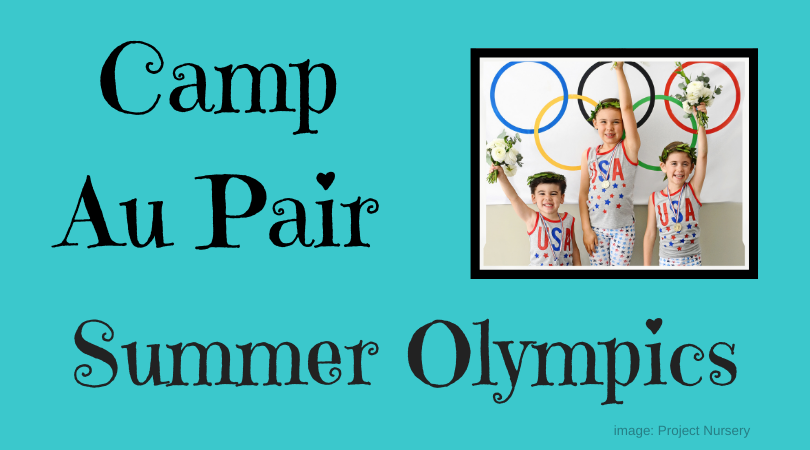
Camp Au Pair – Summer Olympics

This week’s Camp Au Pair theme Summer Olympics. The 2021 Summer Olympics are taking place in Tokyo, Japan, July 23-Aug 8.

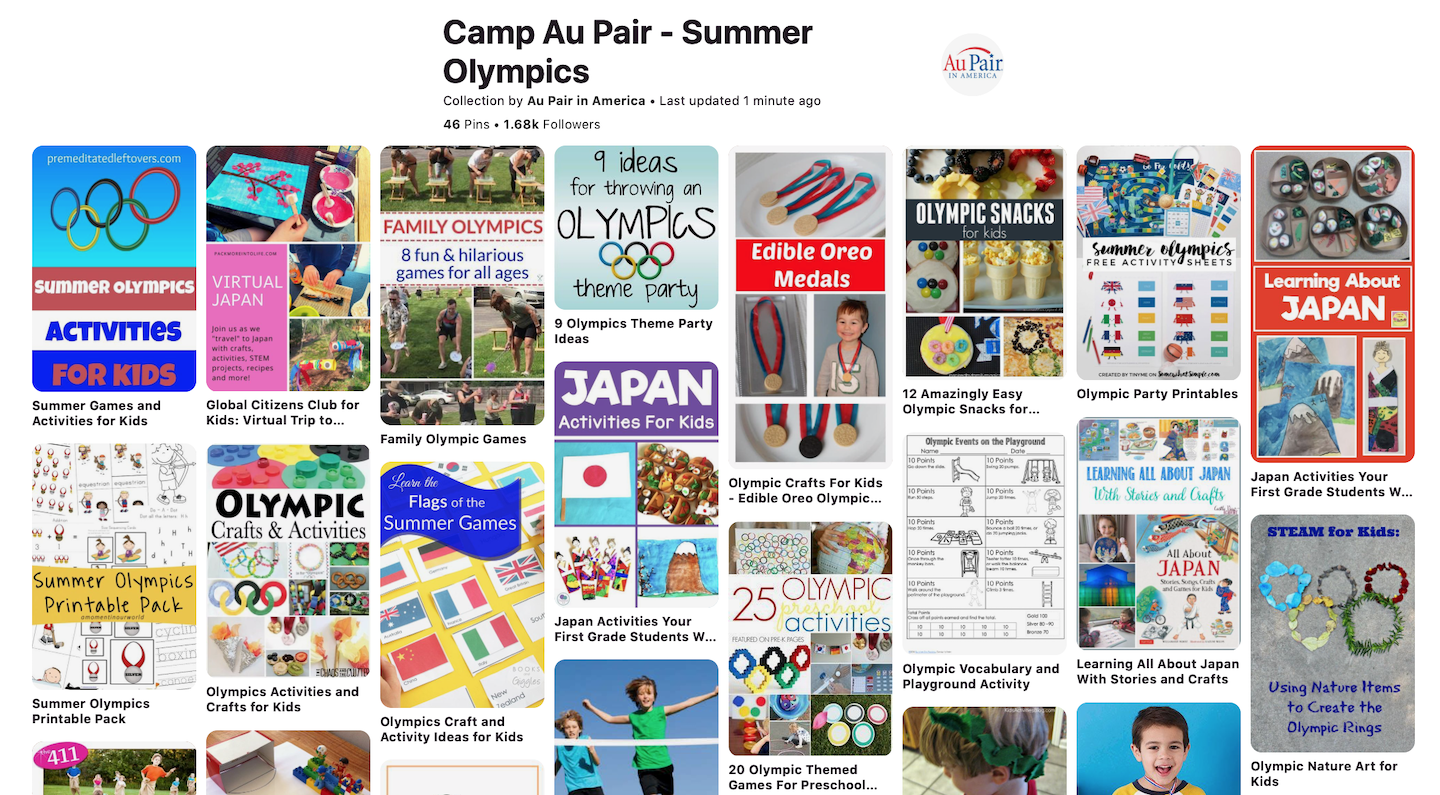
Crafts, recipes, activities, and games related to the Summer Olympics can be found here on the Camp Au Pair Summer Olympics pinboard.

Videos – On YouTube you can find many great videos of about the Olympics.

Books – Stop by your local library and look for books about the Olympics.

Some good ones include: Olympig!, G is for Gold Medal: An Olympic Alphabet, How to Train with a T-Rex and Win 8 Gold Medals, Wilma Unlimited, America’s Champion Swimmer: Gertrude Ederle, Way to Go Alex!, Touch the Sky, Pele: King of Soccer, A Picture Book of Jesse Owens & Babar’s Celestville Games.

You may also find some of these books read aloud on YouTube.

Fun Fact: The Olympic symbol consists of five interlaced rings of equal dimensions, used alone, in one or in five different colors, which are, from left to right, blue, yellow, black, green and red. The Olympic symbol (the Olympic rings) expresses the activity of the Olympic Movement and represents the union of the five continents and the meeting of athletes from throughout the world at the Olympic Games.

Image: Project Nursery