Category Archives: q and a

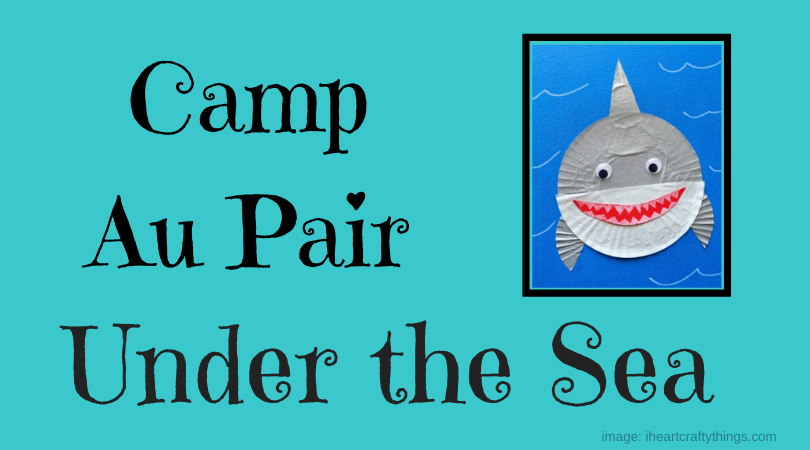
Camp Au Pair – Under the Sea


In honor of Shark Week (see below), next week’s Camp Au Pair theme is Under the Sea.

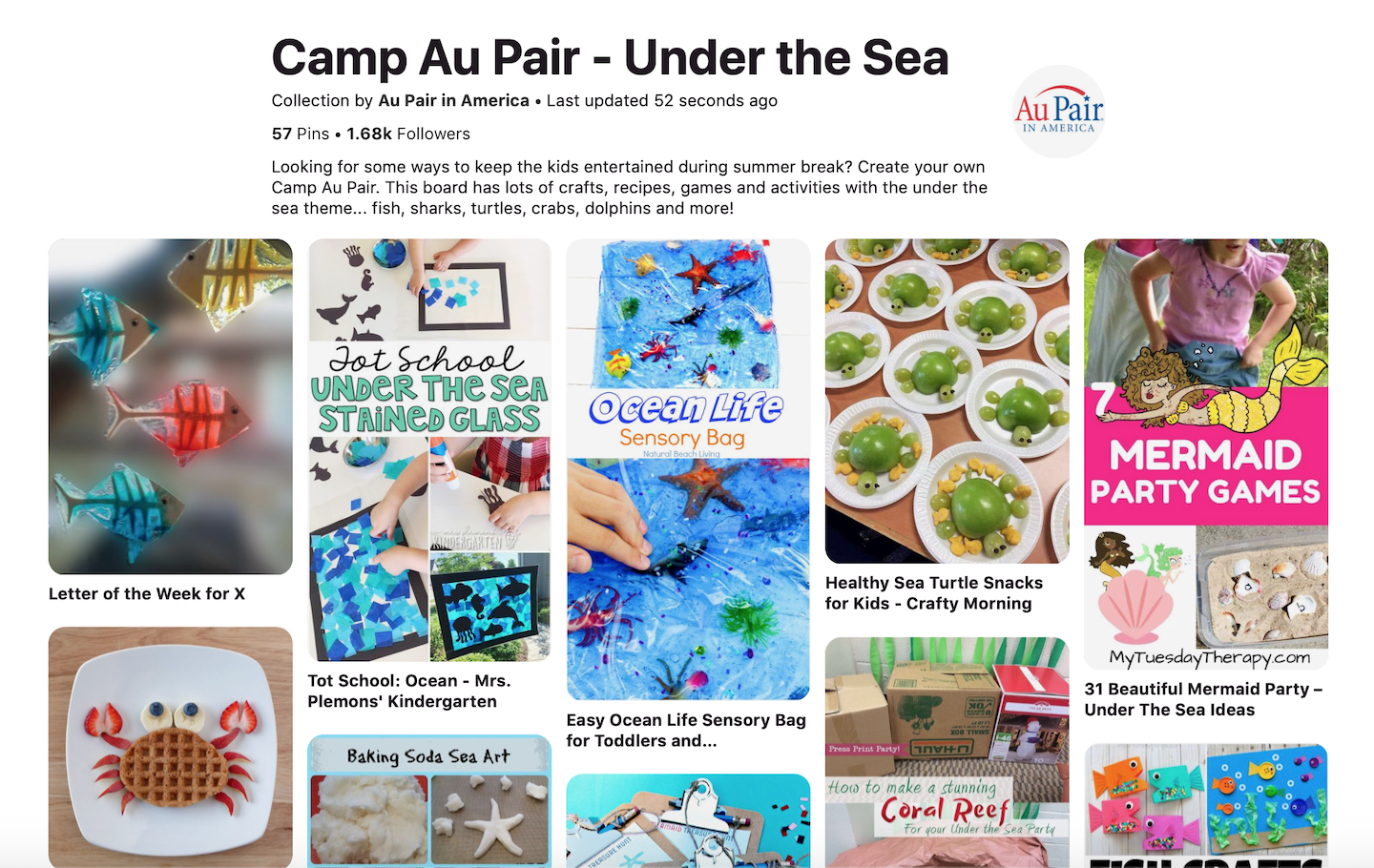
Crafts, recipes, activities, and games related to creatures who live under the sea can all be found here on the Camp Au Pair – Under the Sea pinboard.
Webcams – You can do a google search for aquariums and zoos across the country (and the world) with webcams that allow you to observe sea creatures. Here is one to get you started.

Field Trips can be a great way for kids to learn and have new experiences. Get permission from your host parents before any outings and be sure to take all social distancing precautions. Search online to see if your area has any of the following:

  • Any pet store with fish tanks
  • Aquarium
  • Zoo
  • Nature Center

Television – The Discovery Channel has an annual Shark Week. This year it will be July 11-18, 2021. Much of the programming will be too scary for younger kids, but for nature-loving tweens and teens, it could be a great way to get them interested in sharks and other ocean animals. Check out 15 JAW-some Activities for Shark Week with lots of fun ideas for kids in grades 5 and up, but a few for younger kids too.

Online Games – NOAA has fun interactive games that help kids learn about sea turtle survival.

Videos – Look for fun videos on YouTube about sea creatures. There’s more to see than Baby Shark. Movies like Finding Nemo, Dolphin Tale, and the Little Mermaid also go well with this theme.

Books – Stop by your local library and look for books on sea creatures. The Rainbow Fish is a classic children’s book, your kids may already own. If not, you can find videos like this of it being read aloud.

Photo: mimisdollhouse.com
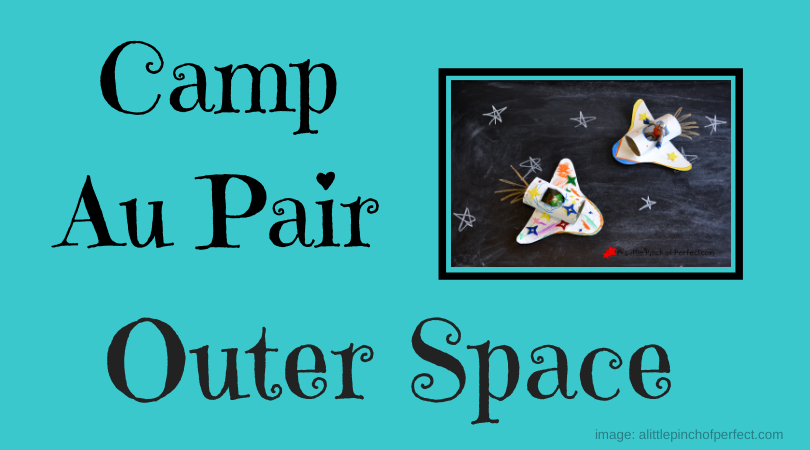
Camp Au Pair – Outer Space

Next week’s Camp Au Pair theme is Outer Space.

Crafts, recipes, activities, and games related to outer space can all be found here on the Camp Au Pair – Outer Space pinboard. Here is a fun one that combines a science lesson, art, and snack time.

https://www.opticscentral.com.au/moon-phases-explained-with-oreos

Field Trips can be a great way for kids to learn and have new experiences. Get permission from your host parents before any outings and be sure to take all social distancing precautions. Search online to see if your area has any of the following:

  • Air & Space Museum
  • Science Center
  • Planetarium

Webcams – You can do a google search for websites with webcams that allow you to observe space. Here is one from the International Space Station to get you started.

Online Games – NASA has a gallery of free space games for kids.

Videos – Look for fun videos on YouTube about outer space. Solar System 101 and 25 Space Secrets Astronauts Want You to Know are good for school-aged kids. The Planet Song is for toddlers and preschoolers. WALL-E, Zathura, Monsters vs. Aliens & Star Wars are all great family movies that fit with this theme. For older kids, movies like Hidden Figures and the Martian too, both are rated PG-13.

Books – Stop by your local library and look for books on outer space.  Me & My Place in Space, Mousetronaut, There was an Old Astronaut who Swallowed the Moon, and Mae Among the Stars are a few fun ones to get you started. Story Time from Space is a YouTube channel with real astronauts reading children’s books aloud.

Photo: alittlepinchofperfect.com

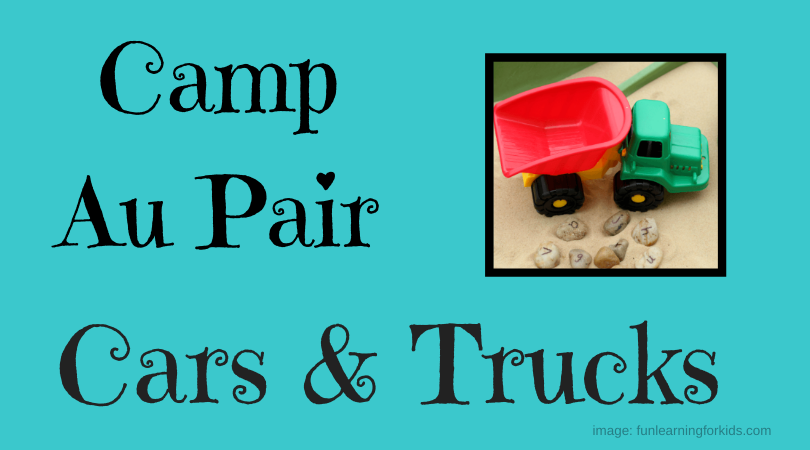
Camp Au Pair – Cars & Trucks

Next week’s Camp Au Pair theme is Cars & Trucks.

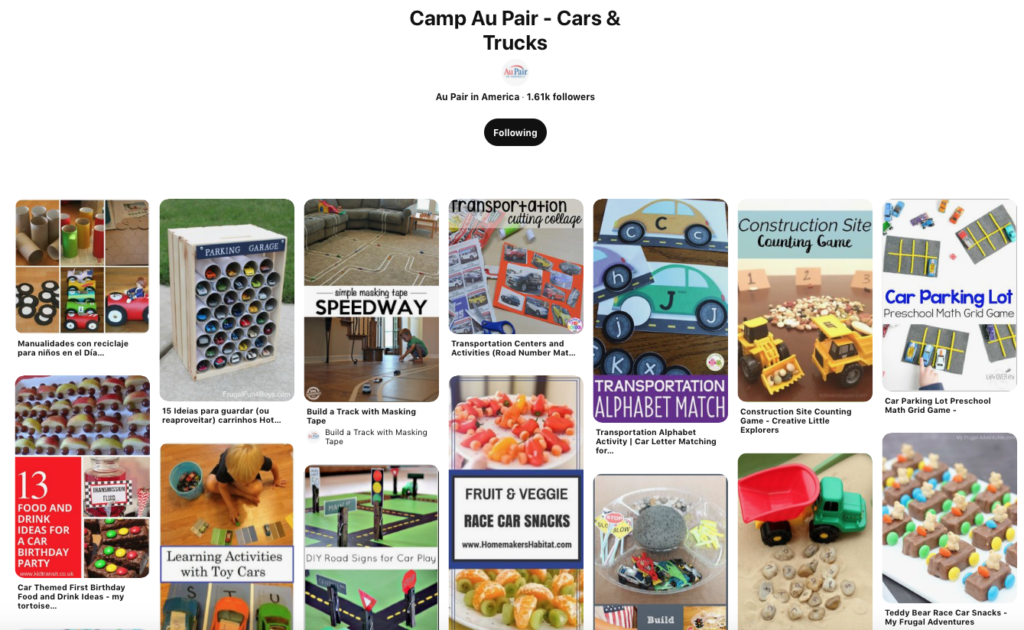
Crafts, recipes, activities, and games related to all kinds of vehicles can all be found here on the Camp Au Pair – Cars & Trucks pinboard.

Field Trips can be a great way for kids to learn and have new experiences. If your host parents are okay with you taking the kids to any outdoor, socially distanced activities, here are a few places to go, that fit this theme:

  • Look for construction areas where the kids can observe big machines in action. Kids should observe from the car or a safe area.
  • Keep an eye out for the trash truck and let them watch the truck in action.
  • Go to a drive-through car wash or let the kids make their own car wash at home.
  • Look for a go kart track in your area. Before you go, check the website to find out what the age and/or height requirements are for children.

VideosMighty MachinesAmazing Big Trucks are kid-friendly video channels showing machinery and big trucks in action. Look for fun videos on YouTube about cars and trucks.

Movies – Cars, Cars 2 & 3, Turbo, Bumble Bee, Chitty Chitty Bang Bang & Bob the Builder Mega Machines movies all fit this theme.

Books – Check your kids’ bookshelf for books on cars & trucks. You can also find many read aloud book videos on YouTube. Little Blue Truck, Trash Trucks, Cool Cars and Don’t Let the Pigeon Drive the Bus are a few fun ones to get you started.

Image: funlearningforkids.com

Welcome to Camp Au Pair in America!

When kids are out of school for the summer, it doesn’t take long for them to become bored and  sometimes that leads to sibling squabbles and mischief. Even though they don’t realize it, they are usually missing routine and predictability in their daily schedule. One solution is to make fun plans to keep them busy! 

Each week this summer we will share a different Camp Au Pair theme. These weekly themes are designed to give you ideas to keep your host kids occupied and engaged all summer long. They will also be learning. (But shhhh, don’t tell them that part.) Check back each Friday, for the next week’s theme. This gives you a chance to make plans and gather materials for the next week. For each theme there will be crafts, games, snacks and activities. You can just use these ideas or add your own and customize the themes to fit the ages and interests of your host children.

Here are the themes you can look forward to:

  • Art Experiences
  • Backyard Safari
  • Bugs & Butterflies
  • Cars and Trucks
  • Dinosaurs
  • Explore the World
  • Nature Explorations
  • Outer Space
  • Pirate Adventures
  • Princesses & Knights
  • Science (STEM)
  • Under the Sea

Check out Summer Fun & Summer Holidays pin boards for even more ideas.

If you get some great pictures doing these activities with your host kids, please send those to your counselor. We love to share your accomplishments and inspire other au pairs!

Let’s make this an amazing summer!


Social Distancing: Free Virtual Escape Rooms

Libraries may be closed due to COVID-19, but many librarians are coming up with creative ideas to keep people entertained and promote literacy. One of those creative ideas is free virtual escape rooms. With a variety of themes, some may be fun to do on your own, others as activities with the kids.

Sydney Krawiec, Youth Services Librarian at Peters Township Public Library in McMurray, PA created this Hogwarts Virtual Escape Room. She shared this tutorial on how to create your own virtual escape room, which seemed to spark the creativity of many other librarians.

Some amazing librarians all over the country have been busy creating virtual escape rooms with a variety of themes.

Special thanks to the Humboldt County Library in Winnemucca, Nevada for gathering info on many of these escape rooms. Follow them on Facebook for their storytimes and weekly Facebook Live Science Time on Fridays.

Image: Canva.com

Social Distancing: 5 Online Adventures for Kids

Reading, playing, and doing art projects are always great ways to entertain children and keep them physically active and learning. It’s a good idea to limit screen time. But, in this time of social distancing, technology can play an important role in allowing kids to see and connect with the world outside of their homes. Many online resources are popping up to create those opportunities.

Here are five to get you started:

And if kids have questions about the coronavirus, Live Science has created an ultimate kids’ guide to the new coronavirus that has lots of information and is appropriate for school-aged kids.

Three Ways for Au Pairs to Stay Red Cross Ready

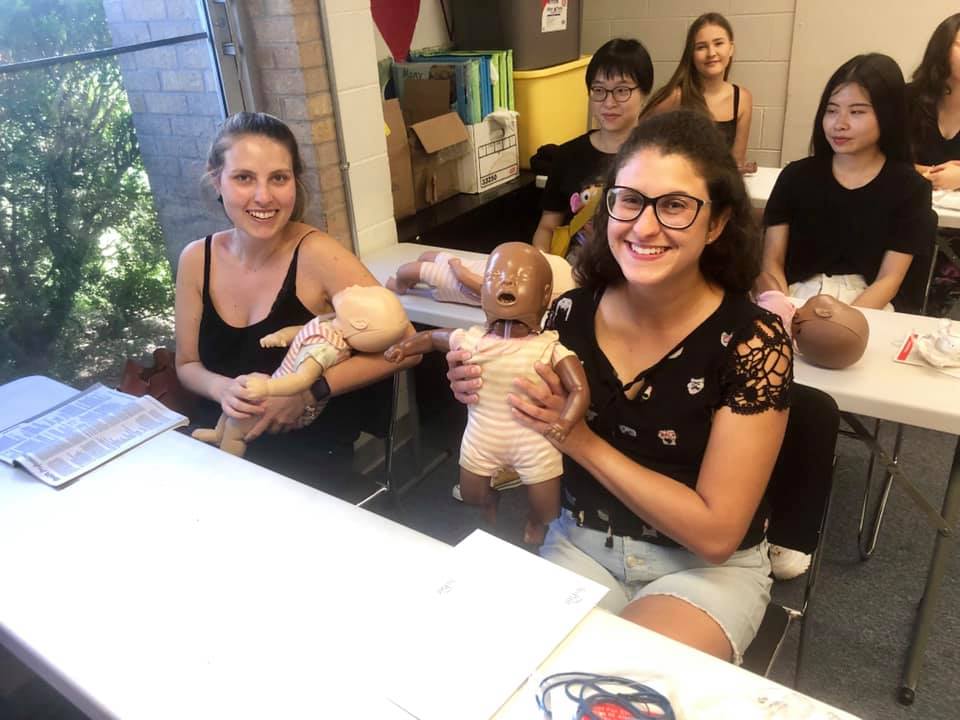
Being knowledgeable in basic first aid and CPR is important for au pairs (and anyone else caring for children). Au Pair in America’s commitment to infant/child safety begins before au pairs arrive to the U.S., with pre-arrival training and continue throughout the au pair year.

#1 Training At Orientation

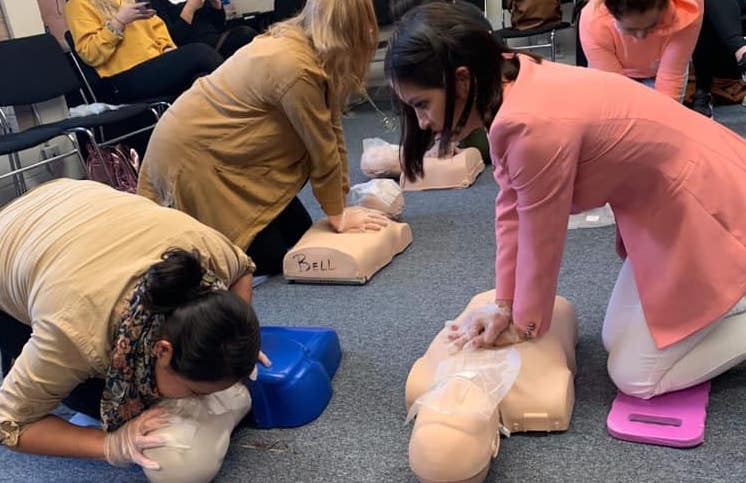
Our orientation includes seminars by American Red Cross instructors who provide hands-on demonstrations in infant/child CPR and safety. Printed materials are provided that reinforce the safety information and can be used to review from time to time.

#2 Enroll in a Red Cross Certification Class

After settling into their host community, all au pairs are encouraged to complete an Infant/Child CPR and First Aid certification program. Au Pair in America will pay for this training through the American Red Cross.

Classes are available through the Red Cross. Au Pair in America will pay for the cost of a class providing an au pair has at least six months left on her visa and is taking one of several approved childcare/child safety-related classes, such as Adult and Pediatric First Aid/CPR/AED. Au pairs should check with their community counselor and host family before signing up. Au Pair in America will register the au pair directly.
To locate a class, visit www.redcross.org/takeaclass. For step-by-step instructions on how to locate a class and have Au Pair in America complete enrollment, click here.

#3 Stay Current on Safety Information

The Official American Red Cross First Aid app puts expert advice for everyday emergencies in your hand. Available for iPhone and Android devices, this app gives you instant access to the information you need to know to handle the most common first aid emergencies. With videos, interactive quizzes and simple step-by-step advice, it’s never been easier to know first aid. Download the app for free from the American Red Cross website or in your app store.

Photos: Robin Leon

Make Your Own Play Dough

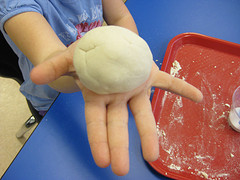
Play dough is the perfect modeling material for children. Their small hands can pat, poke, pinch, roll and knead it into many shapes. Keep it in an airtight container to use another day, or let it air dry into favorite shapes.

8640007416_3170564961_m

Measure 2 cups of flour, one cup of salt and 4 teaspoons of cream of tartar into a bowl. Add 1/4 cup of oil to one cup of water in a separate bowl then add the mixture to the dry ingredients. For colored play dough, squeeze 10-20 drops of food coloring into the water before you add it to the mixture. Cook the dough at low heat in a wide pan, stirring constantly until it becomes rubbery. Remove the dough from the heat and knead it for a few minutes. When it cools the kids can play too!

Photo: Kevin Jarrett (Flickr)

Focus on Play: New Ideas for Some Classic Toys

It is good to offer kids a balance of independent play time and play where you are actively engaging with them. You can make toys they may be bored with, feel new and exciting, by suggesting different ways to play with them. Try some of the ideas below as a starting point.

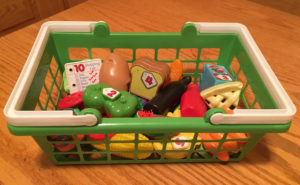
Play Food/Dishes

  • Teach your host children how to say the names of some of the food and dishes in your language.
  • Using English and/or your language play games where you are ordering food like in a restaurant. Take turns with who will be the waiter and who is the customer.
  • Come up with silly food combinations.  For example: Who wants pickles on their slice of cake?
  • Play a guessing game where the children have to figure out what food you are talking about.  For example: I grow under the ground in the dirt.  People eat me fried, mashed and baked.  What am I? (a potato)
  • Play a game with setting the table using your language to ask for the different items (plate, spoon, etc.)
  • Ask the children to divide the foods up into the different food groups (vegetables, meat, dairy, etc.)

Lego Blocks and Other Building Toys

  • Divide up all of the blocks between the people playing, by taking turns for each person to select block by block.
  • Suggest specific things to build (robots, houses, mountains etc.) and build together.
  • Challenge everyone to use all of their blocks.
  • Sort the blocks by color or shape and make patterns with them (red, blue, red, blue or square, triangle, rectangle.)  You can create a pattern and ask the child to fill in what comes next to continue the pattern.
  • Make the tallest block tower you can and let them knock it down (over and over again, if like most kids, they like destroying things.)

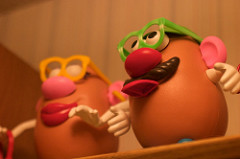
Mr. Potato Head

  • Teach your host children the names of the different parts in your language and play a game asking them to put on the body parts by name.
  • Play Hide and Seek with Mr. Potato Head. Have the children cover their eyes and count, while you hide Mr. Potato Head, then they go looking for him. Switch things up by letting them hide Mr. Potato Head and then you are the one to locate him.
  • Play the same game above, but using Simon Says.  Simon Says is a game where the leader gives commands by saying “Simon says” first. For example, “Simon says, put on the nose.”  The players are only to follow the commands when the leader says “Simon says.”  If the leader doesn’t say “Simon says” first and just says, “put on the nose,”  and the player follows the command, they are out of the game.  Repeat the game multiple times, so all kids get a turn to be the leader at least once.

Photos:  Lisa Maxwell (top) & Tom Smalls (bottom)

Avoiding Homesickness this Holiday Season

Homesickness can be a problem during the holidays, even if it hasn’t been at any other time of the year. Au pairs often miss their friends and family, familiar places and their own traditions and customs. The holiday activities in the United States seem, and may actually be, different just at a time when an au pair would welcome something familiar. 

It is common for au pairs’ emotions to be close to the surface during the holidays. Her highs are higher, her lows are lower. The enormity of what she has done–actually living in another country (which is an amazing thing when you think about it!)–hits her and throws her into a self-protective mode.

Host parents can help her through this unfamiliar territory by talking to her about what your specific family activities will be (gifts, meals, visitors, religious services, in-home traditions, or none of these, as the case may be.) In the spirit of cultural exchange, ask her if she has any favorite holiday traditions or foods that you might be able to incorporate into your family’s celebration of the season. Let her know what you will be doing, when you will be doing it, and what she can expect. Talk to her about what has to be accomplished and get her involved and interested. Don’t expect her to just “know” what needs to be done. Give her some clear, agreed upon assignments. Make her feel a part of things. And, let her know her contribution is needed and appreciated.

Photo: Sheila Sund (Flickr)