Tag Archives: au pair

Camp Au Pair – Cars & Trucks

Next week’s Camp Au Pair theme will be Cars & Trucks.

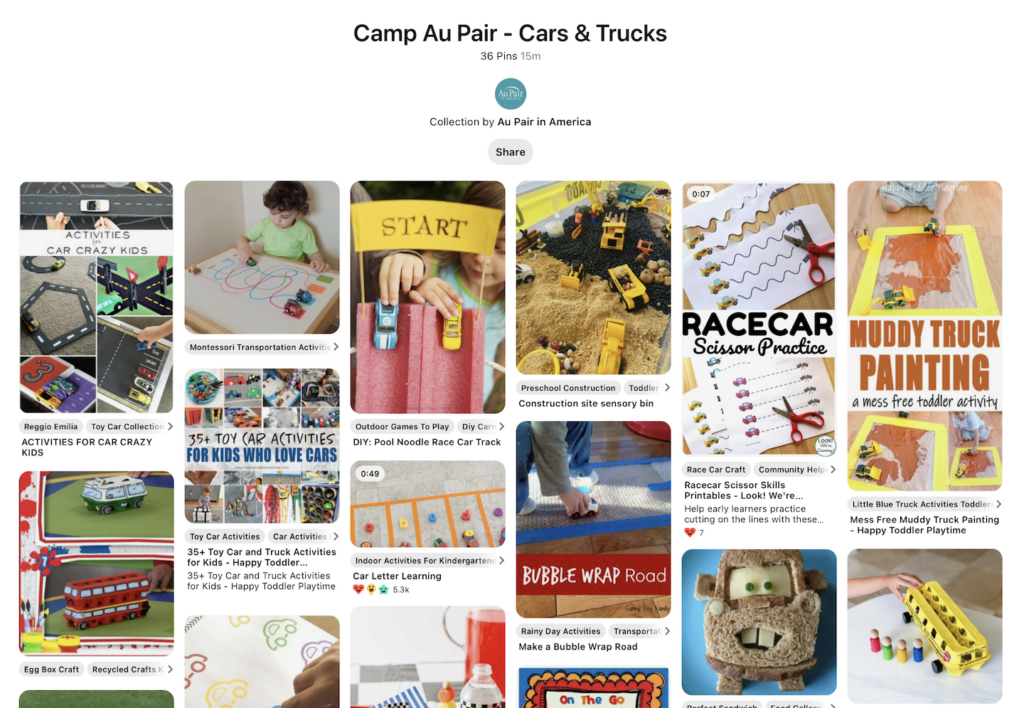
Crafts, recipes, activities, and games related to all kinds of vehicles can all be found here on the Camp Au Pair – Cars & Trucks pinboard.

Field Trips can be an excellent way for kids to learn and have new experiences. Get permission from your host parents before any outings. Here are a few field trips that go with this theme:

  • Go kart track (even if they aren’t old enough to drive, watching the cars is fun.)
  • Look for construction areas where the kids can observe big machines in action. Kids should observe from the car or a safe area.
  • Keep an eye out for the trash truck and let them watch the truck in action.
  • Go to a drive-through car wash and/or let the kids make their own car wash at home.

Virtual Field Trips

  • Watch vehicles being assembled with virtual auto plant tours from Toyota & BMW.

Videos – Mighty Machines & Amazing Big Trucks are kid-friendly video channels showing machinery and big trucks in action. Look for fun videos on YouTube about cars and trucks.

Movies – Here are some movies that fit the cars and trucks theme.

  • Bumble Bee
  • Bob the Builder Mega Machines
  • Cars, Cars 2 & 3
  • Chitty Chitty Bang Bang
  • Go Karts
  • Speed Racer
  • The Love Bug
  • Turbo 

Books – Check your kids’ bookshelf for books on cars & trucks. You can also find many read aloud book videos on YouTube. Cool Cars , Little Blue TruckThe Garbage Trucks Are Coming Today, and With Any Luck, I’ll Drive a Truck  are a few fun ones to get you started.

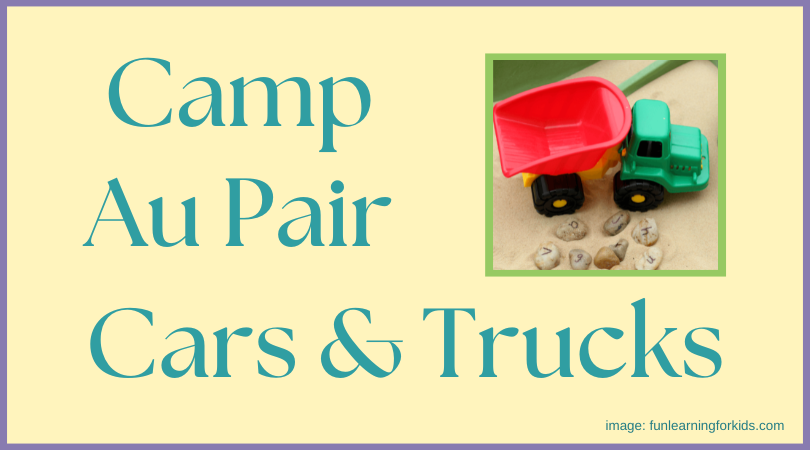
Image: funlearningforkids.com

Camp Au Pair – Under the Sea

Next week’s Camp Au Pair theme is Under the Sea.

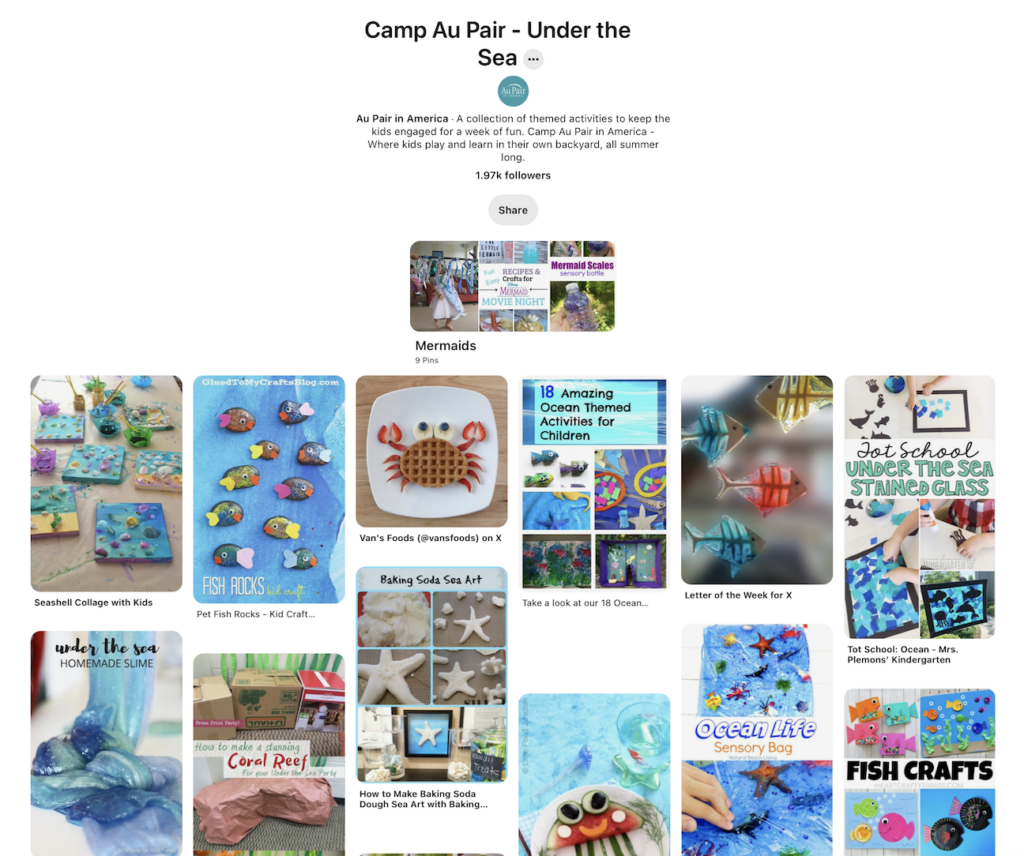
Crafts, recipes, activities, and games related to creatures who live under the sea can all be found here on the Camp Au Pair – Under the Sea pinboard.

Field Trips can be a great way for kids to learn and have new experiences. Get permission from your host parents before any outings. Check the websites before you go to be sure you understand the hours, costs, and whether advance tickets/reservations are required. Search online to see if your area has any of the following:

  • Pet or outdoor store (Bass Pro Shop) with fish tanks
  • Aquarium
  • Zoo
  • Nature Center

National Oceanic & Atmospheric Administration (NOAA) – NOAA has a lot of fun, interactive and educational activities on their website. They focus on whales, sharks, sea turtles, sea lions and more.

  • Virtual Underwater Dive
  • Online Games
  • Puzzle, Activity & Coloring Sheets

Webcams – You can do a google search for aquariums and zoos across the country (and the world) with webcams that allow you to observe sea creatures. Here are a few to get you started.

Videos – Look for fun videos on YouTube about sea creatures. There’s more to see than Baby Shark. Movies like Finding Nemo, Dolphin Tale, and The Little Mermaid also go well with this theme.

Books – Stop by your local library and look for books on sea creatures. The Rainbow Fish is a classic children’s book, your kids may already own. If not, you can find videos like this of it being read aloud.

Movies – There are lots of movies with under the sea themes.

  • A Dolphin Tale 
  • Finding Dory
  • Finding Nemo
  • Little Mermaid
  • Moana
  • Moana 2
  • Shark Tale 
  • Song of the Sea

Television – There are some episodes of children’s television shows that talk about life under the sea.

The Magic School Bus is a television series that follows Ms. Frizzle and her class as they set off on field trips. Most episodes can be found on YouTube. Here are some episodes that fit this week’s theme.

Bill Nye the Science Guy has episodes on FishMarine Animals and more on YouTube.

The Discovery Channel has an annual Shark Week coming up on July 20. Check out 15 JAW-some Activities for Shark Week with lots of fun ideas for kids in grades 5 and up, but a few for younger kids too.

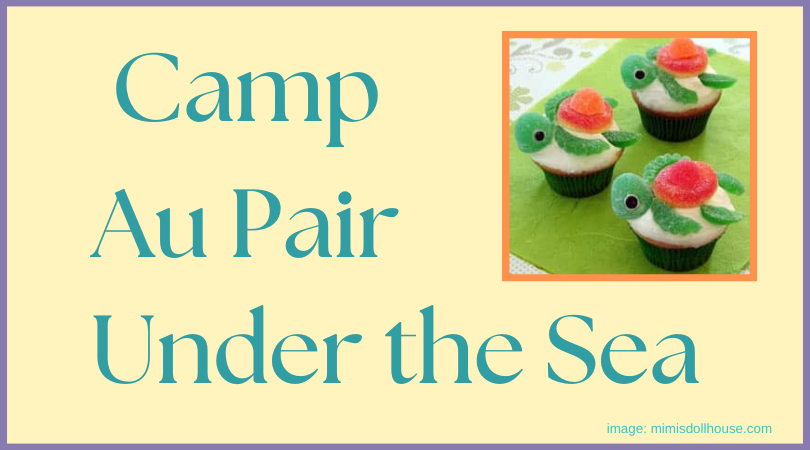
Photo: mimisdollhouse.com

Welcome to Camp Au Pair in America!

When kids are out of school for the summer, it doesn’t take long for them to become bored and sometimes that leads to sibling squabbles and mischief. Even though they don’t realize it, they are usually missing routine and predictability in their daily schedule. One solution is to make fun plans to keep them busy! 

Each week this summer we will share a different Camp Au Pair theme. These weekly themes are designed to give you ideas to keep your host kids occupied and engaged all summer long. They will also be learning. (But shhhh, don’t tell them that part.) Check back each Friday, for the next week’s theme. This gives you a chance to make plans and gather materials for the next week. For each theme there will be crafts, games, snacks and activities. You can just use these ideas or add your own and customize the themes to fit the ages and interests of your host children.

Here are the themes you can look forward to:

  • Under the Sea
  • Outer Space
  • Nature Exploration
  • Dinosaurs
  • Cars and Trucks
  • Bugs & Butterflies
  • Science (STEM)
  • Backyard Safari
  • Art Experiences
  • Explore the World
  • Pirate Adventures

Check out Summer Fun & Summer Holidays pin boards for even more ideas.

If you get some great pictures doing these activities with your host kids, please send those to your community counselor. We love to share your accomplishments and inspire other au pairs!

Let’s make this an amazing summer!

Welcome to Camp Au Pair in America!

When kids are out of school for the summer, it doesn’t take long for them to become bored and sometimes that leads to sibling squabbles and mischief. Even though they don’t realize it, they are usually missing routine and predictability in their daily schedule. One solution is to make fun plans to keep them busy! 

Each week this summer we will share a different Camp Au Pair theme. These weekly themes are designed to give you ideas to keep your host kids occupied and engaged all summer long. They will also be learning. (But shhhh, don’t tell them that part.) Check back each Friday, for the next week’s theme. This gives you a chance to make plans and gather materials for the next week. For each theme there will be crafts, games, snacks and activities. You can just use these ideas or add your own and customize the themes to fit the ages and interests of your host children.

Here are the themes you can look forward to:

  • Nature Exploration
  • Art Experiences
  • Under the Sea
  • Science (STEM)
  • Bugs & Butterflies
  • Cars and Trucks
  • Backyard Safari
  • Dinosaurs
  • Explore the World
  • Outer Space
  • Pirate Adventures
  • Princesses & Knights

Check out Summer Fun & Summer Holidays pin boards for even more ideas.

If you get some great pictures doing these activities with your host kids, please send those to your community counselor. We love to share your accomplishments and inspire other au pairs!

Let’s make this an amazing summer!

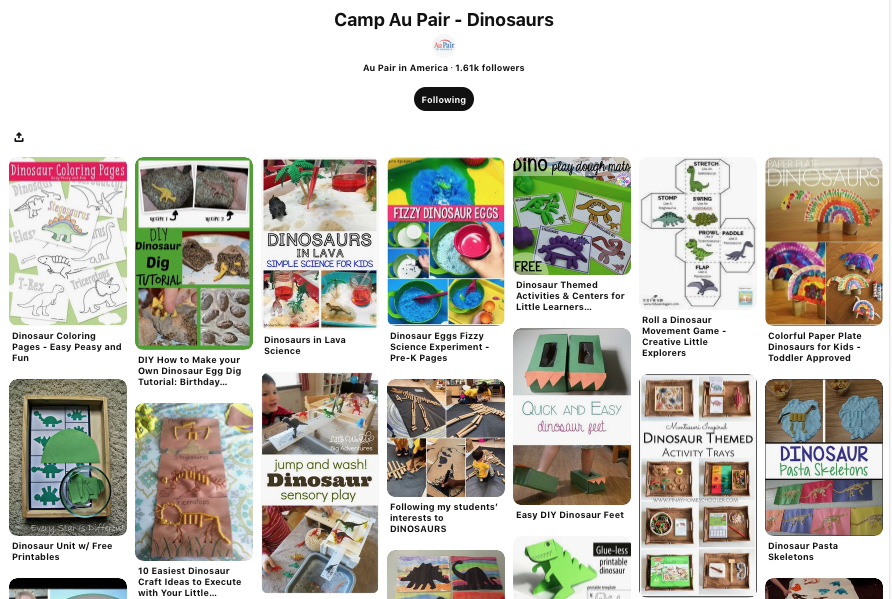
Camp Au Pair – Dinosaurs

Next week’s Camp Au Pair theme is Dinosaurs.

Crafts, recipes, activities, and games related to dinosaurs can all be found here on the Camp Au Pair – Dinosaurs pinboard.

Field Trips can be a great way for kids to learn and have new experiences. Get permission from your host parents before any outings and be sure to take all social distancing precautions.

Field Trip Ideas:

  • Children’s museum
  • Natural history museum
  • Parks with fossil hunting programs
  • Play spaces with dinosaur areas
  • Science centers

Virtual Field Trips:

Toys – Many kids have dinosaur toys already. See what your kids have and think of fun, new ways you can play with these toys with them. Imagine taking a plastic dinosaur and making footprints in play dough to form your own fossils.

Webcam – The Calvert Marine Museum in Maryland offers a webcam where you can watch paleontologists remove rock from around fossils.

Videos – Look for fun videos on YouTube about dinosaurs and fossils. Here are a few to get you started.

Movies – Here are some movies that fit the dinosaur theme.

  • Dinosaur
  • Dinosaur Island
  • Ice Age: Dawn of the Dinosaurs
  • Land Before Time
  • Lego Jurassic World
  • The Good Dinosaur
  • Walking with Dinosaurs
  • We’re Back! A Dinosaur’s Story

For older kids:

  • Journey to the Center of the Earth
  • Jurassic Park (which is rated PG-13)

Books – Check your kids’ bookshelf for books on dinosaurs. You can also find many read aloud book videos on YouTube.

Photo: krojotak.com

Sun Safety Tips for Au Pairs from Macroni Kids

summersafety.jpg


Everyone loves summer, especially children.

But while you’re planning some family fun in the sun, be sure to make safety a top priority. Accidents are the leading cause of death for children ages 1 to 4 in the United States, and the summer months bring with them a unique set of risks.

Keep reading for 5 tips to keep your kids safe this summer.

#1: BE SMART WITH SUN SAFETY FOR KIDS

Sunburn, dehydration and sun or heat stroke are among the hot-weather risks parents need to be aware of when young children are playing outside.

  • Sunburn. Apply sunscreen with an SPF of 15 or above, at least 30 minutes before letting children go outside.
    • Reapply every 2 hours, or after swimming or sweating.
    • The sun’s UV rays can penetrate clouds, so you still need protection on overcast days.
    • Have kids wear protective gear, such as sunglasses with UV protection, a hat and tight-knit cotton clothing.
  • Dehydration. Provide plenty of water when kids are engaged in outdoor activities, and avoid sugary or caffeinated drinks.
  • Sun or heat stroke. Plan outdoor activities for earlier in the morning or later in the afternoon when possible. It’s safest to stay indoors between 10 a.m. and 4 p.m., when the sun’s rays are at their strongest.

Babies are at greater risk from excessive sun exposure. Protect your infant with lightweight clothes with long sleeves and legs, a wide-brimmed hat, and a lightweight blanket. Apply baby sunscreen, and choose a stroller with a large canopy to shield those harmful rays.

#2: COOL OFF WITH WATER SAFETY FOR KIDS

According to the Centers for Disease Control and Prevention, drowning is the leading cause of injury death for children ages 1 to 4 in the U.S., and over half of all drownings occur in the summer.

Adult supervision and other water safety habits are essential, whether you’re planning a trip to the beach, a day at the lake or just an afternoon splash in the neighborhood pool.

  • We really cannot emphasize this enough: there is no substitute for adult supervision. Never let children swim without an adult or lifeguard on duty.
    • Inflatable swimming aids such as “floaties” provide a false sense of security. Keep young children within arm’s reach at all times while in or near water.
    • Never leave children unattended at the pool for any reason — that includes turning your head to answer the phone, read a book or converse with other adults.
    • Likewise, never leave children unattended in a hot tub.
  • Obey all posted rules at public pools or other swimming areas — especially those pertaining to running and horseplay. Keep wheeled toys away from the water’s edge. Observe all diving rules.
  • If you have a pool at home, keep it securely covered when not in use, and protect it with a childproof fence and locking gate. Don’t allow diving from the side of the pool. A hot tub should have a locking lid.
  • Learn CPR and other First Aid so you’re prepared in the event of an accident.
  • Children must wear a properly-fitting life jacket at all times while riding on a boat, and adults must never consume alcohol while operating a boat.

#3: PREVENT INJURIES WITH PLAYGROUND, CAR AND BIKE SAFETY

Summertime brings with it road trips and lots of outdoor adventures. Don’t let all those fun outings end in tragedy or a trip to the hospital.

  • Car safety for kids. Never let kids ride in the cargo areas of pickup trucks or vans. Children under 12 should ride in the back seat, and be properly restrained in an appropriate child safety seat for their height and weight.
  • NEVER leave children in a parked car, even for a few minutes. In Georgia heat, it only takes a few minutes for children to die in a car. “Look before you Lock”— what is in the backseat! 
  • Bike safety. Bicyclists of all ages, including kids, must wear a properly fitting helmet while riding a bike. Make sure your child’s bike is the right size, and teach him or her to obey all traffic rules while riding.
  • Playground safety. As with other summertime activities, kids should always have adult supervision when having fun on the playground.
    • Equipment should be firmly anchored and well-maintained. There should be shock-absorbing material such as rubber, gravel or wood chips, and equipment should be installed at least 6” from fences or sidewalks.
    • Avoid clothing or accessories that could cause strangulation. These include drawstrings, necklaces or loose-fitting garments.

#4: BE CAREFUL WITH POISON IVY

Poison ivy, poison oak and poison sumac all contain urushiol, a rash-causing substance that produces an allergic reaction in 60-80% of all people.

You don’t even have to touch the plant to be affected. Urushiol can be transferred by touching another person or an article of clothing that has been in contact with an offending plant. If can also be inhaled if a poison ivy plant is burned.

You can reduce the risk to you and your kids by:

Learning to identify poison ivy, poison oak and poison sumac leaves

  • Avoiding outdoor areas where you know poison ivy is present
  • Wearing long sleeves and pants in areas where poison ivy may be present
  • Washing skin as quickly as possible if exposure occurs
  • Bathing and washing clothes after time outdoors
  • Bathing pets who may have been exposed

Symptoms of poison ivy exposure include red, itchy, swollen skin and blisters.

  • Call a doctor if your child develops a fever or any type of rash.
  • The rash typically takes 1-2 weeks to heal.
  • Treatment includes cool showers and soothing lotion to calm the skin.
  • If your child has a severe reaction, your doctor may prescribe pills or creams to promote healing.

#5: WATCH FOR TICK BITES

Always check for ticks after you or your kids have been outdoors during the summertime. Removing the tick as quickly as possible reduces the risk of tick-borne illness such as Lyme disease.

  • Don’t use petroleum jelly or a hot match. These don’t work and may cause the tick to burrow even deeper into the skin.
  • Remove the tick using the following steps:
    • Use tweezers to grasp the tick as close to the skin as possible.
    • Pull firmly and steadily until the tick is removed.
    • Don’t twist or rotate the tick.
    • If part of the tick stays in, it will eventually come out on its own.
    • Gently wash the affected area with soap and water.
  • Call your pediatrician. He or she may prescribe antibiotics if your child is at risk of Lyme disease.
  • Pay attention for symptoms of Lyme disease. Early treatment is crucial for long-term recovery.
    • Red ringed rash around the affected area
    • Red or irritated skin
    • Flu-like symptoms
    • Painful or swollen joints
    • Facial paralysis

See full article at

https://alpharetta.macaronikid.com/articles/5b19339ca3600634584d781a/have-fun-in-the-sun-with-these-summer-safety-tips-for-kids

Tips For Driving Safely During Your Au Pair Year

Au Pair Driving Tips. Keep Safe! 
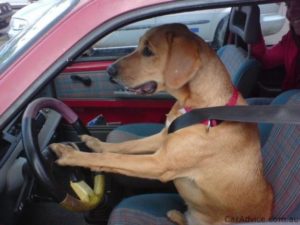
 

You have your Georgia Driver’s License and you are ready to drive!

Here are some important tips to keep you and those who drive with you safe:

The most important thing to remember is, to be honest with your host family. If something happens while you are driving, immediately tell your host family. Most hosts will forgive you, but if they discover that you did not tell them, this can lead to a rematch or you might even have to go home early. 

Your host family may have some restrictions after you receive the Georgia license. Here are some common ones:

  • Your host family should continue to provide support and practice time whenever possible.
  • Learning to drive with confidence is a life skill. Along with the privilege of using your host family’s car comes responsibility. It is your shared responsibility with your host family to make every effort to learn to drive safely while you are an au pair. If you feel that you need additional instruction, you may want to consider paying for some lessons until you feel completely comfortable with your driving ability.
  • Your community counselor can recommend a driving instructor/school and help coordinate lessons or an assessment. Some instructors may offer a discounted price for au pairs.
  • Talk to your host family or community counselor if you have any concerns about driving. NEVER drive if you do not feel safe.
  • NEVER, EVER… not even for a moment leave your host child in the car while you park and go inside a place.

Even after you obtain your Georgia Driver’s license:

Your host family will most likely restrict how far the car can go in the first weeks after obtaining a driving license. It takes time to earn your host family’s trust and to build your own confidence.

To reduce your risk of an accident drive by yourself only in the first month. After that restrict the number of friends in the car to only one other person.

Map out school zones or road work areas in your normal path of driving to avoid a large speeding fine.

Be very familiar with driving laws requiring you to stop for school buses. Review our video on the FB page.

Understand that driving and parking in downtown Atlanta is risky. There are currently large numbers of carjackings and smash-and-grab crimes occurring inside the city. Your host family may determine that driving this far is off-limits for their car.

Driving late at night is dangerous because of drunk drivers on the road. In Georgia, after 3am for every five cars that pass you, three of those five drivers have been drinking alcohol. Host families often have car curfews because of this reason.

New Driver Safety Tips: 

Ask questions about the dashboard indicator lights. These are very important and some of them could indicate an urgent problem that would require you to pull over in a safe place and turn the car off.

BE aware that if you have one beer or one glass of wine or one mixed liquor drink and you drive within one hour—you will test positive for alcohol and can be charged with a DUI (driving under the influence of alcohol). Age 21 is the legal age to drink alcohol in the USA. If you drink alcohol while out, use Lyft or Uber to safely return home.

USA police departments make a lot of money when they find someone drinking and driving. They are LOOKING for any excuse to pull you over and test you. If you are arrested for driving while drinking, you or your family back home will need to get you out of jail. APIA will NOT get you out of jail. This is about $7000.00 and then you will need to go home.

If you damage someone else’s car, and no one is hurt, you still must call the police.  You must stop, move the car, and exchange names and insurance info. Take pictures of the car and the damage you made and any damage other than yours on their car. If you have hit a parked car with no driver, take pictures and leave your name and the host family’s phone number. Failing to do these things, and not stopping is considered ” leaving the scene of an accident”. The penalty for this can be as much as five years in jail and several thousand dollars in fines.

Driving in the rain or on wet streets increases your likelihood of having an accident. Sometimes it is best to stay home if you know bad weather is on the way.

Make a system for checking behind the car before backing up. Use the rearview mirrors and backup camera, but also look behind the car before getting in. When in a driveway, look for children, dogs, shrubs, or toys. Most Au pair accidents involve backing up.

When entering a busy street or highway from a parking lot, look for the nearest exit with a traffic light and go there to enter the street. Trying to cross a busy street with no signal is dangerous.

At intersections, look twice before pulling out.

If someone is yelling or honking at you to enter a busy street or intersection, ignore them and wait until you are confident. Accidents happen when you are pressured to move when you are not ready.

Parking a big American car in a small American space is difficult. Practice parking in small spaces outside your host family home with trash cans. Your host family will respect your efforts to be responsible.

Do not hold/talk with your cell phone while driving. This is a law in Georgia. Do not listen to earphones to hear music from your cell phone.

Traffic along busy shopping malls requires special caution. Go slower and do not try to change lanes. Avoid these areas at holiday times.

Let it pass by if you realize you are about to miss your turn. You can safely turn around and go back, but trying to make a last-minute maneuver will cause an accident.

Never turn your head to speak to another person in the car. Children will cry and misbehave, but you must keep your eyes on the road ahead.

If your car runs off the road, don’t panic. Turning the steering wheel sharply to get back on the road will cause the car to turn over or cross into the oncoming traffic. Instead, slow down and travel off the road until you can safely and slowly return back to the road.

While traveling in a neighborhood, use caution and go very slowly. Dogs and children can quickly dart in front of you.

Never let the gas get lower than half a tank. Running out of gas can put you and your host family’s children in danger. Use your own money and give the receipt to the host family.

Many intersections now have automatic cameras that take pictures of everyone going through the light. If you enter the intersection on a yellow light, and it turns red while you are beneath it, you will be ticketed. Never slam on the brakes when approaching the yellow light. Slow down and use caution to stop appropriately.

Be mindful of school zones. The fine for speeding here is very high.

Be mindful of school buses. When you see the yellow flashing light, prepare to stop.

When you see that a police car is pulled over on the side of the road. Merge into the other lane or slow down to make sure the police officer is safe. This is called the “Move Over Law”.

Your host family can require you to pay 500.00 towards any damage that is caused to their car while you are driving. Be a responsible driver and study the situations that you are not sure about. Ask questions to clear up any confusion and always use caution.

For your information: Chapter (or section 5 and 7) have detailed information about the laws and road signs.

https://online.flipbuilder.com/hatf/oknz/
10 tips for getting your host child to listen to you!!

My Host child is driving me Crazy! He won’t listen to me and doesn’t do what I ask him to do. 

Have you ever said this sentence? Chances are that if you are caring for a host child, you have!! Caring for children can be difficult and challenging for most adults. If we add the cultural difference and language barrier to this situation- wow! Getting your host child to listen can seem overwhelming at times.

First Cry Parenting has a great video to teach you 10 tips that will greatly improve your ability to get your host children to do what you ask. This will make your role as an Au pair easier and help you to feel less stressed.  Let your host parents know that you watched the video and then ask your host family for tips on how they manage the kids.


Make Plans for Summer Fun with the Kids!

When the kids are out of school on summer break there are soooo many possibilities. But, if you don’t make plans, you will often end up in the house with bored kids getting into trouble and arguing with their siblings.  Make plans!

Having lots of ideas ready can minimize those problems.

Looking for fun activity ideas to get the summer started off right with your host kids?

The Au Pair in America Summer Fun Pinboard is a great place to start. Together, create a Summer Bucket List. Talk with the kids about things they would like to see and do. Even toddlers and preschoolers can contribute to the conversation. Run these plans by your host parents and clear things like how much you may spend and when is best to do some of these activities.

Check back here next week for information on Camp Au Pair in America: a weekly blog series with themes for a summer break filled with fun and new adventures.

Photo: MissMessie (Flickr)

Making Thanksgiving Memories Together

Thanksgiving is a public holiday celebrated on the fourth Thursday in November every year in the United States. It started as a harvest festival and has been celebrated nationally since 1789.  The most important part of Thanksgiving for American families is to spend time together with the special people in their lives. A part of the tradition is to focus as a family and individual on the gifts in our lives and relationships. What are you THANKFUL for?

Martin Cathrae

 “My favorite holiday was Thanksgiving. Firstly, it was my first holiday with the whole family in America. Secondly, the whole family came together. All aunts and uncles and their kids came to grandma’s. We played football with all of them, including grandma and grandpa. It was the first time I played it and it was so much fun for all. We had a great dinner with all the typical things you can imagine … it was deeeelicious! It was so great to be with such a big family and I really enjoyed that day. I will remember it my whole life, I hope.” – Swantje from Germany

Here are a few tips to help you have a terrific Thanksgiving experience.

Host Parents
Please plan to include your au pair in your Thanksgiving celebration, if at all possible. If you are traveling or will not be able to invite your au pair to join you for Thanksgiving, give her plenty of notice and help her make alternate plans. You don’t want to leave your au pair alone over the holiday.

Au Pairs
If you are invited to attend dinner, please let your family know within 5 days of the invitation, whether you are planning to attend, so they may make plans. If your host family is unable to include you in their Thanksgiving plans, please let me know if you have trouble making other plans, so I can assist.

Make sure to discuss time off during this holiday weekend. Many host families work the Friday after Thanksgiving so do not assume you have this day off or the entire weekend. Talk to your host family, BEFORE you make any plans.

Thanksgiving is a very special time to gather with friends and family. It is also very hectic for your host family who has to prepare food or travel with children. This is a great time to ACT like a part of the family. If you see a way to be helpful- do it! Your participation in this stressful time will be appreciated.

Bonus Tip for the Kids
If you are looking for a fun recipe to make with your au pair, check out these turkey cookies. Find more fun activities and recipes on the Au Pair in America Fall Holidays pinboard.