Monthly Archives: January 2018

Happy Groundhog Day!

This Friday, February 2nd, is Groundhog Day  … but what is this strange custom?

The Delaware Indians of Pennsylvania considered groundhogs, which have long been plentiful in the Pennsylvania area, to be honorable ancestors.  In the Delawares’ legend of human creation, their ancestral forefathers began life as animals within the earth, and emerged during their evolution into human form.  The groundhog is also known as the Woodchuck, or the marmota monax, is a member of the squirrel family, and naturally feeds upon green plants, such as dandelion, clover, and grass.

Settlers of German ancestry arrived in the same Pennsylvania area in the 18th century, bringing with them the tradition of “Candlemas Day,” which falls halfway between the Winter Solstice and the Spring Equinox.  Custom held that if the sun came out on that day, which fell on February 2, six weeks of cold wintery weather would follow.

Over time, it became the custom of the Pennsylvania Germans to watch a badger on this day to see if the sun was bright enough to cast a shadow in front of him.  Mixing with the local native American’s reverence of the groundhog, by 1886, a groundhog was selected and dubbed Punxsutawney Phil.

Today, residents of Gobbler’s Knob, Pennsylvania keep the tradition alive by caring for the groundhog whose full name is “Punxsutawney Phil, Seer of Seers, Sage of Sages, Prognosticator of Prognosticators, and Weather Prophet Extraordinary.”  His handlers, John Griffiths and Ben Hughes, state that “Phil weighs 15 pounds and thrives on dog food and ice cream in his climate-controlled home at the Punxsutawney Library.  Up on Gobbler’s Knob, Phil is placed in a heated burrow underneath a simulated tree stump on stage before being pulled out at 7:25 a.m. to make his prediction.”

Each year, the Punxsutawney Groundhog Club hosts a three-day celebration of entertainment and activities celebrating Punxsutawney Phil. The recording of Phil’s predictions has been kept consistently since 1900, and according to Stormfax.com, his predictions are correct 39% of the time.

 

Staying Healthy Amid a Flu Outbreak

Staying Healthy Amid a Flu Outbreak


The Flu is an illness that usually includes sore, achy muscles; fatigue; sometimes a fever and a general malaise; and can keep you in bed for up to two weeks.  This season, the news contains daily stories of this year’s flu epidemic, which is one of the deadliest strains in years.  Read on to find out how you can remain healthy.


According to the Centers for Disease Control and Prevention (a well-established and highly esteemed U.S. government agency), “Influenza (flu) is a contagious respiratory illness caused by influenza viruses. It can cause mild to severe illness. Serious outcomes of flu infection can result in hospitalization or death.”*2

The flu affects the nose and mouth and possibly the lungs.  The CDC states that symptoms include many (but not necessarily all of) the following: cough, sore throat, runny or stuffy nose, muscle or body aches, headaches, fatigue, sometime a fever or fever and chills, and sometimes vomiting or diarrhea.  It is spread by direct contact, such as touching something upon which an infected person has coughed or sneezed.  The symptoms usually come on 1 to 4 days after the exposure, and begin suddenly.

So, how do you avoid getting sick?  Doctor Adrian Cotton states in a National Public Radio interview*1: “the No. 1 thing people can do is wash their hands, wash their hands and wash their hands. Stay away from people that have active flu-like symptoms, which is fevers, chills, heavy cough. But washing hands is probably the biggest thing that can be done. And then No. 2 is get the influenza vaccine. And then the third thing we’re telling people is if you think you have the flu, please don’t go to the emergency room. Please find – call your primary care doctor and go see them first. And, you know, save the emergency room for if you’re really, really sick.”

Remember that the disease is contagious before you begin to feel its symptoms, so it’s especially important to wash your hands and the hands of the children in your care frequently.  Toys, pacifiers, or anything a child puts in his or her mouth should be washed before and after use.  Water with soap will remove the germs.  Water with a few drops of bleach will kill the germs, as will anti-bacterial gel.  It’s a good idea to carry hand wipes or antibacterial gel with you when you go out, and avoid direct contact with countertops and door handles when possible by using a clean paper towel in between the surface and your hand, or simply not touching what you don’t really need to.  If you do touch a common surface, such as a door handle, be sure not to touch your eyes, nose, mouth or food until you’ve washed your hands thoroughly.


Other great articles about the flu epidemic:

“Planes and the flu: 6 things to know to help you stay healthy while flying” By ABC News, Jan 18, 2018, 7:41 AM ET, http://abcnews.go.com/Health/planes-flu-things-stay-healthy-flying/story?id=52418032

“TIPS: How to Stay Healthy this Flu Season” ABC Channel 15 Arizona, by Cameron Polom, Jan 12, 2018, 6:23 PM,  https://www.abc15.com/news/state/tips-how-to-stay-healthy-this-flu-season


Citations:

*1  Kelly McEvers, NPR Southern California Public Radio, transcribed by Verb8tm, Inc., Heard on All Things Considered, January 16, 20184:34 PM ET, “As Flu Season Strains Hospitals, Doctor Offers Advice For How To Stay Healthy”  https://www.npr.org/2018/01/16/578422409/as-flu-season-strains-hospitals-doctor-offers-advice-for-how-to-stay-healthy


*2 Centers for Disease Control and Prevention, National Center for Immunization and Respiratory Diseases (NCIRD), October 5, 2017, maintained by: Office of the Associate Director for Communication, Digital Media Branch, Division of Public Affairs, “About Flu” https://www.cdc.gov/flu/about/index.html


Focus on Play: New Ideas for Some Classic Toys

It is good to offer kids a balance of independent play time and play where you are actively engaging with them. You can make toys they may be bored with, feel new and exciting, by suggesting different ways to play with them. Try some of the ideas below as a starting point.

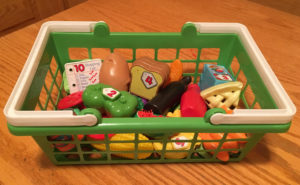
Play Food/Dishes

  • Teach your host children how to say the names of some of the food and dishes in your language.
  • Using English and/or your language play games where you are ordering food like in a restaurant. Take turns with who will be the waiter and who is the customer.
  • Come up with silly food combinations.  For example: Who wants pickles on their slice of cake?
  • Play a guessing game where the children have to figure out what food you are talking about.  For example: I grow under the ground in the dirt.  People eat me fried, mashed and baked.  What am I? (a potato)
  • Play a game with setting the table using your language to ask for the different items (plate, spoon, etc.)
  • Ask the children to divide the foods up into the different food groups (vegetables, meat, dairy, etc.)

Lego Blocks and Other Building Toys

  • Divide up all of the blocks between the people playing, by taking turns for each person to select block by block.
  • Suggest specific things to build (robots, houses, mountains etc.) and build together.
  • Challenge everyone to use all of their blocks.
  • Sort the blocks by color or shape and make patterns with them (red, blue, red, blue or square, triangle, rectangle.)  You can create a pattern and ask the child to fill in what comes next to continue the pattern.
  • Make the tallest block tower you can and let them knock it down (over and over again, if like most kids, they like destroying things.)

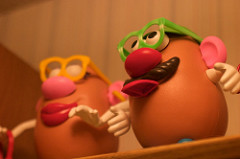
Mr. Potato Head

  • Teach your host children the names of the different parts in your language and play a game asking them to put on the body parts by name.
  • Play Hide and Seek with Mr. Potato Head. Have the children cover their eyes and count, while you hide Mr. Potato Head, then they go looking for him. Switch things up by letting them hide Mr. Potato Head and then you are the one to locate him.
  • Play the same game above, but using Simon Says.  Simon Says is a game where the leader gives commands by saying “Simon says” first. For example, “Simon says, put on the nose.”  The players are only to follow the commands when the leader says “Simon says.”  If the leader doesn’t say “Simon says” first and just says, “put on the nose,”  and the player follows the command, they are out of the game.  Repeat the game multiple times, so all kids get a turn to be the leader at least once.

Photos:  Lisa Maxwell (top) & Tom Smalls (bottom)