Yearly Archives: 2018

10 Tips for Summer Safety

  1. Remember to bring along drinks, especially water. Try to get children to drink water every 20 minutes, when they are outside in hot weather.
  2. Pay attention to surfaces that can be hot against children’s skin, such as metal slides and other playground equipment in the sun.
  3. Safety around water is particularly important. A child can drown in just a few inches of water. Whenever you are near water you must never leave a child alone – if the phone rings, take them with you or let it ring! Always stay within arm’s reach when the children are in or near water.
  4. Young babies should be kept out of direct sunlight. Keep the baby in the shade or under a tree, umbrella or stroller canopy.
  5. Dress babies in lightweight clothing and use brimmed hats.
  6. Apply sunscreen 30 minutes before going outside, even if it appears overcast (cloudy).
  7. Try to keep children out of the sun in the middle of the day when the sun is strongest.
  8. Learn what poison ivy looks like and keep children out of it. A good rule to teach the children is “leaves of three, let it be.”
  9. Use insect repellent spray to keep away mosquitos and ticks. Ask your host parents before applying.
  10. Check for ticks when you bring children in from playing outside, especially if you’ve been in tall grass or the woods.

Photo: Scott97006 (Flickr)

SaveSave

May is National Water Safety Month


With summer right around the corner, now is a good time to remind yourself of important water safety guidelines.  It is important for all adults in the children’s lives to be on the same page about swimming pool rules, and an even better idea to use a Water Watcher Card for each child you take to the beach or pool.

According to Stop Drowning Now, a national water-safety organization, a Water Watcher Card is an important lifesaving tool.  “The Water Watcher Card is to be worn by a responsible adult whose only job is to actively supervise the children in the water for a specific amount of time ([such as] 15-minute shifts).  Water watcher tags are critical during parties or large gatherings. In 94% of the instances when a child drowns, adults thought another adult was watching the child. Water watcher tags are helpful in taking the guesswork out of “who is watching the children.“*[ http://www.stopdrowningnow.org]

A Water Watcher Card is a laminated reminder card attached to an elastic bracelet or lanyard.

Several different versions are available as free downloads:

or you can order them already made:

Brush up on important swimming safety tips:

“8 Life-Saving Water Safety Rules Every Parent Needs to Know” (Parents Magazine)

“Water Safety” (Kids Health)

“The Ultimate Guide to Swimming Safety For Kids” (Mom Loves Best)

“13 Water Safety Tips Every Parent Should Know” (via Buzzfeed)

Water Safety: Tips for Parents of Young Children” “Healthy Children.org)

Daylight Saving Time Begins March 11

What is Daylight Saving Time?

During Daylight Saving Time, clocks are turned forward one hour, effectively moving an hour of daylight from the morning to the evening. Today, approximately 70 countries worldwide utilize Daylight Saving Time, in at least some portion of the country. The U.S. started observing it in 1918, so it celebrates it’s 100th birthday, this year.

In March, we move the clock forward one hour, losing an hour of sleep. In November, we move the clock back one hour, regaining that extra hour of sleep.

An easy way to remember it is: Spring forward, Fall back.

Before you go to bed on March 10, be sure to set the clocks forward one hour!

Photo: Mark Lee

Things to do

I love my son, but sometimes he drives me totally nuts!  This past long weekend is a perfect example.  All he wanted to do, it seemed, was lay on the sofa in his pajamas and watch TV.  I couldn’t even get him to play legos with me, a pastime we often enjoy together.

Finally, as I was cleaning up, I spied a board game that we had recently purchased but hadn’t played yet.  I waited until his TV show was ending and suggested we play the game.  Surprisingly, he jumped at the chance!

While we were playing it occurred to me that I hadn’t been reading the Mom Websites much lately.  Then I realized that I had been waiting for my son to come up with ideas on what to do, rather than telling him what our plans are.  He’s not a very creative kid, so asking him to come up with ideas on his own doesn’t usually work.  I discovered long ago that I have to give him options to choose from.

Had I planned ahead, this lazy weekend could have been avoided.  We could have been out in the community having fun and learning new things.  But I forgot to plan something.

If any of this sounds familiar to you, you might appreciate the attached listing of Things To Do Locally.  The first section is how to find things to do in the area with children, and the rest will help you find out more about what is going on in your community so you can explore on your own.

things to do locally

A little bit of planning ahead, and offering two or three options to the kids to have input on can make a huge difference!  And to be clear, the options offered should never be: “Do you want to go to this event with me?,” but rather: “When we go out this afternoon, do you want to go to Event A or Event B?”

So, when you have time, explore the Mom Websites listed and sign up for some newsletters.  The site will email you when something cool is happening in your area.


Happy Groundhog Day!

This Friday, February 2nd, is Groundhog Day  … but what is this strange custom?

The Delaware Indians of Pennsylvania considered groundhogs, which have long been plentiful in the Pennsylvania area, to be honorable ancestors.  In the Delawares’ legend of human creation, their ancestral forefathers began life as animals within the earth, and emerged during their evolution into human form.  The groundhog is also known as the Woodchuck, or the marmota monax, is a member of the squirrel family, and naturally feeds upon green plants, such as dandelion, clover, and grass.

Settlers of German ancestry arrived in the same Pennsylvania area in the 18th century, bringing with them the tradition of “Candlemas Day,” which falls halfway between the Winter Solstice and the Spring Equinox.  Custom held that if the sun came out on that day, which fell on February 2, six weeks of cold wintery weather would follow.

Over time, it became the custom of the Pennsylvania Germans to watch a badger on this day to see if the sun was bright enough to cast a shadow in front of him.  Mixing with the local native American’s reverence of the groundhog, by 1886, a groundhog was selected and dubbed Punxsutawney Phil.

Today, residents of Gobbler’s Knob, Pennsylvania keep the tradition alive by caring for the groundhog whose full name is “Punxsutawney Phil, Seer of Seers, Sage of Sages, Prognosticator of Prognosticators, and Weather Prophet Extraordinary.”  His handlers, John Griffiths and Ben Hughes, state that “Phil weighs 15 pounds and thrives on dog food and ice cream in his climate-controlled home at the Punxsutawney Library.  Up on Gobbler’s Knob, Phil is placed in a heated burrow underneath a simulated tree stump on stage before being pulled out at 7:25 a.m. to make his prediction.”

Each year, the Punxsutawney Groundhog Club hosts a three-day celebration of entertainment and activities celebrating Punxsutawney Phil. The recording of Phil’s predictions has been kept consistently since 1900, and according to Stormfax.com, his predictions are correct 39% of the time.


Staying Healthy Amid a Flu Outbreak

Staying Healthy Amid a Flu Outbreak


The Flu is an illness that usually includes sore, achy muscles; fatigue; sometimes a fever and a general malaise; and can keep you in bed for up to two weeks.  This season, the news contains daily stories of this year’s flu epidemic, which is one of the deadliest strains in years.  Read on to find out how you can remain healthy.


According to the Centers for Disease Control and Prevention (a well-established and highly esteemed U.S. government agency), “Influenza (flu) is a contagious respiratory illness caused by influenza viruses. It can cause mild to severe illness. Serious outcomes of flu infection can result in hospitalization or death.”*2

The flu affects the nose and mouth and possibly the lungs.  The CDC states that symptoms include many (but not necessarily all of) the following: cough, sore throat, runny or stuffy nose, muscle or body aches, headaches, fatigue, sometime a fever or fever and chills, and sometimes vomiting or diarrhea.  It is spread by direct contact, such as touching something upon which an infected person has coughed or sneezed.  The symptoms usually come on 1 to 4 days after the exposure, and begin suddenly.

So, how do you avoid getting sick?  Doctor Adrian Cotton states in a National Public Radio interview*1: “the No. 1 thing people can do is wash their hands, wash their hands and wash their hands. Stay away from people that have active flu-like symptoms, which is fevers, chills, heavy cough. But washing hands is probably the biggest thing that can be done. And then No. 2 is get the influenza vaccine. And then the third thing we’re telling people is if you think you have the flu, please don’t go to the emergency room. Please find – call your primary care doctor and go see them first. And, you know, save the emergency room for if you’re really, really sick.”

Remember that the disease is contagious before you begin to feel its symptoms, so it’s especially important to wash your hands and the hands of the children in your care frequently.  Toys, pacifiers, or anything a child puts in his or her mouth should be washed before and after use.  Water with soap will remove the germs.  Water with a few drops of bleach will kill the germs, as will anti-bacterial gel.  It’s a good idea to carry hand wipes or antibacterial gel with you when you go out, and avoid direct contact with countertops and door handles when possible by using a clean paper towel in between the surface and your hand, or simply not touching what you don’t really need to.  If you do touch a common surface, such as a door handle, be sure not to touch your eyes, nose, mouth or food until you’ve washed your hands thoroughly.


Other great articles about the flu epidemic:

“Planes and the flu: 6 things to know to help you stay healthy while flying” By ABC News, Jan 18, 2018, 7:41 AM ET, http://abcnews.go.com/Health/planes-flu-things-stay-healthy-flying/story?id=52418032

“TIPS: How to Stay Healthy this Flu Season” ABC Channel 15 Arizona, by Cameron Polom, Jan 12, 2018, 6:23 PM,  https://www.abc15.com/news/state/tips-how-to-stay-healthy-this-flu-season


Citations:

*1  Kelly McEvers, NPR Southern California Public Radio, transcribed by Verb8tm, Inc.Heard on All Things Considered, January 16, 20184:34 PM ET, “As Flu Season Strains Hospitals, Doctor Offers Advice For How To Stay Healthy”  https://www.npr.org/2018/01/16/578422409/as-flu-season-strains-hospitals-doctor-offers-advice-for-how-to-stay-healthy


*2 Centers for Disease Control and PreventionNational Center for Immunization and Respiratory Diseases (NCIRD), October 5, 2017, maintained by: Office of the Associate Director for Communication, Digital Media Branch, Division of Public Affairs, “About Flu” https://www.cdc.gov/flu/about/index.html

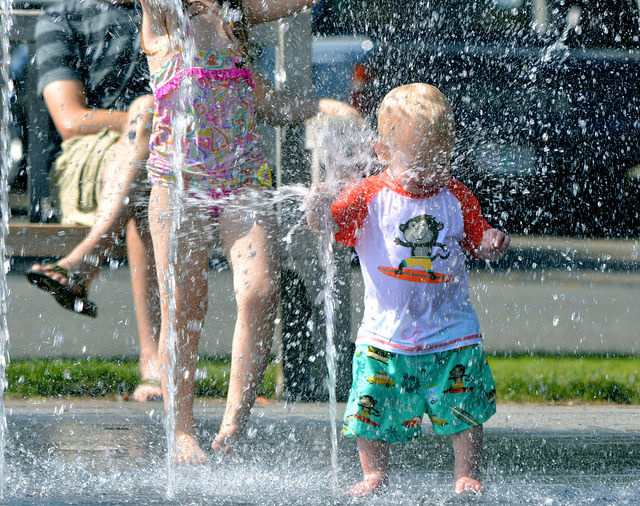


Focus on Play: New Ideas for Some Classic Toys

It is good to offer kids a balance of independent play time and play where you are actively engaging with them. You can make toys they may be bored with, feel new and exciting, by suggesting different ways to play with them. Try some of the ideas below as a starting point.

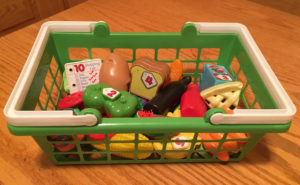
Play Food/Dishes

  • Teach your host children how to say the names of some of the food and dishes in your language.
  • Using English and/or your language play games where you are ordering food like in a restaurant. Take turns with who will be the waiter and who is the customer.
  • Come up with silly food combinations.  For example: Who wants pickles on their slice of cake?
  • Play a guessing game where the children have to figure out what food you are talking about.  For example: I grow under the ground in the dirt.  People eat me fried, mashed and baked.  What am I? (a potato)
  • Play a game with setting the table using your language to ask for the different items (plate, spoon, etc.)
  • Ask the children to divide the foods up into the different food groups (vegetables, meat, dairy, etc.)

Lego Blocks and Other Building Toys

  • Divide up all of the blocks between the people playing, by taking turns for each person to select block by block.
  • Suggest specific things to build (robots, houses, mountains etc.) and build together.
  • Challenge everyone to use all of their blocks.
  • Sort the blocks by color or shape and make patterns with them (red, blue, red, blue or square, triangle, rectangle.)  You can create a pattern and ask the child to fill in what comes next to continue the pattern.
  • Make the tallest block tower you can and let them knock it down (over and over again, if like most kids, they like destroying things.)

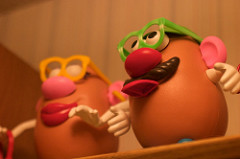
Mr. Potato Head

  • Teach your host children the names of the different parts in your language and play a game asking them to put on the body parts by name.
  • Play Hide and Seek with Mr. Potato Head. Have the children cover their eyes and count, while you hide Mr. Potato Head, then they go looking for him. Switch things up by letting them hide Mr. Potato Head and then you are the one to locate him.
  • Play the same game above, but using Simon Says.  Simon Says is a game where the leader gives commands by saying “Simon says” first. For example, “Simon says, put on the nose.”  The players are only to follow the commands when the leader says “Simon says.”  If the leader doesn’t say “Simon says” first and just says, “put on the nose,”  and the player follows the command, they are out of the game.  Repeat the game multiple times, so all kids get a turn to be the leader at least once.

Photos:  Lisa Maxwell (top) & Tom Smalls (bottom)