Tag Archives: scam

Scam Alert: Fake Texts

You may receive texts, emails and phone calls from scammers posing as government agencies putting pressure on you to take action by sending them money. It is NOT NORMAL for government agencies to contact you by text for the purpose of collecting money you owe. Never click a link and take action on one of these messages without first showing the message to your host parents. 99.9% of the time when you get something like this it is a scam.

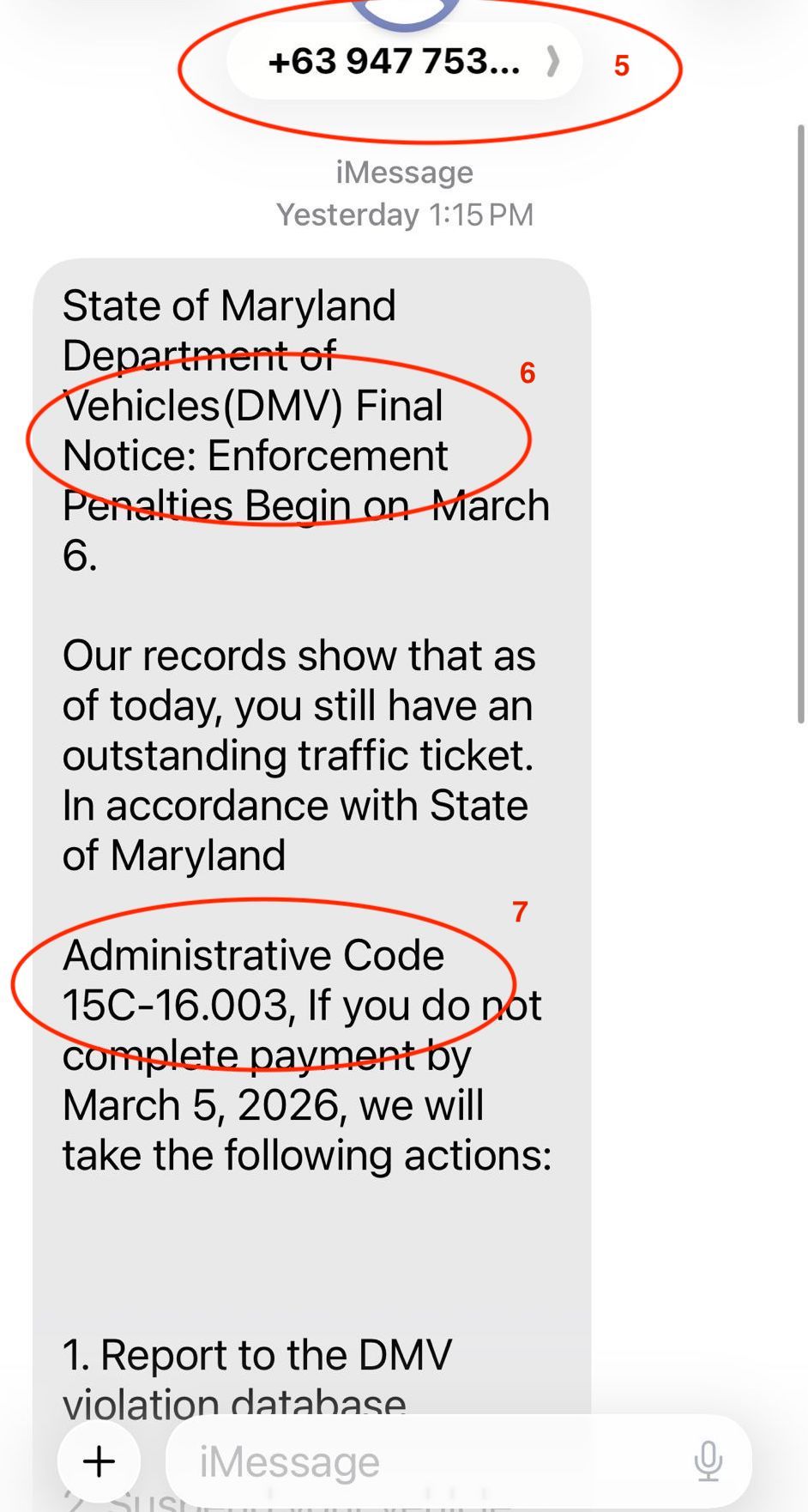
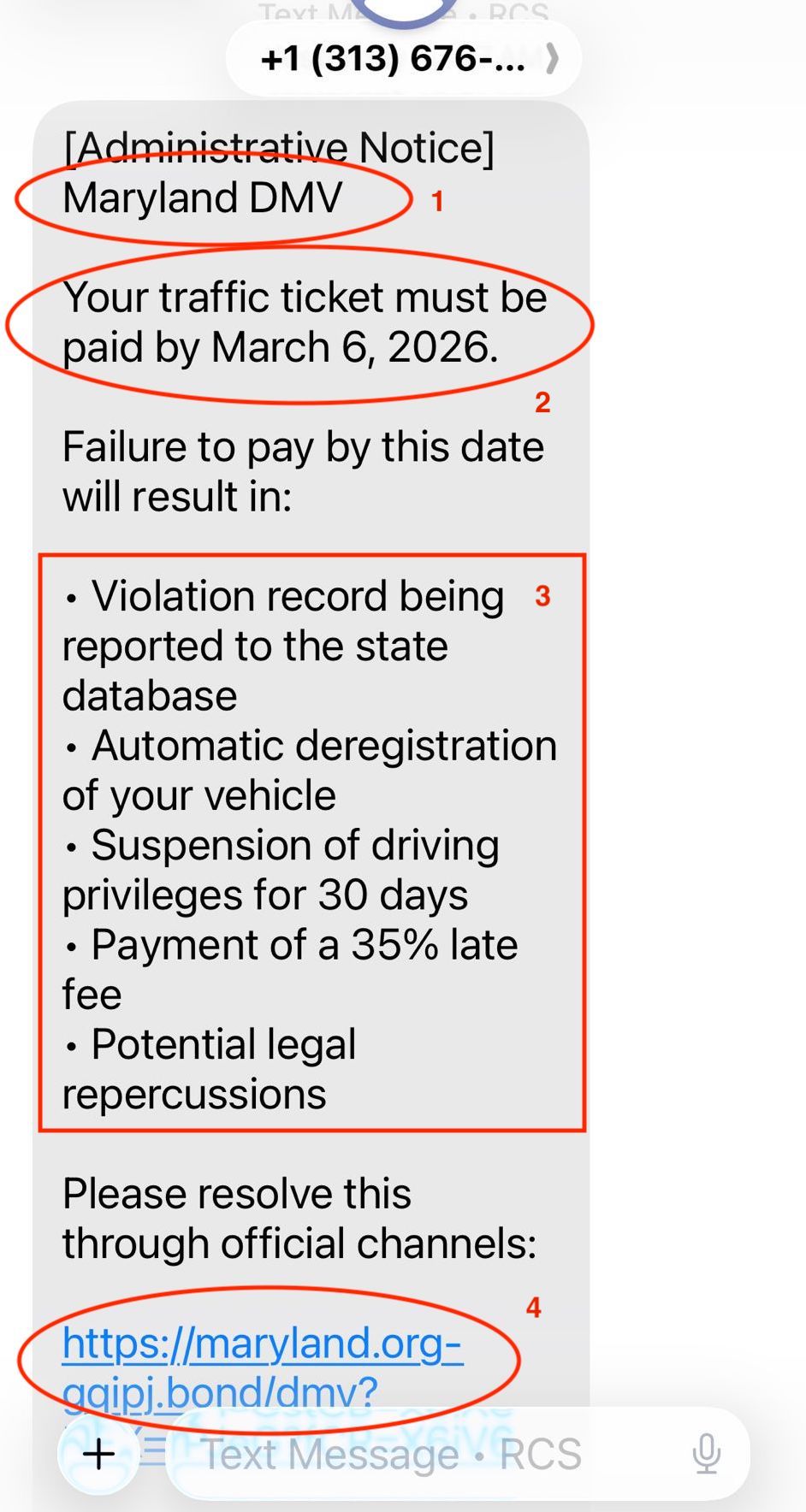
Below are two screenshots of some texts I received recently. I have highlighted some of the red flags that help you realize it’s a scam. If you do have a pending traffic ticket or charge from a video toll you may be nervous receiving this, but it is just a coincidence.

If you click a scam link, in addition to losing your money, you may be compromising the security of your banking information, and personal data on your device. 
Red Flags in these Text Messages

  1. Maryland has a Motor Vehicle Administration (MVA) not a Deptartment of Motor Vehicles (DMV).
  2. Sense of urgency: Telling you that you must act immediately.
  3. Scare tactics: Listing serious consequences to make you afraid.
  4. Fake Link: Most government websites will end in .gov. The actual Maryland MVA website is https://mva.maryland.gov/. You can always look at trusted sources (like our driver’s license resource page) to see if the website matches the official website.
  5. A foreign phone number: A U.S. government agency will not be sending text messages from a phone number that is outside of the U.S. One of these messages has a U.S. phone number, so this is a good example of how the same scam can have different variations, so it’s good to know different red flags to look out for.
  6. Final notice: If you had an actual ticket, you would receive the citation in the mail and if you didn’t pay that, you would receive multiple late notices by mail. You would not be hearing about this for the first time in a text message that is labeled as final notice.
  7. This is a fake code they added to make this look more official. Even if it was the actual code, anyone can reference that, so don’t be fooled. In this case, I looked up this code and it has to do with the care of and riding of a horse!

If you are ever in doubt, ask your host family or community counselor.
 

Avoid Falling Victim to Scammers

There are always people out there who are looking for ways to trick people out of their money and personal information. Below I will explain some scams and how to protect yourself.


SCAM #1 – Calls asking for your PIN, password, personal information, or payment.

  • Your bank will not call you and ask you for your PIN number or password.
  • IRS and Social Security Administration will not ask you for payment or personal info over the phone. Government agencies usually handle issues like this by sending a letter.
  • The number shown on the caller ID can be manipulated, don’t take that as a sign that a call is legitimate.

What to do? Whenever you are in doubt, hang up and call the bank (or company) directly using a number you already have for them.

SCAM #2 – Email asking you to click a link to verify your personal information or share your password or PIN.

  • Be very suspicious of emails asking you to click links.
  • Scammers are very good at creating official-looking emails and web pages.

What to do? Whenever you are in doubt, go directly to the website (not using the link in the email).

SCAM #3 – You see an offer online telling you to send them some money and they will double it or a pop-up ad says that you have won a great prize and just need to give them your information.

  • When something sounds too good to be true, it usually is.

What to do? Do not give your personal information or any money to people you don’t know.

SCAM #4– You receive a call and you are told to stay on the phone while you go transfer or withdraw money from the bank and if you don’t you will be arrested or your bank account seized.

  • They are using the idea that this is an urgent situation to make you act quickly without thinking to avoid the consequence they have told you.

What to do? Do not follow their instructions.

Whenever you are in doubt, do not do as the caller or email asks. Check with your host parents or community counselor.

One last note on protecting your personal information…

It is very important to keep your social security number private. 

There are very few situations where you will need to share this (bank, IRS, department of motor vehicles). Those are times you are taking an action and need to provide it. At other times, leave your Social Security card safe at home. There is not a legitimate time when someone would be calling you on the phone or emailing you asking for that number.

Image: Canva.com

Avoid Falling Victim to Scammers

There are always people out there who are looking for ways to trick people out of their money and personal information. Below I will explain some scams and how to protect yourself.


SCAM #1 – Calls asking for your PIN, password, personal information, or payment.

  • Your bank will not call you and ask you for your PIN number or password.
  • IRS and Social Security Administration will not ask you for payment or personal info over the phone. Government agencies usually handle issues like this by sending a letter.
  • The number shown on the caller ID can be manipulated, don’t take that as a sign that a call is legitimate.

What to do? Whenever you are in doubt, hang up and call the bank (or company) directly using a number you already have for them.

SCAM #2 – Email asking you to click a link to verify your personal information or share your password or PIN.

  • Be very suspicious of emails asking you to click links.
  • Scammers are very good at creating official-looking emails and web pages.

What to do? Whenever you are in doubt, go directly to the website (not using the link in the email).

SCAM #3 – You see an offer online telling you to send them some money and they will double it or a pop-up ad says that you have won a great prize and just need to give them your information.

  • When something sounds too good to be true, it usually is.

What to do? Do not give your personal information or any money to people you don’t know.

SCAM #4– You receive a call and you are told to stay on the phone while you go transfer or withdraw money from the bank and if you don’t you will be arrested or your bank account seized.

  • They are using the idea that this is an urgent situation to make you act quickly without thinking to avoid the consequence they have told you.

What to do? Do not follow their instructions.

Whenever you are in doubt, do not do as the caller or email asks. Check with your host parents or community counselor.

One last note on protecting your personal information…

It is very important to keep your social security number private. 

There are very few situations where you will need to share this (bank, IRS, department of motor vehicles). Those are times you are taking an action and need to provide it. At other times, leave your Social Security card safe at home. There is not a legitimate time when someone would be calling you on the phone or emailing you asking for that number.

Image: Canva.com

Avoid Falling Victim to Scammers

There are always people out there who are looking for ways to trick people out of their money and personal information. Below I will explain some scams and how to protect yourself.


SCAM #1 – Calls asking for your PIN, password, personal information or payment.

  • Your bank will not call you and ask you for your PIN number or password.
  • IRS and Social Security Administration will not ask you for payment or personal info over the phone. Government agencies usually handle issues like this by sending a letter.
  • The number shown on the caller ID can be manipulated, don’t take that as a sign that a call is legitimate.

What to do? Whenever you are in doubt, hang up and call the bank (or company) directly using a number you already have for them.

SCAM #2 – Email asking you to click a link to verify your personal information or share your password or PIN.

  • Be very suspicious of emails asking you to click links.
  • Scammers are very good at creating official-looking emails and web pages.

What to do? Whenever you are in doubt, go directly to the website (not using the link in the email).

SCAM #3 – You see an offer online telling you to send them some money and they will double it or a pop-up ad says that you have won a great prize and just need to give them your information.

  • When something sounds too good to be true, it usually is.

What to do? Do not give your personal information or any money to people you don’t know.

SCAM #4– You receive a call and you are told to stay on the phone while you go transfer or withdraw money from the bank and if you don’t you will be arrested or your bank account seized.

  • They are using the idea that this is an urgent situation to make you act quickly without thinking to avoid the consequence they have told you.

What to do? Do not follow their instructions.

Whenever you are in doubt, do not do as the caller or email asks. Check with your host parents or community counselor.

One last note on protecting your personal information…

It is very important to keep your social security number private. 

There are very few situations where you will need to share this (bank, IRS, department of motor vehicles). Those are times you are taking an action and need to provide it. At other times, leave your Social Security card safe at home. There is not a legitimate time where someone would be calling you on the phone or emailing you asking for that number.

Image: Canva.com

Avoid Falling Victim to Scammers

There are always people out there who are looking for ways to trick people out of their money and personal information. There have been several new scams recently, so we are going to explain ways to identify scams and how to protect yourself.

SCAM #1 – A caller says they are a contact tracer and you may have been exposed to COVID-19 and asks you to pay for a test kit.

  • Contact tracers will not ask you for payment.

What to do? Do not give any payment information to someone who calls you on the phone.

SCAM #2 – Calls asking for your PIN, password, personal information or a payment.

  • Your bank will not call you and ask you for your PIN number or password.
  • IRS and Social Security Administration will not ask you for payment or personal info over the phone. Government agencies usually handle issues like this by sending a letter.
  • The number shown on caller ID can be manipulated, don’t take that as a sign that a call is legitimate.

What to do? Whenever you are in doubt, hang up and call the bank (or company) directly using a number you already have for them.

SCAM #3 – Email asking you to click a link to verify your personal information or share your password or PIN.

  • Be very suspicious of emails asking you to click links.
  • Scammers are very good at creating official looking emails and webpages.

What to do? Whenever you are in doubt, go directly to the website (not using the link in the email).

SCAM #4 – You see an offer online telling you to send them some money and they will double it or a pop-up ad says that you have won a great prize and just need to give them your information.

  • When something sounds too good to be true, it usually is.

What to do? Do not give your personal information or any money to people you don’t know.

SCAM #5 – You receive a call and you are told to stay on the phone while you go transfer or withdraw money from the bank and if you don’t you will be arrested or your bank account seized.

  • They are using the idea that this is an urgent situation to make you act quickly without thinking to avoid the consequence they have told you.

What to do? Do not follow their instructions.

Whenever you are in doubt, do not do as the caller or email asks. Check with your host parents or community counselor.

One other note: It is very important to keep your social security number private. There are very few situations where you will need to share this (bank, IRS, motor vehicles). Those are times you are taking an action and need to provide it. There is not a legitimate time where someone would be calling you on the phone or emailing you asking for that number.

Image: Canva.com