Category Archives: Host Family Tips

Federal & School Holidays

As you may be aware, the public school children are out of school several days in September and October. These are regular workdays for an au pair, unless your host parents tell you otherwise. As with any “school holiday” start making plans for activities with the kids now.

In addition to holidays in September (Labor Day, Rosh Hashanah, and Yom Kippur) many public schools are also out additional days for teacher development and the end of the grading period. As with any holiday, it is up to the host family’s schedule whether you will have the holiday off. Please check with your host families before you assume you have this day off. Do not make any travel plans until you have received confirmation that you will not work on this day.

Host parents, please check your schedule to make sure that you are factoring in these hours and make adjustments as needed to stay within the State Department regulations not exceeding 10 hours per day or 45 hours per week (or 30 hours her week for Educare.)

Photo: Dafne Cholet

Holiday & Vacation Reminders

“Rest and be thankful.” – William Wordsworth

Holidays and vacations are a great opportunity to rest, recharge and explore the U.S.

Memorial Day Weekend is the unofficial start of summer travel season. Here are some reminders about program rules regarding holidays, vacations and international travel.

Holidays

  • Host families are not required to give au pairs off on any specific holidays.
  • Each host family will make different arrangements on holidays, some au pairs will be off and others will be required to work.
  • Au pairs should not make plans for holidays without checking with your host family first.

Vacations

  • During the pandemic, it is important that au pairs and host families discuss what travel and activities are an acceptable level of risk, before plans are made.
  • Au pairs earns 2 weeks of paid vacation during the course of her year.
  • Vacation time should be mutually agreed upon.
  • All vacation should be preplanned (at least 4 weeks in advance).
  • All au pair’s friends and/or family visits/vacations should be pre-approved prior to purchasing tickets.
  • If an au pair travels with her host family, it should be discussed in advance whether this is the au pair’s vacation or if she is working.
  • If an au pair travels with the host family to work, the host family is required to pay for her transportation, lodging and meals.

Travel Outside of the U.S.

Check out this blog post with current information on international travel.


Photo: Leah Kelly from Pexels


Travel Outside of the U.S.

Au Pair in America is discouraging international travel during the pandemic for multiple reasons. Here are some resources to help you understand the process and risks, so you can make an informed decision.

10 Things to Know Before You Go

  1. Read APIA Travel Advisory due to COVID-19
  2. If an au pair decides to travel outside of the U.S., she and her host family need to understand and accept the possible risks.
  3. The following au pairs should NOT travel outside of the U.S.:
    • Au pairs who arrived on National Interest Exception (NIE) visas. (Those are single entry visas.)
    • Au pairs in their travel month
    • Au pairs on a special 6 month extension
  4. As you make your travel plans, please review the appropriate checklist(s) from APIA:
  5. Au pairs must mail their original DS-2019 along with a Travel Validation Request Form  to APIA, at least 3-4 weeks prior to international travel.
  6. Year 1 au pairs should plan international travel to return to the U.S. prior to the date their visa says it expires. This can be different from your actual program end date.
  7. Au pairs must find out if they will need a visa to visit another country. This can be different for au pairs than for host parents. You must check with the consulate of the country you are planning to visit, find more information HERE.
  8. The CDC requires a negative PCR test to fly into the U.S. Investigate where you can get this test and how much it will cost before you travel.
  9. When you return to the U.S. you should follow CDC and local guidelines regarding quarantine and testing.
  10. There is always some risk with traveling outside the US, as re-entry is at the discretion of the port of entry agent. Au Pair in America is not responsible for additional costs or travel arrangements should a delay in returning to the US occur.

Photo: Porapak Apichodilok from Pexels

Positive Discipline – Rewarding Good Behavior

Years ago when my kids were younger, I had a cluster meeting at my house and a few au pairs commented on the chore and behavior charts I had posted in my family room. With four kids, I sometimes found it difficult to keep track of who had done what and who had gained or lost various privileges. So, over the years, I have used charts to keep everything on track.  I have also created charts for host families and au pairs dealing with behavior the children may be having.

I uploaded a few of these charts in case you may find them helpful.

Positive Behavior – Recognizing and rewarding positive behavior can often be a good way to reduce negative behavior. The goal behind lots of children’s actions is the same, attention seeking. Try to show them more positive attention when they do well and make less of a fuss over negative behaviors.

Explain how the chart will work and then look for times when you can call their attention to something they did that was kind or helpful. It is nice to have short term and longer term goals. For example, the thrill of putting a sticker on the chart can be exciting for toddlers and preschoolers and that along with your words of praise are instant gratification. Saying when you get 5 stickers you get a larger reward (trip to the park, extra story or video, special activity) is intended to make them want to keep up the positive behavior. Positive Behavior Chart

Tracking Privileges – For school aged children it can be helpful to tie how they are behaving to privileges they want to have. I used this chart with different colored push pins, so my children could see where they were on the ladder and I could remember who I had told they could do what. The ladder style chart is based on an idea of the Dilley Family (famous parents of sextuplets.) I figured if it worked for them with six kids, it might work for me- and it has for many years. You can tell my kids are teenagers now, because I have Gameboy and PSP listed. You can make this chart your own substituting the kinds of activities your kids enjoy.  Ladder Chart 

Chores – Having chores teaches children that they are an important part of the family and their efforts count. This teaches responsibility and promotes positive self-esteem.  Chore Chart with Basic Chores

These are just a starting point, you can make your own charts and even involve the children in the process.

#1 Tip – Be Consistent!

All adults in the house need to be on the same page. It takes time to change behavior. Don’t expect instant results.


What to Keep in the Car Glove Box

What is the glove box? It’s the little drawer/compartment in front of the passenger seat of your car where you can store documents and important items.

If you are like me, you probably have napkins and straws from fast food restaurants and other assorted items in your glove box in the car.  It can be a nifty storage place, but it’s main purpose is to keep some important documents related to the car. glove box

It is very important that you keep all of the necessary documents in the car glove box. These items will be necessary if you are stopped by a police officer or have an auto accident. Not having these items can result in your receiving a ticket (citation) from a police officer.

Essential Documents

*Some host parents may tell you to carry these in your wallet instead of keeping them in the car. Follow their instructions.

Helpful Extras

  • Flashlight
  • Tire Pressure Gauge
  • Vehicle Owner’s Manual
  • Map or GPS
  • Tissues and Hand Sanitizer
  • First Aid Kit

In Your Wallet
Carry your Maryland license or country driver’s license and international driver’s permit with you at all times, especially when you are driving. You should leave your passport and Social Security Card and other documents at home, to reduce the risk of losing them.

Surviving and Thriving in the Holiday Season

The winter holiday season is most often a time of joy and excitement. However, it can also be a time of stress and disappointment for both host families and au pairs. The pandemic will add it’s own complexities to the holiday season this year.

Here are some ideas and insights that will hopefully help you avoid the stress and disappointment and share more of the joy and excitement.

Holiday Work Schedules

Miscommunication over the schedule is the #1 issue for host families and au pairs over the holidays. As a reminder to assist with scheduling, program guidelines state an au pair can work up to 45 hours per week and no more than 10 hours per day. Hours cannot be carried from week to week. Please take the time to discuss your schedules and expectations.

The au pair program regulations do not have requirements for au pairs to be given holidays off. However, in the spirit of the program and since most parents will be at home spending time with their children, the majority of host families give au pairs some or all of the winter holidays off: Thanksgiving Day, Christmas Day, New Year’s Eve and New Year’s Day. Please discuss this so that everyone is clear about the schedule when making holiday plans.

Religion

For au pairs with religious beliefs different from your own, you may choose to encourage her to share the associated traditions with your family. If you are not comfortable with this aspect of cultural exchange, your au pair may need your help as well as appropriate time off to participate in her own holiday traditions. Enabling her to do this is very important. Her holiday or her time to celebrate the holiday may not be the same as yours; try to take this into consideration if you can when you make her work schedule. You may find that there is no conflict in giving her time off if her traditions are different, and it can relieve a great deal of anxiety to take her preferences into consideration. If you do need your au pair to work during the holiday, please tell her way in advance so that it is not a surprise. Help her to see this as a positive aspect of the cultural exchange if she will be actively sharing in the holiday celebration.

Changes to Routine

The dynamics of established relationships and routines change during the holiday. The high emotions and energy of the children (compared to their more reasonable behavior during the rest of the year) may seem like craziness to the au pair. Assure her that this new set of behaviors is temporary and the household will be back to normal soon. In the meantime, suggest specific things she can do to help. Encourage her to roll with the punches and enjoy the craziness. Also, the number of gifts, food, decorations, etc., can be unfamiliar and overwhelming. Try to include the au pair in some quiet, meaningful time together when the true spirit of the holidays is shared.

These are important days ahead. This is perhaps the greatest opportunity of the year to respect and learn about cultural differences, which is, indeed, one of the basic elements of the Au Pair in America program. There will be fun-filled memories. This should be a time of love and understanding. Please do your part to make that happen.

Wishing you all every happiness of the season!

Photo: Sean Hobson

Making Thanksgiving Memories Together

Thanksgiving is a public holiday celebrated on the fourth Thursday in November every year in the United States. It started as a harvest festival and has been celebrated nationally on and off since 1789.  The most important part of Thanksgiving for American families is to spend family time together.  Traditionally, this is a time when extended family members gather together. The CDC is recommending people just celebrate Thanksgiving with those in their household to reduce spread of the coronavirus. This year Thanksgiving will be a little different, but you can still experience the same American holiday experience with your host family.

Martin Cathrae

Here are a few tips to help you have a terrific Thanksgiving experience.

Host Parents
Please plan to include your au pair in your Thanksgiving celebration, if at all possible. If you are traveling or will not be able to invite your au pair to join you for Thanksgiving, give her plenty of notice and help her make alternate plans. You don’t want to leave your au pair alone over the holiday.

Au Pairs
If you are invited to attend dinner, please let your family know within 5 days of the invitation, whether you are planning to attend, so they may make plans. If your host family is unable to include you in their Thanksgiving plans, please let me know if you have trouble making other plans, so I can assist.

Make sure to discuss time off during this holiday weekend. Many host families work the Friday after Thanksgiving so do not assume you have this day off or the entire weekend. Talk to your host family, BEFORE you make any plans.

Bonus Tip for the Kids
If you are looking for a fun recipe to make with your au pair, check out these turkey cookies. Find more fun activities and recipes on the Au Pair in America Fall Holidays pinboard.

Contest for au pairs: The first au pair to let Lisa or Christine know which traditional Thanksgiving food you are most looking forward to trying, will receive a prize!


Fall Traditions: Trick or Treating Safety Tips

cdc.gov

We always share trick or treating safety tips each October. This year those tips are very different. While we still want to be sure kids are visible to cars and safely supervised, there are new health and safety considerations due to COVID.

Not all families will feel comfortable going trick or treating and that is completely understandable. For those who do, here are some tips from the CDC:

Steps to Take when Trick or Treating

Traditional Halloween activities are fun, but some can increase the risk of getting or spreading COVID-19 or influenza. Plan alternate ways to participate in Halloween.

illustration of a child wearing a pumpkin costume holding a Halloween treat bag wearing face masks appropriately and Make trick-or-treating safer

  • Avoid direct contact with trick-or-treaters.
  • Give out treats outdoors, if possible.
  • Set up a station with individually bagged treats for kids to take.
  • Wash hands before handling treats.
  • Wear a mask.

Wear a mask

  • Make your cloth mask part of your costume.
  • A costume mask is not a substitute for a cloth mask.
  • Do NOT wear a costume mask over a cloth mask. It can make breathing more difficult.
  • Masks should NOT be worn by children under the age of 2 or anyone who has trouble breathingillustration of two children in costume wearing face masks appropriately

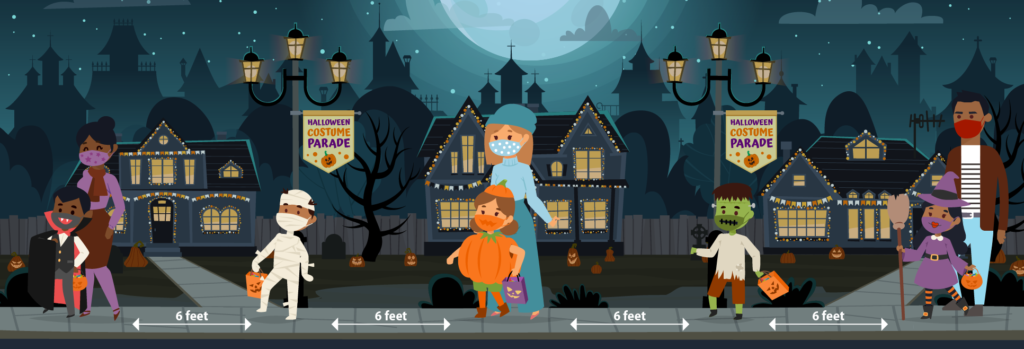
Stay at least 6 feet away from others who do not live with you

  • Indoors and outdoors, you are more likely to get or spread COVID-19 when you are in close contact with others for a long time.

illustration of a child wearing a wizard costume washing their handsWash your hands

  • Bring hand sanitizer with you and use it after touching objects or other people.
  • Use hand sanitizer with at least 60% alcohol.
  • Parents: supervise young children using hand sanitizer.
  • Wash hands with soap and water for at least 20 seconds when you get home and before you eat any treats.

Images: cdc.gov

Where to Get Your Flu Shot

Many au pairs and host families are looking for places to get flu shots this time of year. Au Pair insurance does not cover immunizations, but there are lots of places to get flu shots for $35 or less. If the host family is urging their au pair to get a seasonal flu shot and she agrees to get it, the host family would be responsible for the expense.

If you are planning to get the seasonal flu vaccine, it is recommended that you get it as early as possible.


Anne Arundel County Health Department – Free flu shots are available by appointment only.

Montgomery County Health Department – Free Flu Shot Clinics will be offered as the vaccine becomes available.

Prince George’s County – Typically offer Free Flu Shot Clinics, check their website for the 2020 schedule as it becomes available. (not posted yet as of 9/25)

I have been told that Kaiser Permanente is offering free flu shots as well.

Flu shots are also available for a fee (usually $25-35) at pharmacies such as Target, CVS, Rite Aid, Walgreens, etc.

5 Tips to Make Learning at Home Easier

Nenad Stojkovic

With most students learning at home because of the pandemic, we find ourselves with a back to school season like no other. Here are some tips to help make the process go more smoothly for everyone involved.

  1. Communicate – Host parents and au pairs need to communicate regularly about who is handling which tasks and how things are going. It may take some trial and error to find the best plan for your situation.
  2. Keep Expectations Reasonable – Most au pairs are not trained as teachers and just as this is new to parents, it is also new to them. Keep expectations reasonable. Au pairs should not be solely responsible for children’s virtual schooling.
  3. Lyn Lomasi

    Designate a School Area – It is important to set up an area where school takes place. If it is a multipurpose space like the kitchen table, create a simple setup that you can remove and replace when school is in session. This would include school supplies, laptop/tablet, and books. Store these items in a basket or bin nearby, to make the switch easy.

  4. Create a Routine for Children – Even though it’s tempting to be more relaxed with school at home, it’s best to stick to familiar routines (breakfast, getting dressed, etc.) This will help now and also when they have to return to traditional school in the future. Keep their school schedule posted, so they know what to expect and when breaks are coming up.
  5. Make Time for Fun – While school is very important, so is mental health. Outside of school time try to offer lots of opportunities for free play and being outdoors. If kids miss talking to their friends consider arranging virtual playdates, so they can connect outside of school time.

Living in a pandemic affects us all differently. Be kind to each other and yourself. We are all doing the best we can, in this strange time. Things won’t always go as planned, but by supporting each other we will make it through.