

Category Archives: Blog

Going Unplugged During Work Hours

Phones, tablets, and laptops are wonderful tools to stay connected and informed, but we need to be careful not to let them become distractions from real life interactions and most importantly our responsibilities.

Au Pairs – Imagine for a moment that you went to the hospital and you were in the care of doctors and nurses.  How would you feel if those doctors and nurses who were there to care for you were more interested in texting or using their personal computer than caring for you?  How would that make you feel, about yourself and about them?  Would you think that you were getting the treatment you deserved?  Would you feel like paying the bill after your stay?

Life as an au pair, it is a fine balance between employee and family member. You live with your host family and participate with them as a member of the family, but you also have clear responsibilities as a childcare provider. Being a childcare provider is truly one of the most important jobs I can think of, because you are helping to shape our next generation.  What message are you sending them when you would rather interact with a computer than with them? How will they feel about themselves and about you? Children feel as though everything is about them. They will see this as a rejection of them and they will be more likely to act out.

It also poses a safety concern when you are not paying enough attention to the children in your care.  Accidents happen, but when an adult care giver is close by and appropriately supervising the chances of a major injury dramatically reduce.

During work hours, the following would not be considered acceptable:
-Texting*
-Talking to friends on the phone
-Chatting with friends online
-Using Skype or FaceTime
-IMing
-Emailing
-Updating your status on Facebook
-Using Snapchat, WhatsApp or any other app or social media site
-Watching videos on YouTube
-Tweeting on Twitter
-Uploading photos on Instagram
-Anything else on the computer unless it is going to Nickjr.com together with your host children

*you do want to be on the look out for texts from your host parents

Think about this — even if you work 45 hours a week, that leaves you 123 hours per week for all of that other stuff, or about 70 hours (if you are getting the recommended 7-8 hours of sleep per night.)

Host Parents – You need to be clear about what you consider acceptable during work hours to avoid misunderstandings.  Also, please understand that you are dealing with a new generation of people who are very accustomed to being plugged in at all times.  Their intention is not to be rude, they don’t necessarily realize how their actions will be perceived.  Please use this information as an opportunity to begin a dialogue on the issue.

SaveSave

SaveSave

Stopping for School Buses

With schools about to go back in session and many new au pairs who have recently arrived, I wanted to remind everyone about what to do in different situations with school buses. If you have questions, please ask myself or your host parents.

The rules regarding stopping for school buses are:

  • It is against the law to pass a stopped school bus while its lights are flashing and its’ stop arm is extended.
  • On undivided roadways, with no physical barrier or median, vehicles must stop on both sides of the roadway.
  • Yellow flashing lights indicate that the bus is preparing to load or unload children. Motorists should slow down and prepare to stop their vehicles.
  • Red flashing lights and extended stop arms indicate that the bus has stopped, and children are getting on or off. Motorists approaching from either direction must wait until the red lights stop flashing before proceeding.

Police, who observe a motorist failing to stop and remained stopped for a school bus, can issue the violator a citation which carries a $570.00 fine and 3 points. There are also cameras on buses and the camera-generated fine is $125. Drivers failing to stop for pedestrians in a crosswalk can be issued a citation for $80.00, and drivers failing to exercise due caution when encountering children can be issued a citation for $70.00.

Smithsonian Folklife Festival

The Annual Smithsonian Folklife Festival will take place June 29-July 4 and July 6-9. 

The Annual Smithsonian Folklife Festival is an international exhibition of living cultural heritage. This year will be the 50th anniversary of this popular event. Attracting more than one million visitors yearly, the two-week long celebration is the largest annual cultural event in the United States.

The Festival is held outdoors on the National Mall in Washington, D.C., between 7th and 12th Streets and inside the Arts & Industries Building. There is no admission charge. Visitors should dress for hot and humid weather. Parking around the Mall is extremely limited, so visitors are advised to use public transportation. Smithsonian is the closest Metro station to the Festival site. L’Enfant Plaza, National Archives, and Federal Center stations are within a half-mile. For general Smithsonian visitor information, http://www.si.edu/Visit or call 202.633.1000 (voice).

Festival hours are 11 a.m. to 5 p.m., with special events taking place most evenings beginning at 5:30 or 7 p.m. View the schedule here.

I highly recommend that you visit their website to plan your visit http://www.festival.si.edu/

Simple Mother’s Day Gifts to Make

Mother’s Day in the U.S. is Sunday, May 14.

Mother’s Day recognizes mothers, motherhood and maternal bonds in general, as well as the positive contributions that they make to society. It was established by Anna Jarvis, with the first official Mother’s Day was celebrated at St. Andrew’s Methodist Church in Grafton, West Virginia, on May 10, 1908.

You will find great ideas for projects you can make with your host children here on the Au Pair in America Mother’s Day pinboard.

Photo: Mrs. Flinger (Flickr)

Options for those Last Few Education Hours

3324251659_c5b4e7da64How many total classroom hours do you need?

  • Standard au pairs must complete 72 hours or 6 credits or 7.2 CEUs.
  • Educare companions must complete 144 hours or 12 credits or 14.4 CEUs.

Certain combinations of classes can leave you just a few hours short of the requirement.

Here are several options for completing those last few hours. Prices listed are correct as of February 10, 2017 and are subject to change. Consult the university websites for full information.

Virginia International University Saturday Museum Classes
5 hours (.5 CEUs) for $40 (+$20 reg. fee)
Held almost every Saturday morning (10:30am) in DC. Metro accessible locations.
Students will spend a day at a different museum each week and participate in an interactive, themed museum tour facilitated by an ESL instructors.

University of Virgin Islands Experience America through Art Galleries & Museums
5 hours (.5 CEUs) for $40
Held once per month on a Saturday (10 am or 1:30pm) in DC. Metro accessible locations.
Students self guide through a local museum over a 3 hour period and complete an outside assignment. The assignment is creating a detailed pictorial report of the visit, due within 7 days of the course.

University of Virgin Islands Fitness Fridays
2 hours (.2 CEUs) for $20
Held once per month on a Friday evening (8 pm) in DC. Metro accessible location.
A fitness class where students will stretch, move and exercise. Register early, space is limited.

Local Community Colleges
Check on our Resource Page under Education Options for links to local community colleges. In the Non-Credit or Continuing Education Catalogs, they will have a variety of small courses in a variety of subjects.

Photo: Ian Lee (Flickr)

Looking for Valentine’s Day Activities?

Valentine’s Day (February 14) is a time of love, friendship, giving, and caring. Americans use Valentine’s Day as an opportunity to tell friends and family how much they care.  Children usually exchange cards at school.

Are you looking for Valentine’s day activity and craft ideas?

Look no further…  Au Pair in America has a Pinterest pinboard devoted to Valentine’s Day:

APIA Valentine’s Day Pinboard

Photo: Clever Cupcakes (Flickr)

Big Kids Need Interaction Too

Just because a child is old enough to occupy themselves, doesn’t mean that they should be expected to do so the majority of the time.  Host families have a certain expectation of activity and involvement for their children. Get the kids engaged and active. You can be more fun than the TV or video game.
Problem:
But, my kids don’t want to do anything but watch TV or play video games.

Solution:
Instead of saying – “Would you like to (fill in the blank with any activity)?  The answer will often be, “No.”

Try this – “Now we are going to (fill in the blank with any activity.) or “Would you rather do  ___ or ____?”  (Make sure both the choices are things you approve of.)
Your chances of co-operation are greatly increased. Even kids who are reluctant to try new things will usually get in the spirit of things and have fun, if you pick a good activity.

Problem:
I don’t know what to do with school age kids?

Solution:
Here are a few easy ideas to start with.  Look for more on the internet and the library.  Google “activities school age kids” or “activities tweens”
-Cooking
-Making things (check craft stores like Michael’s for kits and models that are age appropriate)
-Going fun places (check the Cluster Google Map for all kinds of great places in the local area including pottery making, jewelry making, farms, museums and more)
-Sports (soccer, tennis, swimming, bicycling, roller skating, ice skating, and more)
-Visit places in the area like the library, museums and attractions in DC, mini-golf and go-karts
-Let them teach you to do something they enjoy.  Kids this age love being the expert.
-Get outdoors and visit local parks.  You can even make a project of reviewing all the local parks (what kind of equipment they have, is there shade, water fountain?)  They can write this up and keep, so they remember which ones they want to go to again and which ones to skip in the future.
-Let them help you search and plan some activities.
-Check on the APIA Pinterest page and here on our cluster blog for ideas.
-If your host children are in scouts, find out if there are things that they need to complete that you can work on with them.  Even if they are not in scouts, I suggest you check your local library for Cub Scout Handbooks (Tiger, Wolf, Bear & Webelos.)  They are full of activities appropriate for boys (and girls) from age 7-11.
-If you have a GPS, try taking them geocaching. Here is a website with all the details.

Note: Always get permission from your host parents before taking the kids places.

Driving – Car Safety Kit

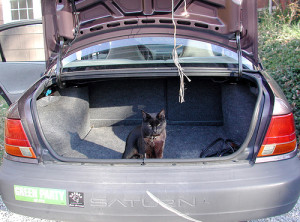
62922586_bd9aa19227What should you have in the trunk of your car in case of an emergency?

I’ll give you a hint- it’s not a cat. While they are cute, they are not very helpful in a crisis. Below is a list of some more helpful things to keep in the car.

Recommended items to have in the car in case of emergency

  • Cell phone car charger
  • Jumper Cables (be sure you know how to use them)
  • Flashlight and extra batteries
  • Flares & Reflective triangles
  • Bag of sand or kitty litter (to help if stuck in ice, snow)
  • Small shovel, snow brush and ice scraper
  • Extra windshield solvent
  • Blankets and extra clothing
  • Nonperishable food items and water (e.g.. snack bars)
  • List of emergency telephone numbers on a card in the glove compartment
  • Auto club card (AAA or roadside assistance)

Here is another post with a list of what to keep in the car glove box.

It is always a good idea to keep the gas tank at least half full at all times, especially in the winter.

Photo: Bart Everson

Winter Driving Tips

snow carDriving in the snow and ice can be a challenge even for experienced drivers. If you don’t have to

go out in bad weather, stay home. If you do have to go out, here are some tips from AAA. Check out the full article on the AAA website.
Tips for driving in the snow:
  • Accelerate and decelerate slowly. …
  • Drive slowly. …
  • The normal dry pavement following distance of three to four seconds should be increased to eight to ten seconds. …
  • Know your brakes. …
  • Don’t stop if you can avoid it. …
  • Don’t power up hills. …
  • Don’t stop going up a hill. …
  • Stay home.

Photo: Steve Pisano (Flickr)

Visiting Baltimore By Train

If you want to visit Baltimore, but are worried about driving there or if you don’t have access to a car, the MARC train is a great option.  Here is some information on how you can enjoy visiting Baltimore via public transportation. Prices and info are accurate as of Dec 3, 2016. Please check links to verify prices and schedules before you go.

Getting from DC to Baltimore
The MARC Train Penn Line runs from Union Station (DC) to Baltimore Penn Station. Cost for a one way ticket ($6-8.) Considering cost of gas and parking in the city, if you drive, makes the train a pretty good deal.

View the schedules here –> Weekend Penn Line & Weekday Penn Line

On Saturdays, there are currently running 9 trains from about 9 am (1st train northbound from DC) to about 9:00 pm (last train southbound from Baltimore.)  On Sundays, there are currently running 9 trains from about 10:30 am (1st train northbound from DC) to about 5:00 pm (last train southbound from Baltimore.) It is very important to be sure of the time of the final train back from Baltimore to DC. 

On Weekdays, the MARC Penn Line runs from about 5:45 am (1st train northbound from DC) to about 9:15 pm (last train southbound from Baltimore.)

In our cluster area, here are your options:

  1. Take the Metro Red Line to Union Station and get on the MARC Penn Line there.
  2. Take the Metro Orange Line to New Carrollton and get on the MARC Penn Line there.
  3. Drive or take a bus to Bowie State Station (off Rt 197) and get on the MARC Penn Line there.

Free Way to Get Around Baltimore 

Baltimore offers a FREE Charm City Circulator service that features 4 shuttle bus lines and 1 water taxi line. The shuttle buses run about every 10 minutes. Visit the website here to view the maps: Charm City Circulator 

To visit the Inner Harbor take the Purple Line from Baltimore Penn Station to stop #302 – S. Calvert St. & W. Pratt St.