Yearly Archives: 2025

Fall Traditions: Carving Pumpkins

It was great to see so many of you at our Pumpkin Patch Host Family & Au Pair Meeting on Sunday! A treasured fall/Halloween tradition in the United States is pumpkin carving or making “jack-o’-lanterns”. Whether this is your first time decorating a pumpkin or you are a seasoned pro, these videos have a few tips and ideas you may find helpful.

How do I make it safe for the children? If you are carving a pumpkin with your host child(ren), remember to be very careful with them around sharp tools. You can purchase kid-safe pumpkin carving tools that cut without a sharp blade. If you don’t have those, let kids help with all of the tasks that don’t involve a knife such as: picking the pumpkin, scooping out the insides, choosing the design and adding any other decorative touches. You can buy or print pumpkin templates online and school aged kids can use a thumbtack to mark the pattern on the pumpkin. Here you can find a free template and instructions on how to do this.

How long do they last? Carved jack-o-lanterns begin to deteriorate after just a few days outside (depending on the weather). Temperatures over 60˚F (15˚C), rain, and freezing then thawing all make them rot more quickly. So, if you want your pumpkin to be fresh on the big night, don’t carve it more than a few days before Halloween and/or keep it in a cool place. Another way to preserve the jack-o-lantern longer is to coat the cut surfaces with petroleum jelly.

Check out Au Pair in America’s Halloween Fun Pinterest board and our Fall Bucket List for more fall traditions and activities to try.

Here is video readings of one of my favorite pumpkin stories.

Image: Jeff Kramer

Preparing for Cold Weather

We’re in that time of year when Maryland temperatures start dipping a little lower. It can be 70°F (21°C) one day and 40°F (4°C) the next. But, that doesn’t mean you need to hide indoors. There are lots of ways to stay warm and enjoy the outdoors through fall and winter.

There is a Scandinavian saying…

If you come from a warmer climate this may sound impossible to you. Over the years I have noticed that the temperature difference is much easier on those who have a gradual adjustment. It allows your body time to adjust to the lower temperatures. So, that’s the good news for all of you who are already here. Your body is already getting adjusted, give your mind a chance to stay open to enjoying the outdoors.

The next thing to do is get yourself the proper clothing and accessories. Start shopping for cold weather clothing: sweater, coat, gloves, hat, scarf, long underwear & boots. Ask your host family if they have some you can use and/or if there are items they are planning to provide for you before you start to make purchases. Then start looking out for sales and checking thrift shops. Take a look at what you already have and think of ways to layer it. A long sleeve t-shirt under a sweatshirt may be as warm as a jacket. A pair of leggings or tights under a pair of jeans adds a lot of warmth. Search on YouTube and TikTok for videos giving more layering suggestions.

It may also help to remind yourself that people in other parts of the U.S. and other countries experience much colder temperatures than we do and are still able to enjoy the outdoors.

Pick your activities carefully. If you are sitting next to a fire pit or doing physical activity you will feel warmer. When you take the kids to the playground or out in the snow, don’t sit on the bench and watch. You will feel warmer and have more fun if you are actively involved and have fun with them.

If you have tips on enjoying the cold weather, please share them!

Image: Canva.com

Hints for Success – Homesickness/Culture Shock

Almost everyone experiences culture shock and homesickness when they come to a completely new environment. Everything is different: the language, the food, and the people.

Here are my Top 5 Tips for
Dealing with Homesickness

1. Make friends – Don’t wait for other au pairs to reach out to you, reach out to them. There are other new au pairs who are feeling the same way you are right now. Set a goal to reach out to a few of them each day. Some will respond and some will not. Don’t let that discourage you. No one will ever be mad at you for sending them a message to say hello or ask if they want to do something together. Make friends from various countries and you will also get a chance to practice your English skills together.

2. Stay in touch with your home country, but not too much. Skyping or talking on the phone every day with your family and/or friends back home normally makes homesickness worse. Try texting instead and reduce the Skype and phone calls to once a week, until you feel stronger. It’s much harder seeing the faces and hearing the voices of those you miss.

3. Get out of the house (or your room specifically) – Go to cluster meetings, have coffee, go to the park, and/or go places with other au pairs. If someone invites you out, say “yes” whenever possible. Also, don’t be afraid to do the inviting. If your host family invites you to do things with them, say “yes.” This will help you get to know each other and contribute to your overall happiness.

4. Share your culture with your host family – If you are missing some favorite foods from home, find ways that you can make them here and share them with your host family. There are many international markets in our area, you should be able to find most of the ingredients you need. If you are not really a cook, search online for restaurants and bakeries that have a taste of home. Your host family is probably just as excited to learn about your culture as you are to learn about America.

5. Make plans – Create your own Au Pair Bucket List (places you want to go, new foods to try, new things to experience during your year in the U.S.) and start doing them now. Post on our cluster WhatsApp group to find others who may want to join you on your adventures.

Realize that it definitely gets easier with time.

All au pairs experience homesickness to some extent and nearly all of them stay and have a successful year (some stay for two years.) So, it must get better, right? Once you get past the initial homesickness, most au pairs report how quickly the year goes by.

Photo by:  Shimelle Laine (Flickr)

Where to Get Your Flu Shot

Many au pairs and host families are looking for places to get flu shots this time of year. Your au pair medical insurance is a type of travel insurance and it does NOT cover preventive care like vaccines. But there are lots of places to get flu shots for free or a small fee.

If a host family is urging their au pair to get the seasonal flu shot and she agrees to get it, the host family would be responsible for the expense.

If you are planning to get the seasonal flu vaccine, it is recommended that you get it as early as possible. Below are some links to help you decide where to go for a flu shot.

County and State Health Departments

Some host families have told me that they have taken their au pair with them to Kaiser Permanente and the au pair has received the flu shot even though they don’t have Kaiser Permanent themselves.

Local Pharmacies

Flu shots are also available for a fee at local pharmacies. Go to GoodRX and pick a local pharmacy discount offer to get the flu shot for $30 and up.

Because your medical insurance plan doesn’t cover vaccines, you should not present your insurance card. The claim will be denied and you will receive a bill in the mail.

Costco offers flu shots for $21.99 and up.

What are the Rules for Holidays?

There are no regulations requiring host families to give au pairs any specific holidays off. In the spirit of the au pair program, many host families will give their au pair the day off on major holidays (Thanksgiving, Christmas, New Year’s Eve, July 4th). Most au pairs look forward to sharing holidays like Thanksgiving and Christmas with their host families to truly experience American family life.

There are other federal holidays (usually on Mondays), when many offices and sometimes schools are closed. These are regular workdays for an au pair, unless their host parents tell them otherwise.

There are also days when the children will be home from school. These can be on holidays, special work days for teachers or closures due to bad weather. Host parents and au pairs should review the calendar sent home from school and mark these on the family calendar and/or au pair work schedule. It’s a good idea for au pairs to plan some activities to occupy children who are at home. Keeping kids occupied and engaged can prevent boredom and sibling squabbles.

Au Pairs – Please check with your host parents before you assume you have any holiday off. Do not make any travel plans until you have received confirmation that you will not work on this day.

Host Parents – Please let your au pair know in advance when she will have a holiday off or a day when kids will be home from school, so she may plan accordingly. When there are school days off,  be sure to make adjustments to your au pair’s work schedule  to stay within the State Department regulations: not exceeding 10 hours per day or 45 hours per week (or 30 hours per week for Educare).

Photo: Dafne Cholet

Going Unplugged During Work Hours

Phones, tablets, and laptops are wonderful tools to stay connected and informed, but we need to be careful not to let them become distractions from real-life interactions and most importantly our responsibilities.

Au Pairs – Imagine for a moment that you went to the hospital and you were in the care of doctors and nurses. How would you feel if those doctors and nurses who were there to care for you were more interested in texting or using their personal computer than caring for you? How would that make you feel, about yourself and about them? Would you think that you were getting the treatment you deserved? Would you feel like paying the bill after your stay?

Life as an au pair, it is a fine balance between employee and family member. You live with your host family and participate with them as a member of the family, but you also have clear responsibilities as a childcare provider. Being a childcare provider is truly one of the most important jobs I can think of because you are helping to shape the next generation. What message are you sending them when you would rather interact with a computer than with them? How will they feel about themselves and about you? Children feel as though everything is about them. They will see this as a rejection of them and they will be more likely to act out.

It also poses a safety concern when you are not paying enough attention to the children in your care. Injuries and accidents happen, but when an adult caregiver is close by and appropriately supervising the chances of a major injury dramatically reduce.

During work hours, the following would not be considered acceptable:

  • Texting or talking to friends on the phone
  • Using Skype, FaceTime, or any other video chat
  • Using TikTok, Instagram, Snapchat, WhatsApp, Twitter, Facebook, YouTube,  or any other app or social media site
  • Playing online games
  • Anything else on your phone or computer (unless it is going a children’s website together with your host children)

There are some things you can do to make avoiding phone distractions easier:

  • Turn off notifications on apps that may distract you during the day.
  • Set specific notification sounds and ring tones for your host parents, so you can tell when it’s them trying to contact you.
  • Set boundaries with your friends and family back home and let them know when your typical work hours are and ask them to avoid contacting you during those times unless it’s an emergency.
  • Set up the driving mode feature on your phone.

Even if you work 45 hours a week, that leaves you 123 hours per week for all of that other stuff, or about 70 hours (if you are getting the recommended 7-8 hours of sleep per night.)

Phone Use in the Car – Using your phone to text or talk without Bluetooth while driving is illegal, a huge safety risk, and a bad example for the children (future drivers) in the car with you. One moment of distraction when you are driving can change someone’s life forever: your own and/or others around you.

Host Parents – You need to be clear about what you consider acceptable during work hours to avoid misunderstandings. Also, please understand that you are dealing with a generation of people who are very accustomed to being plugged in at all times. Their intention is not to be rude, they don’t necessarily realize how their actions will be perceived. Please use this information as an opportunity to begin a dialogue on the issue.

Image: Pexels.com

Back to School Planning

Back to school time is here. This can mean changes to the au pair schedule and possibly to the duties.  It is very important to communicate these changes to avoid problems.

Here is a list of topics to consider discussing:

  • Au pair’s work schedule.
  • The children’s school and activity schedules.
  • Where the children get dropped off and picked up and who will be doing this.
  • What to do if a child is staying home sick, late to school, does not get off the bus (if they are supposed to).
  • Driving laws regarding stopping for school buses.
  • How to tell if school has been canceled or delayed for bad weather.
  • Add the au pair to your list of people allowed to pick up the kids from school and explain the process.
  • What to pack for lunch.
  • The routine after school (do they have free time before starting homework, what to give for a snack, any chores, where do they put their backpacks & lunchboxes).
  • How to communicate about what’s going on at school. Your Kids in Care logbook from Au Pair in America can be a great two-way communication tool for keeping track of schedules, afterschool activities and day to day info that needs to be transferred between host parents and au pair.
  • If your au pair will be the one going through the children’s backpack and helping with homework, consider designating an area for putting things that need to be read and/or signed by parents.

Here are some Printable Fill-in-the-Blank School Notes for parents. You can print these out and have them ready for times when the kids are absent, late, have an early dismissal or you need to give permission for something.

Check out Au Pair in America’s Pinterest School Tips and Ideas pinboard for things like organization ideas, back to school traditions, printable lunch box notes, and fun lunch recipes.

Reminder: It is illegal in the State of Maryland for a child under the age of 8 to be left alone in the home or car. Please make sure that your drop off routine does not include leaving children under 8 at home or in the car while dropping off another child. Even if a host parent gives permission to do this, it is not allowed, because it is against the law.

Stopping for School Buses

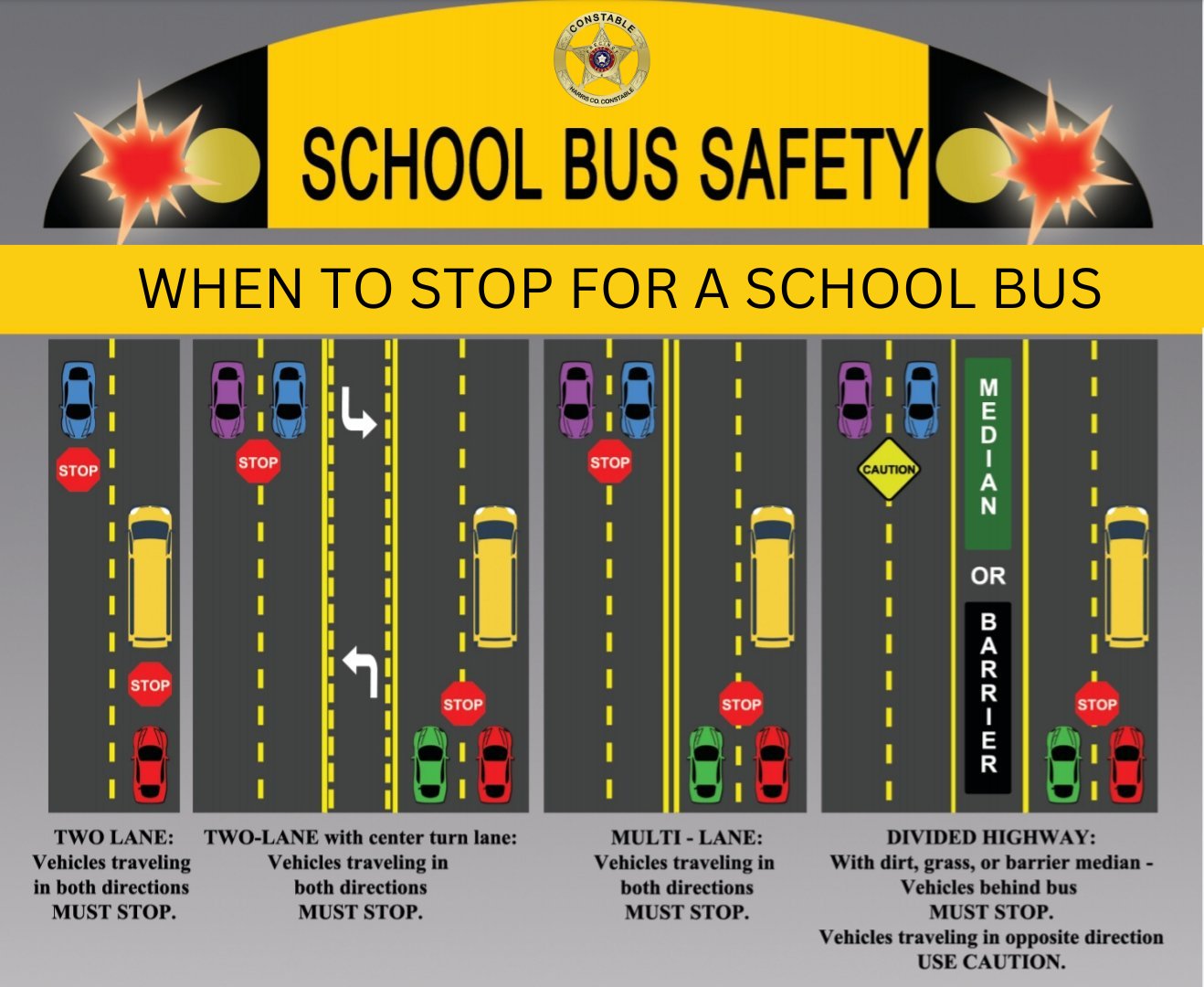
With schools getting back in session soon and many new au pairs, I wanted to remind everyone about the Maryland law that requires you to stop for school buses. Below you will find pictures explaining what to do in 4 different types of roads if you approach a school bus at a stop. If you have questions, please ask me or your host parents.

The rules regarding stopping for school buses are:

  • It is against the law to pass a stopped school bus while its lights are flashing and its’ stop arm is extended.
  • On undivided roadways, with no physical barrier or median, vehicles must stop on both sides of the roadway.
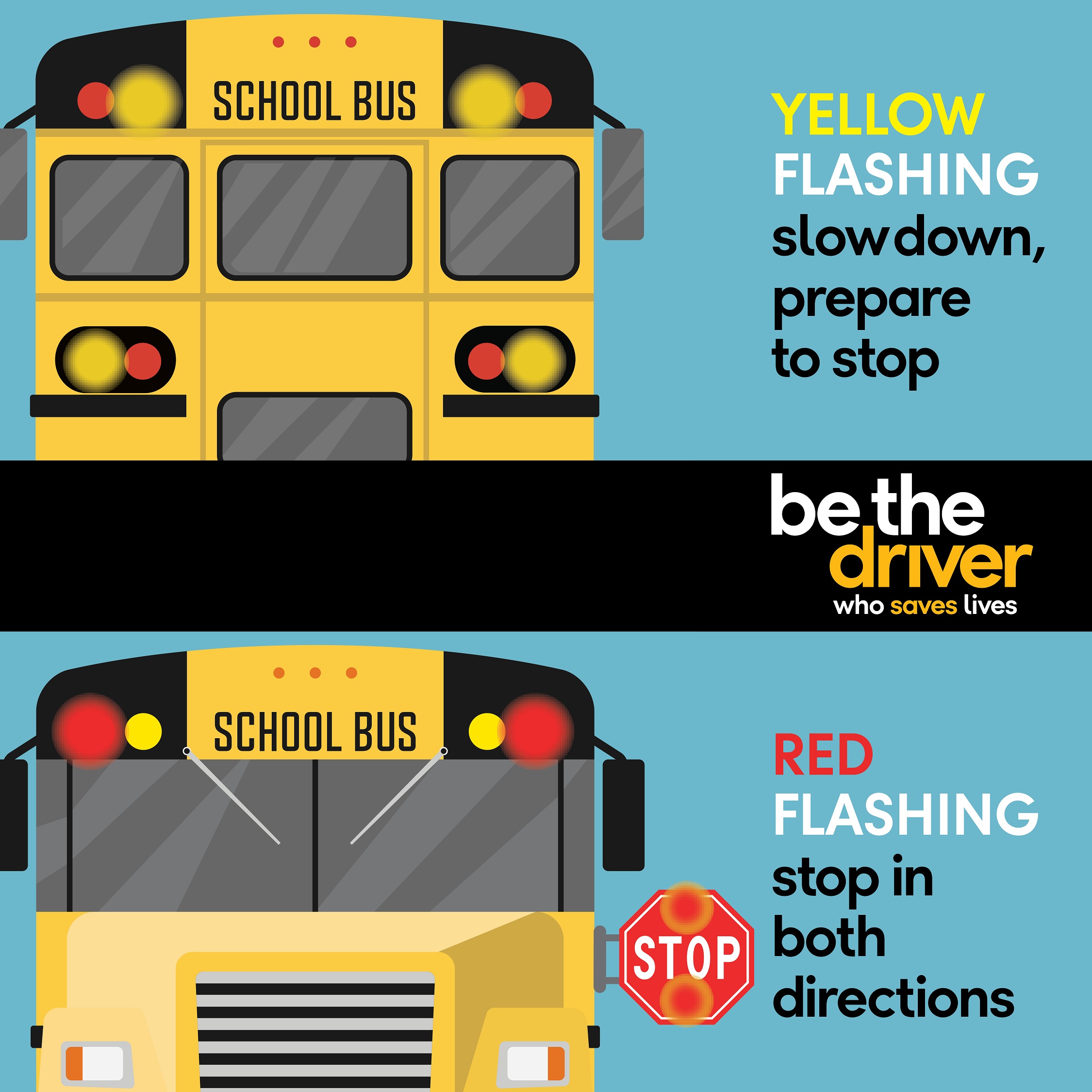
  • Yellow flashing lights indicate that the bus is preparing to load or unload children. Motorists should slow down and prepare to stop their vehicles.
  • Red flashing lights and extended stop arms indicate that the bus has stopped, and children are getting on or off. Motorists approaching from either direction must wait until the red lights stop flashing before proceeding.

Police, who observe a motorist failing to stop and remain stopped for a school bus, can issue the violator a citation which carries a $570.00 fine and 3 points. There are also cameras on buses and the camera-generated fine is $250. Drivers failing to stop for pedestrians in a crosswalk can be issued a citation for $90-$500. These fines are subject to change and could increase. I am sharing them for your information.

Images: Maryland Center for School Safety & MD State Police

Local Fairs & Renaissance Festival

What is a Fair?

According to Wikipedia:
fair (sometimes fayre) is a gathering of people to display or trade produce or other goods, to parade or display animals and often to enjoy associated carnival or funfair entertainment. Activities at fairs vary widely.

Fairs are also known by many different names around the world, such as agricultural show, carnival, fete or fête, county fair, exhibition or state fair, festival, market and show. Flea markets and auto shows are sometimes incorporated into a fair.

MD fair

Montgomery County Fair
August 8-16, 2025. Montgomery County Fairgrounds, 501 Perry Parkway, Gaithersburg, Maryland. (301) 926-3100. This is the fair’s 76th year! Carnival ride and games, animal exhibits, live entertainment, contests, fair food and more!

Maryland State Fair
August 21-September 7, 2025. Maryland State Fairgrounds, 2200 York Road Timonium, Maryland. (410) 252-0200. The Maryland State Fair was named one of the top 50 fairs in North America. This year’s 11-day festival will feature swifty swine racing pigs, live thoroughbred horse racing, bull riding and barrell racing, concerts, agricultural fair tours, games, rides and more.

Prince George’s County Fair
September 4 – 7, 2025. Prince George’s County Equestrian Center and the Showplace Arena, Water St., Upper Marlboro, Maryland. Prince George’s County Fair is the longest running in Maryland (since 1842!). Carnival rides, live animals displays, family circus, fireworks, live entertainment, food.

Anne Arundel County Fair
September 10-14, 2025. Anne Arundel County Fairgrounds, Generals Highway, Crownsville, Maryland. (410) 923-3400. Monster truck rides, carnival rides and games, farm animals and exhibits, pig races, antique saw mill, pie eating contest, talent show and much more.

Renn Fest

Au Pairs enjoying the Renn Fest’s iconic turkey legs.

Maryland Renaissance Festival  (Also known as Renn Fest)
August 23-October 19, 2025.
1821 Crownsville Rd, Annapolis, MD 21401. Set in a fictional 16th-century English village named Revel Grove, the festival is spread over 25 acres (100,000 m2). The second largest renaissance fair in the United States. Features costumed staff,  food, performances, glass-blowing demonstrations, jousting, crafts and much more.

Tickets must be purchased online before you go and they often sell out, so plan ahead. Bring cash to pay for food, drinks and attractions because some only accept cash. They have ATMs there, but the fees are very high.

Tip: If you go on a rainy day, wear shoes you don’t mind getting muddy. The Festival grounds are not paved. 

Camp Au Pair – Outer Space

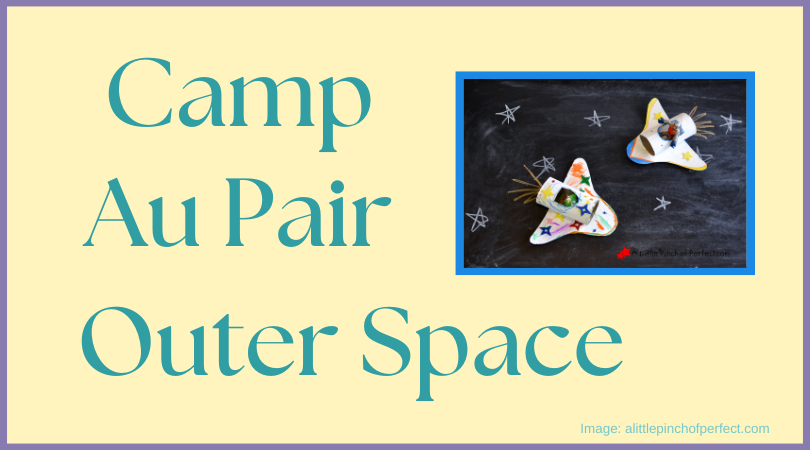
Next week’s Camp Au Pair theme is Outer Space.

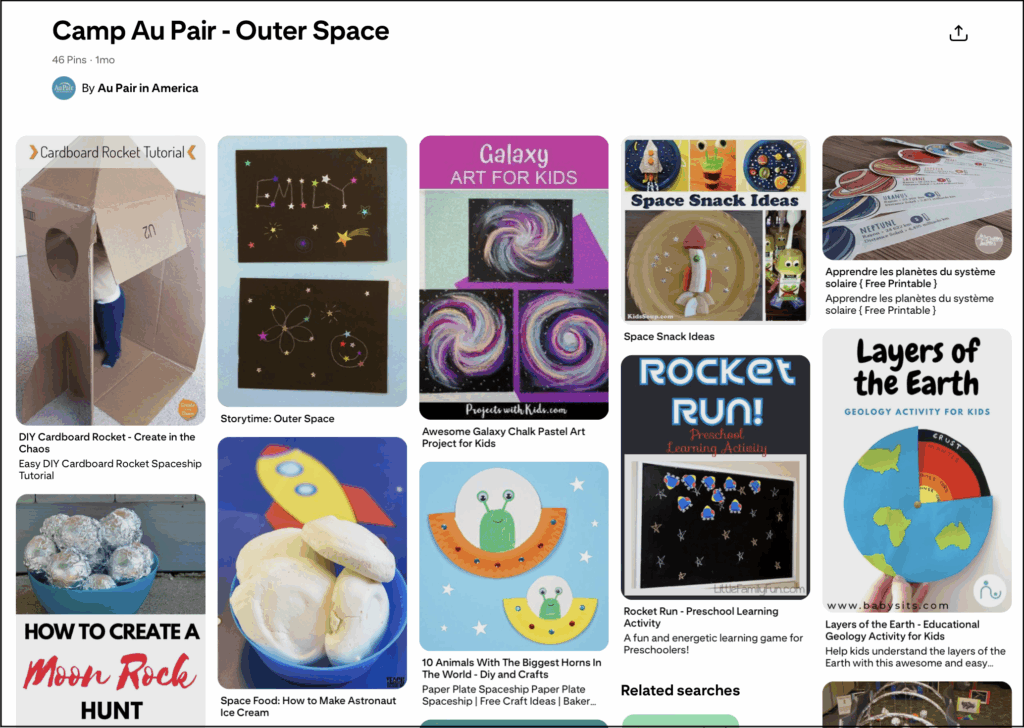
Crafts, recipes, activities, and games related to outer space can all be found here on the Camp Au Pair – Outer Space pinboard.

Here is a fun one that combines a science lesson, art, and snack time.

Field Trips can be a great way for kids to learn and have new experiences. Get permission from your host parents before any outings and be sure to check hours and admission information on the websites before you go. Here are a few places to go, that fit this theme:

  • Air & Space Museum
  • Planetarium
  • Science Center

Webcams – You can do a Google search for websites with webcams that allow you to observe space. Here is one from the International Space Station to get you started.

Online Games – NASA has a gallery of free space games for kids.

Videos – Look for fun videos on YouTube about outer space. Here are a few to get you started.

The Magic School Bus is a television series that follows Ms. Frizzle and her class as they set off on field trips. Most episodes can be found on YouTube. Here are some episodes that fit this week’s theme.

Movies – Here are some movies that fit the space theme.

  • WALL-E
  • Zathura
  • Monsters vs. Aliens
  • Star Wars  

Here are some movies that are PG-13 and may be appropriate for older kids.

  • Hidden Figures
  • The Martian

Books – Stop by your local library and look for books on outer space. You can also find books being read aloud on Youtube.  Me & My Place in SpaceThere Was an Old Astronaut Who Swallowed the Moon, and Mae Among the Stars are a few fun ones to get you started.

Story Time from Space is a YouTube channel with real astronauts reading children’s books aloud.

Photo: alittlepinchofperfect.com