Author Archives: Christine Connally

Preparing for Cold Weather

We’re in that time of year when Maryland temperatures start dipping a little lower. It can be 70°F (21°C) one day and 40°F (4°C) the next. But, that doesn’t mean you need to hide indoors. There are lots of ways to stay warm and enjoy the outdoors through fall and winter.

There is a Scandinavian saying…
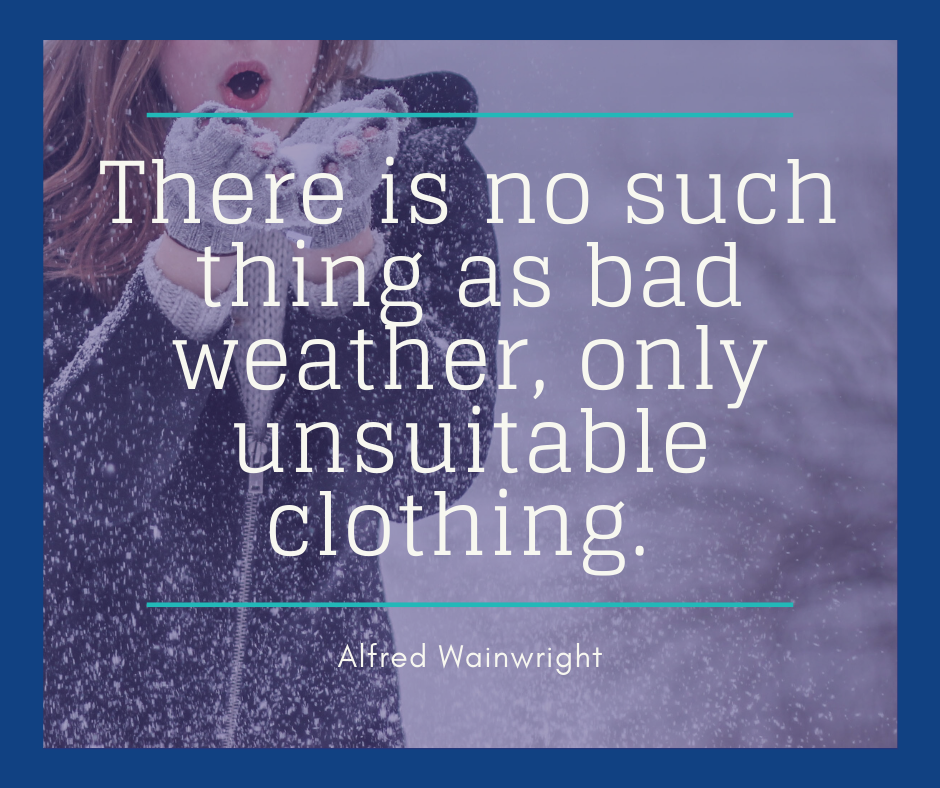
If you come from a warmer climate this may sound impossible to you. Over the years I have noticed that the temperature difference is much easier on those who have a gradual adjustment. It allows your body time to adjust to the lower temperatures. So, that’s the good news for all of you who are already here. Your body is already getting adjusted, give your mind a chance to stay open to enjoying the outdoors.

The next thing to do is get yourself the proper clothing and accessories. Start shopping for cold weather clothing: sweater, coat, gloves, hat, scarf, long underwear & boots. Ask your host family if they have some you can use and/or if there are items they are planning to provide for you before you start to make purchases. Then start looking out for sales and checking thrift shops. Take a look at what you already have and think of ways to layer it. A long sleeve t-shirt under a sweatshirt may be as warm as a jacket. A pair of leggings or tights under a pair of jeans adds a lot of warmth. Search on YouTube and TikTok for videos giving more layering suggestions.

It may also help to remind yourself that people in other parts of the U.S. and other countries experience much colder temperatures than we do and are still able to enjoy the outdoors.

Pick your activities carefully. If you are sitting next to a fire pit or doing physical activity you will feel warmer. When you take the kids to the playground or out in the snow, don’t sit on the bench and watch. You will feel warmer and have more fun if you are actively involved and have fun with them.

If you have tips on enjoying the cold weather, please share them!

CONTEST: The first au pair in our cluster to message Christine or Lisa with their favorite cold-weather activity will win a prize! (Contest Closed – We have a winner)

Image: Canva.com

Fall Traditions: Carving Pumpkins

It was great to see so many of you at our Pumpkin Patch Host Family & Au Pair Meeting on Sunday! A treasured fall/Halloween tradition in the United States is pumpkin carving or making “jack-o’-lanterns”. Whether this is your first time decorating a pumpkin or you are a seasoned pro, these videos have a few tips and ideas you may find helpful.

How do I make it safe for the children? If you are carving a pumpkin with your host child(ren), remember to be very careful with them around sharp tools. You can purchase kid-safe pumpkin carving tools that cut without a sharp blade. If you don’t have those, let kids help with all of the tasks that don’t involve a knife such as: picking the pumpkin, scooping out the insides, choosing the design and adding any other decorative touches. You can buy or print pumpkin templates online and school aged kids can use a thumbtack to mark the pattern on the pumpkin. Here you can find a free template and instructions on how to do this.

How long do they last? Carved jack-o-lanterns begin to deteriorate after just a few days outside (depending on the weather). Temperatures over 60˚F (15˚C), rain, and freezing then thawing all make them rot more quickly. So, if you want your pumpkin to be fresh on the big night, don’t carve it more than a few days before Halloween and/or keep it in a cool place. Another way to preserve the jack-o-lantern longer is to coat the cut surfaces with petroleum jelly.

Check out Au Pair in America’s Halloween Fun Pinterest board and our Fall Bucket List for more fall traditions and activities to try.

Here are video readings of two of my favorite pumpkin stories.

Image: Jeff Kramer

Where to Get Your Flu Shot

Many au pairs and host families are looking for places to get flu shots this time of year. Your au pair medical insurance does NOT cover preventive care like vaccines. But there are lots of places to get flu shots for free or a small fee.

If a host family is urging their au pair to get the seasonal flu shot and she agrees to get it, the host family would be responsible for the expense.

If you are planning to get the seasonal flu vaccine, it is recommended that you get it as early as possible. Below are some links to help you decide where to go for a flu shot.

County and State Health Departments

I have been told that Kaiser Permanente is offering free flu shots as well.

Local Pharmacies

Flu shots are also available for a fee at local pharmacies. Because your medical insurance plan doesn’t cover vaccines, you should not present your insurance card. You need to ask for the price without insurance. With GoodRX offers, the flu shot is available for $25 and up.

Avoid Falling Victim to Scammers

There are always people out there who are looking for ways to trick people out of their money and personal information. Below I will explain some scams and how to protect yourself.


SCAM #1 – Calls asking for your PIN, password, personal information, or payment.

  • Your bank will not call you and ask you for your PIN number or password.
  • IRS and Social Security Administration will not ask you for payment or personal info over the phone. Government agencies usually handle issues like this by sending a letter.
  • The number shown on the caller ID can be manipulated, don’t take that as a sign that a call is legitimate.

What to do? Whenever you are in doubt, hang up and call the bank (or company) directly using a number you already have for them.

SCAM #2 – Email asking you to click a link to verify your personal information or share your password or PIN.

  • Be very suspicious of emails asking you to click links.
  • Scammers are very good at creating official-looking emails and web pages.

What to do? Whenever you are in doubt, go directly to the website (not using the link in the email).

SCAM #3 – You see an offer online telling you to send them some money and they will double it or a pop-up ad says that you have won a great prize and just need to give them your information.

  • When something sounds too good to be true, it usually is.

What to do? Do not give your personal information or any money to people you don’t know.

SCAM #4– You receive a call and you are told to stay on the phone while you go transfer or withdraw money from the bank and if you don’t you will be arrested or your bank account seized.

  • They are using the idea that this is an urgent situation to make you act quickly without thinking to avoid the consequence they have told you.

What to do? Do not follow their instructions.

Whenever you are in doubt, do not do as the caller or email asks. Check with your host parents or community counselor.

One last note on protecting your personal information…

It is very important to keep your social security number private. 

There are very few situations where you will need to share this (bank, IRS, department of motor vehicles). Those are times you are taking an action and need to provide it. At other times, leave your Social Security card safe at home. There is not a legitimate time when someone would be calling you on the phone or emailing you asking for that number.

Image: Canva.com

What are the Rules for Holidays?

There are no regulations requiring  host families to give au pairs any specific holidays off. In the spirit of the au pair program, many host families will give their au pair the day off on major holidays (Thanksgiving, Christmas, New Year’s Eve, July 4th). Most au pairs look forward to sharing holidays like Thanksgiving and Christmas with their host families to truly experience American family life.

There are other federal holidays (usually on Mondays), when many offices and sometimes schools are closed. These are regular workdays for an au pair, unless their host parents tell them otherwise.

There are also days when the children will be home from school. These can be on holidays, special work days for teachers or closures due to bad weather. Host parents and au pairs should review the calendar sent home from school and mark these on the family calendar and/or au pair work schedule. It’s a good idea for au pairs to plan some activities to occupy children who are at home. Keeping kids occupied and engaged can prevent boredom and sibling squabbles.

Au Pairs – Please check with your host parents before you assume you have any holiday off. Do not make any travel plans until you have received confirmation that you will not work on this day.

Host Parents – Please let your au pair know in advance when she will have a holiday off or a day when kids will be home from school, so she may plan accordingly. When there are school days off,  be sure to make adjustments to your au pair’s work schedule  to stay within the State Department regulations: not exceeding 10 hours per day or 45 hours per week (or 30 hours per week for Educare).

Photo: Dafne Cholet

Hints for Success – Homesickness/Culture Shock

Almost everyone experiences culture shock and homesickness when they come to a completely new environment. Everything is different: the language, the food, and the people.

Here are my Top 5 Tips for
Dealing with Homesickness

1. Make friends – Don’t wait for other au pairs to reach out to you, reach out to them. There are other new au pairs who are feeling the same way you are right now. Set a goal to reach out to a few of them each day. Some will respond and some will not. Don’t let that discourage you. No one will ever be mad at you for sending them a message to say hello or ask if they want to do something together. Make friends from various countries and you will also get a chance to practice your English skills together.

2. Stay in touch with your home country, but not too much. Skyping or talking on the phone every day with your family and/or friends back home normally makes homesickness worse. Try texting instead and reduce the Skype and phone calls to once a week, until you feel stronger. It’s much harder seeing the faces and hearing the voices of those you miss.

3. Get out of the house (or your room specifically) – Go to cluster meetings, have coffee, go to the park, and/or go places with other au pairs. If someone invites you out, say “yes” whenever possible. Also, don’t be afraid to do the inviting. If your host family invites you to do things with them, say “yes.” This will help you get to know each other and contribute to your overall happiness.

4. Share your culture with your host family – If you are missing some favorite foods from home, find ways that you can make them here and share them with your host family. There are many international markets in our area, you should be able to find most of the ingredients you need. If you are not really a cook, search online for restaurants and bakeries that have a taste of home. Your host family is probably just as excited to learn about your culture as you are to learn about America.

5. Make plans – Create your own Au Pair Bucket List (places you want to go, new foods to try, new things to experience during your year in the U.S.) and start doing them now. Post on our cluster Facebook or WhatsApp group to find others who may want to join you on your adventures.

Realize that it definitely gets easier with time.

All au pairs experience homesickness to some extent and nearly all of them stay and have a successful year (some stay for two years.) So, it must get better, right? Once you get past the initial homesickness, most au pairs report how quickly the year goes by.

Photo by:  Shimelle Laine (Flickr)

Stopping for School Buses

With schools in session and many new au pairs who have recently arrived, I wanted to remind everyone about what to do in different situations with school buses. If you have questions, please ask me or your host parents.
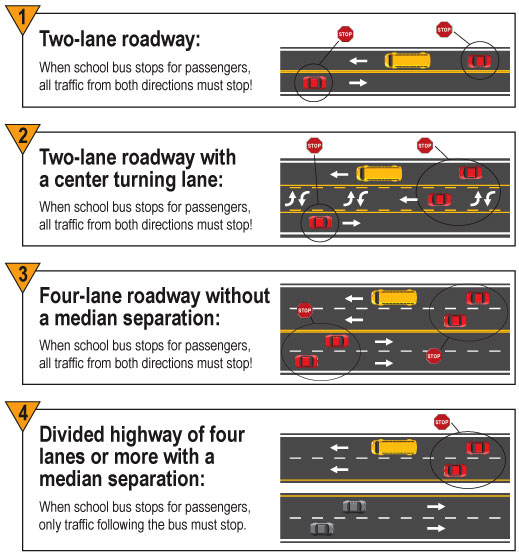



The rules regarding stopping for school buses are:

  • It is against the law to pass a stopped school bus while its lights are flashing and its’ stop arm is extended.
  • On undivided roadways, with no physical barrier or median, vehicles must stop on both sides of the roadway.
  • Yellow flashing lights indicate that the bus is preparing to load or unload children. Motorists should slow down and prepare to stop their vehicles.
  • Red flashing lights and extended stop arms indicate that the bus has stopped, and children are getting on or off. Motorists approaching from either direction must wait until the red lights stop flashing before proceeding.

Police, who observe a motorist failing to stop and remain stopped for a school bus, can issue the violator a citation which carries a $570.00 fine and 3 points. There are also cameras on buses and the camera-generated fine is $250. Drivers failing to stop for pedestrians in a crosswalk can be issued a citation for $90-$500.

For more information, check out this article on the Maryland Dept of Transportation website.

Local Fairs & Maryland Renaissance Festival

What is a Fair?

According to Wikipedia:
A fair (sometimes fayre) is a gathering of people to display or trade produce or other goods, to parade or display animals and often to enjoy associated carnival or funfair entertainment. Activities at fairs vary widely.

Fairs are also known by many different names around the world, such as agricultural show, carnival, fete or fête, county fair, exhibition or state fair, festival, market and show. Flea markets and auto shows are sometimes incorporated into a fair.

MD fairMaryland State Fair
August 24-September 10, 2023. Maryland State Fairgrounds, 2200 York Road Timonium, Maryland. (410) 252-0200. The Maryland State Fair was named one of the top 50 fairs in North America. This year’s 11-day festival will feature swifty swine racing pigs, live thoroughbred horse racing, bull riding and barrell racing, concerts, agricultural fair tours, games, rides and more.

Prince George’s County Fair
September 7-10, 2023. The Showplace Arena, Water St., Upper Marlboro, Maryland. (301) 404-5566. Carnival rides, live animals displays, family circus, fireworks, live entertainment, food.

Anne Arundel County Fair
September 13-17, 2023. Anne Arundel County Fairgrounds, Generals Highway, Crownsville, Maryland. (410) 923-3400. Monster truck rides, carnival rides and games, farm animals and exhibits, pig races, antique saw mill, pie eating contest, talent show and much more.

The Montgomery County Fair took place earlier this month.

Renn Fest

Au Pairs enjoying the Renn Fest’s iconic turkey legs.

Maryland Renaissance Festival 
August 26-October 22, 2023.
1821 Crownsville Rd, Annapolis, MD 21401. Set in a fictional 16th-century English village named Revel Grove, the festival is spread over 25 acres (100,000 m2). The second largest renaissance fair in the United States. Features costumed staff,  food, performances, glass-blowing demonstrations, jousting, crafts and much more.

Tickets must be purchased online before you go and they often sell out, so plan ahead. Bring cash to pay for food, drinks and attractions.

Back to School Planning

Back to school time is here. This can mean changes to the au pair schedule and possibly to the duties.  It is very important to communicate these changes to avoid problems.

Here is a list of topics to consider discussing:

  • Au pair’s work schedule
  • The children’s school and activity schedules
  • Where the children get dropped off and picked up and who will be doing this
  • What to do if a child is staying home sick, late to school, does not get off the bus (if they are supposed to)
  • Driving laws regarding stopping for school buses
  • How to tell if school has been canceled or delayed for bad weather
  • Add the au pair to your list of people allowed to pick up the kids from school and explain the process
  • What to pack for lunch
  • The routine after school (do they have free time before starting homework, what to give for a snack, any chores, where do they put their backpacks & lunchboxes)
  • How to communicate about what’s going on at school. Your Kids in Care logbook from Au Pair in America can be a great two-way communication tool for keeping track of schedules, afterschool activities and day to day info that needs to be transferred between host parents and au pair.
  • If your au pair will be the one going through the children’s backpack and helping with homework, consider designating an area for putting things that need to be read and/or signed by parents.

Here are some Printable Fill-in-the-Blank School Notes for parents. You can print these out and have them ready for times when the kids are absent, late, have an early dismissal or you need to give permission for something.

Check out Au Pair in America’s Pinterest School Tips and Ideas pinboard for things like organization ideas, back to school traditions, printable lunch box notes, and fun lunch recipes.

Reminder: It is illegal in the State of Maryland for a child under the age of 8 to be left alone in the home or car. Please make sure that your drop off routine does not include leaving children under 8 at home or in the car while dropping off another child. Even if a host parent gives permission to do this, it is not allowed, because it is against the law.

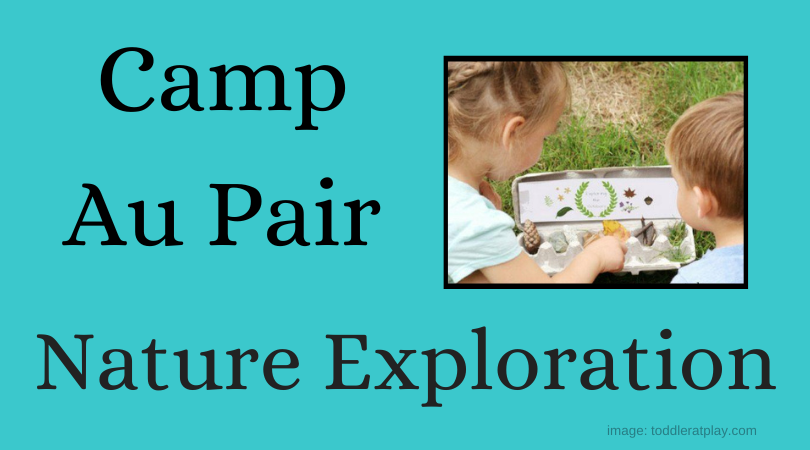
Camp Au Pair – Nature Exploration

This week’s Camp Au Pair theme is Nature Exploration.

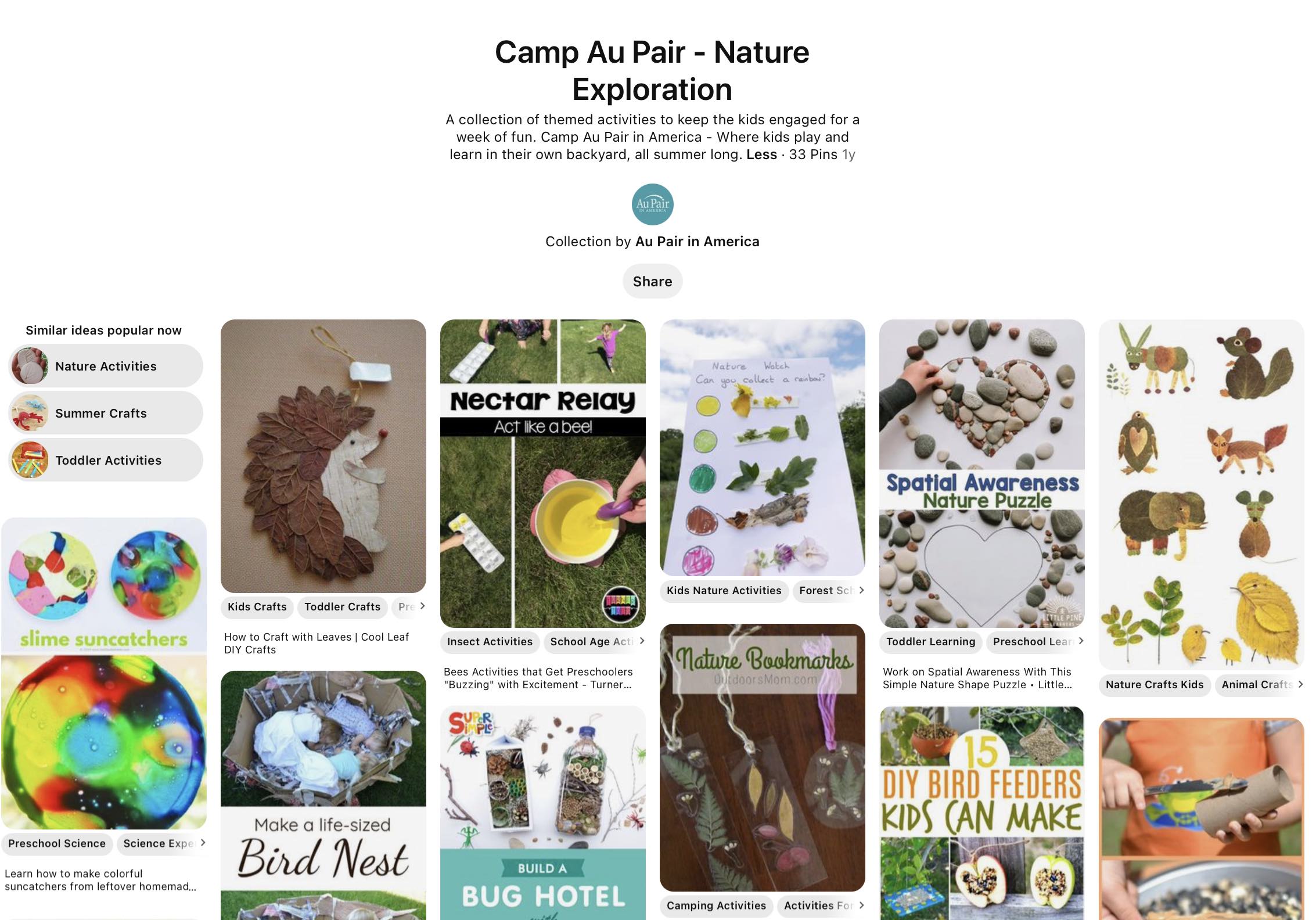
Crafts, recipes, activities, and games can all be found here on the Camp Au Pair – Nature Exploration pinboard.

Field Trips can be a great way for kids to learn and have new experiences. You can start observing nature at any local park or in your own backyard. If you want to take it a step further,  Below is a list of other local places to go explore nature. Get permission from your host parents before any outings and check websites before you go for hours and information.

Safety note: When coming inside after you have been outside exploring nature, it’s always a good idea to check the children and yourself for ticks. For more information, take a look at this post.

  • Aviary
  • Farms
  • Nature Preserve
  • Parks
  • Consider joining the Free Forest School to find outings near you.

Virtual Field Trips:

Webcams – You can do a Google search for websites with webcams that allow you to observe nature.

Videos – Look for fun videos on YouTube about nature.

Books – Check your bookshelves and/or stop by your local library and look for books on nature.  You can also find many read aloud book videos on YouTube. Here are a few to get you started.

Image: toddleratplay.com