As fall approaches in the United States, families across the country are preparing for a new school year. Though many American students head back to class in August or September, the back-to-school season looks very different in other parts of the world. Depending on where children live, the start of the school year can happen during a different time of year and include unique traditions that reflect the local culture and values.
For families interested in raising globally minded children, learning about back-to-school season around the world can be a fun way to explore new cultures together.
Ready to take a closer look at how families around the world prepare for a new school year?
School Start Dates Around the World
In the U.S. and much of the Northern Hemisphere, students typically return to school in late summer or early fall. However, school calendars vary significantly from country to country. In many parts of the world, the academic year is already well underway by the time American children are starting their first day of school.
In Japan, the school year begins in April, coinciding with the start of the fiscal year and cherry blossom season. Since cherry blossoms symbolize new beginnings, the timing adds special meaning to the first day of school.
Regardless of their age or the type of school they’re entering, Russian students all return to school on September 1st, celebrated as Knowledge Day nationwide.
Meanwhile, countries in the Southern Hemisphere often operate on a completely different schedule. For example, in Argentina and Chile, students generally begin their school year in March, while January marks the start of school in South Africa.
These differences remind us that there is no single “right” way to organize the school year. Educational traditions—like so many facets of culture—aren’t fixed, and can vary widely due to influences such as climate, history, location, and local customs.
First-Day Traditions
Just as many American families take pictures on their first day of school, children around the world celebrate the beginning of a new school year in their own unique ways.
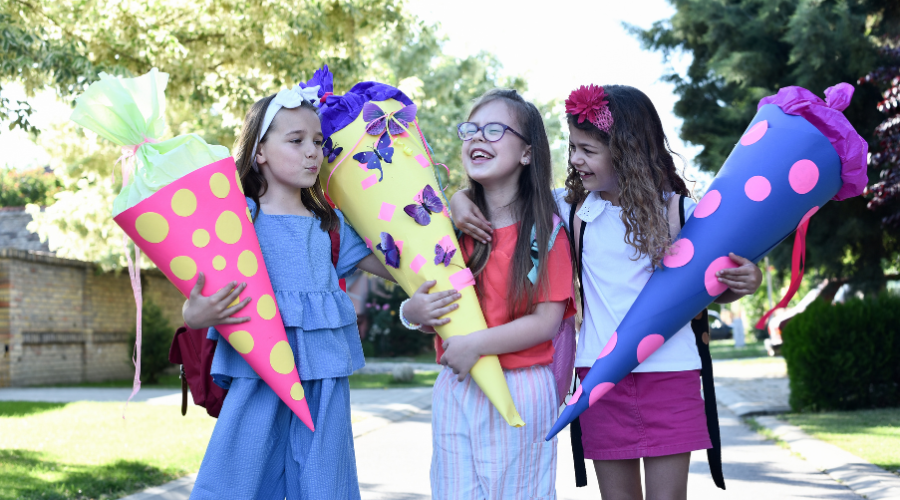
In Germany and Austria, many children receive a schultüte, a large “school cone,” filled with school supplies, small toys, and sweet treats. Many families make the colorful cones themselves, and in some cases they can be nearly as tall as the children carrying them!
Students in Russia celebrate Knowledge Day by bringing fresh flowers to their teachers. In many schools, students also carry balloons and attend elaborate performances prepared by teachers, creating a festive and welcoming atmosphere for the first day.
Known as Admission Day in India, the first day of school is marked by celebration with special events, music, decorations, and the exchange of small gifts. Because school resumes during monsoon season in some regions, umbrellas are a popular gift for students.
School Uniforms
School uniforms are common in many countries, though they don’t always look the way American families might expect.
In Italy, many kindergarten and elementary school students wear a traditional smock called a grembiule over their clothing. The practice promotes a sense of equality among classmates while protecting their clothes during school activities.
In Thailand, school uniforms are an integral part of student life from an early age. While uniform details vary by school, many students wear crisp button-down shirts paired with skirts or shorts, along with school-specific badges and accessories. In many schools, students are expected to remove their shoes before entering classrooms, and some schools even have grooming requirements that specify acceptable hairstyles. Boys in particular may be required to keep their hair short as part of the school’s dress code.
Known as gyobok in South Korea, school uniforms are worn by most middle and high school students. Although styles vary by school and season, uniforms frequently feature blazers, dress shirts, ties, and skirts or slacks. Many students take pride in their school’s unique uniform, and some even become known for particularly stylish designs.
How Students Get to School
While the iconic yellow school bus is a staple of the back-to-school season in the U.S., children in other parts of the world have their own unique ways of getting to class.
Cycling is a way of life for the Dutch. Many parents in the Netherlands transport young children to school using bicycles, including the country’s famous cargo bikes, which can sometimes carry multiple children and school supplies at once.
In Japan, it’s common for children to walk to school independently or as part of organized neighborhood walking groups. This approach reflects the country’s strong emphasis on community responsibility and independence from a young age.
In certain remote communities across the world, including several in Brazil and Colombia, students may travel long distances to school using a combination of buses, motorboats, walking, family transportation, and, in rare cases, even zip lines to cross deep canyons.
Some children face similarly challenging journeys to school in the Philippines due to the country’s mountainous terrain. Near Linabo Peak, for example, students may travel up and down a steep staircase with more than 3,000 concrete steps as part of their daily commute (with some braver children even sliding down handrails for a faster trip). Their determination highlights the value many families place on education, even when getting to school isn’t easy.
Classroom Customs Around the World
Some of the biggest back-to-school differences can be found inside the classroom.
Often recognized for its highly regarded education system, Finland’s schools emphasize student well-being, collaboration, and creativity. Students tend to have shorter school days, less homework, and longer recesses than students in other countries.
Finland isn’t the only country with shorter school days. In Brazil, for example, students spend an average of just 4 hours in the classroom each day. On the other end of the spectrum are China and Thailand, where average school days reach 9.5 hours. Right in the middle is the United States, with the average school day lasting 6.8 hours.
In Japan, classroom customs often involve cleaning. Students frequently participate in daily cleaning routines that encourage responsibility and respect for shared environments—rather than relying solely on custodial staff or teachers to do it for them.
In Botswana, respecting teachers and elders is rooted in the national cultural philosophy of Botho, which emphasizes respect for others. Students are encouraged to participate actively in lessons while also demonstrating courtesy and responsibility, reinforcing the strong connection between education, community, and personal development.
Although school cafeterias and in-school lunches are common in the United States, that’s not the case everywhere. In various countries around the world—including the Philippines, Vietnam, Switzerland, Italy, and Brazil, among many others—students return home in the middle of the day to eat lunch with their parents and families.
The Role of Parents and Families
Around the world, families play an important role in supporting children’s education. In some countries, schools rely heavily on parent organizations and volunteer involvement. In others, families support learning through structured routines at home, participation in cultural traditions, or regular communication with teachers.
It’s also important to recognize that access to education is not equal everywhere. For some families (both in the U.S. and around the world), the start of a new school year can bring significant financial challenges related to tuition, uniforms, transportation, and school supplies. In some communities, economic pressures may require children to contribute to household income or responsibilities, creating additional barriers to regular school attendance.
Despite these hurdles and differences, education remains a powerful source of opportunity and hope for many children and communities around the world.
How Au Pairs Help Children Explore the World Beyond the Classroom
One of the most rewarding aspects of hosting an au pair is seeing cultural exchange become part of everyday life. Through conversations about school, family traditions, holidays, food, and childhood experiences, children gain firsthand exposure to different perspectives and ways of life.
During the back-to-school season, an au pair might share memories of receiving a schultüte in Germany, celebrating Knowledge Day in Russia, riding a bicycle to school in the Netherlands, or starting the school year beneath Japan’s cherry blossoms. These personal stories help bring global traditions to life and encourage children to see the world through a broader lens.
As Joy, an Au Pair in America® host mom in Fort Collins, Colorado, shared:
“Our au pair is amazing… We share in learning about each other’s countries [and] cultures and embrace our differences. My son is learning Chinese and English. We share in the different holidays and learn about her culture daily. It is a wonderful experience.“
As children learn about another culture from someone they know and trust, they develop curiosity, empathy, and a deeper appreciation for the diversity of experiences that exist around the world. Those everyday moments of learning often become some of the most meaningful parts of hosting an au pair.
Ready to bring global perspectives and cultural exchange closer to home? Host an au pair with Au Pair in America®.
School calendars, traditions, uniforms, and classroom customs may differ from one country to another, but families everywhere share a common goal: helping children learn and grow. By hosting an au pair with Au Pair in America®, you can give your children the opportunity to experience another culture firsthand while building connections and memories that last well beyond the school year.
Learn how intercultural childcare can support your family throughout the school year—all while your children discover the world from the comfort of home.
