
Category Archives: Blog

5 Thanksgiving Tips for Host Parents & Au Pairs

Thanksgiving is celebrated on the fourth Thursday of November each year. Based on the Pilgrims’ harvest meal in 1621, Thanksgiving was proclaimed a national holiday by President Abraham Lincoln during the 1860s. You can learn more about the holiday here.

Even though a few other countries also celebrate Thanksgiving, it’s still considered a uniquely American holiday ~ one that the au pairs look forward to experiencing.

“I really enjoyed Thanksgiving with my host family. It was as I imagined! So much food to try. Everyone got dressed up and shared what they were thankful for. It was so warm and special. The next day we began to prepare for Christmas. It was magical.” – Selina from Germany

Here are some tips to help you have a terrific Thanksgiving experience: 

Host Parents

1.  Please plan to include your au pair in your Thanksgiving celebration, if at all possible. Thanksgiving with an au pair offers an opportunity to consider the relevance of the history and meaning of Thanksgiving as you compare the hospitality offered by the Native Americans to the recently arrived Pilgrims and the hospitality you offer your au pair.

2.  If you are traveling or will not be able to invite your au pair to join you for Thanksgiving, give her plenty of notice and help her make alternate plans. You don’t want to leave your au pair alone over the holiday.

Au Pairs

3.  If you are invited to attend dinner, please let your family know within 5 days of the invitation, whether you are planning to attend. It is considered rude in America to accept the invitation for dinner and then change your mind later in the month. Please be thoughtful.

4.  Make sure to discuss time off during this holiday weekend. Many host families work the Friday after Thanksgiving so do not assume you have this day off or the entire weekend. Talk to your host family BEFORE you make any plans.

5.  If your host family is unable to include you in their Thanksgiving plans, please let me know if you have trouble making other plans. You may be able to join a friend and their host family for the holiday dinner.

Bonus Tip for the Kids
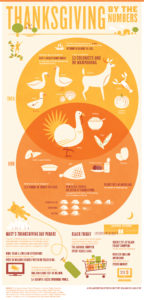
Click on this infographic to see a larger version.

If you are looking for a fun recipe to make with your au pair, check out these turkey cupcakes.

Find more fun activities and recipes on the Au Pair in America Fall Holidays pinboard.

Celebrate Halloween!

JWI_HalloweenOwlHalloween (or Hallow e’en) is a celebration observed in a number of countries including the United States on October 31st.  Halloween has a special significance for children, who dress in funny or ghostly costumes and knock on neighborhood doors shouting “Trick or Treat!” Pirates and princesses, ghosts and witches all hold bags open to catch the candy or other goodies that the neighbors drop in.
Since the 800’s, November 1st is a religious holiday known as All Saints’ Day. The Mass that was said on this day was called Allhallowmas. The evening before became known as All Hallow e’en, or Halloween. Like some other American celebrations, its origins lie in both pre-Christian and Christian customs.

The most popular Halloween activities include trick-or-treating attending Halloween costume parties, decorating, carving pumpkins into jack-o’-lanterns, lighting bonfires, apple bobbing, playing pranks, visiting haunted attractions, telling scary stories, and watching horror films.

For more information and a “how-to” video on carving a pumpkin, click here.  Find more pumpkin carving ideas, scary snacks, and other fun Halloween activities on the APIA Halloween Fun Pinterest board.

Halloween can be a lot of fun but it is also a time when safety should come first. Here are some tips for Monday:

Adult supervision is essential. Always accompany the children if they are going door to door to trick or treat

Try tick-or-treat-friendly homes. Ensure the children only visit houses with lights on. And, you might also suggest the houses they visit have some sort of Halloween decoration on the porch.

Stay outside. Make sure the children don’t go inside someone’s house. They can trick or treat on the porch.

Remain visible. Dress the children in bright costumes or have them wear reflective strips or carry a glow stick or flashlight.

Quality-check treats. Check the candy before they eat it. Throw out any candy that is not in its original wrapper or looks like it has been tampered with.

Say “no” to strangers. Remind the children to never accept a ride or go anywhere with a stranger.  

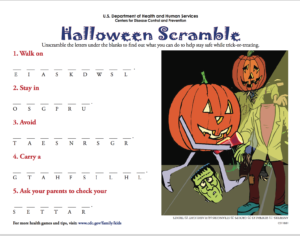
Click here for more Halloween safety tips and a fun word game to help teach these tips to your host kids. 

Halloween Safety Tips

Going trick or treating? Check out these tips from the CDC to help make the festivities fun and safe for trick-or-treaters.

 Swords, knives, and other costume accessories should be short, soft, and flexible.

 Avoid trick-or-treating alone. Walk in groups or with a trusted adult.

 Fasten reflective tape to costumes and bags to help drivers see you.

 Examine all treats for choking hazards and tampering before eating them. Limit the amount of treats you eat.

 Hold a flashlight while trick-or-treating to help you see and others see you. WALK and don’t run from house to house.

 Always test make-up in a small area first. Remove it before bedtime to prevent possible skin and eye irritation.

 Look both ways before crossing the street. Use crosswalks wherever possible.

 Lower your risk for serious eye injury by not wearing decorative contact lenses.

 Only walk on sidewalks whenever possible, or on the far edge of the road facing traffic to stay safe.

 Wear well-fitting masks, costumes, and shoes to avoid blocked vision, trips, and falls.

 Eat only factory-wrapped treats. Avoid eating homemade treats made by strangers.

 Enter homes only if you’re with a trusted adult. Only visit well-lit houses. Never accept rides from strangers.

 Never walk near lit candles or luminaries. Be sure to wear flame-resistant costumes.

screen-shot-2016-10-25-at-1-51-57-pm

Download the CDC’s Halloween Safety Scramble to review these safety tips with your kids.

It’s Cold Out There! A Guide to DC Winter Weather

Reality Bites

When I moved to DC from the warm South Carolina coast for graduate school, I refused to believe that winter weather would actually arrive and (even worse) stick around for several months.

In September, I was confused by the empty hooks hanging in the back of all of the classrooms. I couldn’t imagine that in a few short months each hook would be holding a winter coat.

In October, I ignored the racks of coats and stacks of sweaters displayed in all of the stores. My lightweight jacket and jeans seemed to work just fine.

In November, I dashed to and from the car, grateful for the warmth and heat inside my house and university.  “It’s just a cold snap,” I told myself.

And then it snowed.

I watched my neighbors shovel their sidewalks and head off to work. I checked the university website and was shocked that classes hadn’t been canceled. December had arrived and I was living in DC without a hat, gloves, scarf, or boots. I slipped and slid my way to my car, carefully drove to Nordstroms (marveling at the snow plows clearing the roads), and bought the only pair of snow boots left in the store.

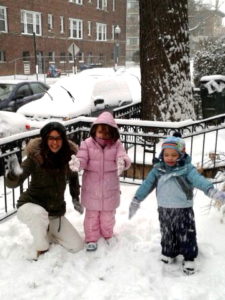
Photo credit: Catherine McEaddy Holmes

Embrace Your Experience

Two decades later, my closet is fully stocked with coats and everything else necessary to live, work, and play in the winter. Because that’s the biggest lesson I’ve learned about living in a city with winter weather- unless we have a blizzard, people go outside in the cold weather. In fact, they even have fun outdoors.

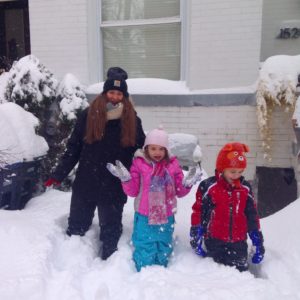
Children love to play in the snow- and they need the exercise. Staying cooped up inside only leads to grumpiness and fights. It’s much more fun to stay outside and build a snowman. Au pairs need to be prepared to join in the excitement.

For those of you not used to this weather, I understand your dismay. However, I encourage you to take advantage of this unique experience. Embrace the cold weather months as a chance to wear sweaters, try out a pair of gorgeous boots, and experience the snow. The au pair year is over very quickly, and before you know it, you’ll be home again showing your friends and families pictures of the first snowman you ever built.

Photo credit: Catherine McEaddy Holmes

Important Tips*

Dress in Layers – Consider buying sweaters, jackets and long underwear.  If you wear several layers, you can take off things to be comfortable. For example, when it might be too warm for a heavy jacket, but too cold for just a sweater, you can combine different pieces of clothing.

Set a Good Example – Host parents will expect you set the example for your kids by wearing a coat when it’s cold outside. You should have a winter coat, hats, gloves, boots, and scarves.  Your host kids will fight wearing a coat if you don’t wear one. Think of yourself as a celebrity and everyone wants to look like you — especially your kids.

Check the “Emergency Change of Clothes” – With young children, we often keep an emergency change of clothes in the car, diaper bag or at their school. If you haven’t already switched out the shorts and t-shirt for something warmer, now is the time to do it.

Buy Cold Weather Clothing Now – Many stores have sales this time of year. Target, T J Maxx, WalMart, and Macy’s have lots of outdoor gear in their stores. DSW has tons of warm and stylish boots and has many DC-area locations, including Columbia Heights, Friendship Heights, and Georgetown. Lands End and Amazon are great online alternatives. An even more affordable option would be to go to a thrift shop. There are many in the area and you can often find a very warm jacket for a small price compared to buying one new.

Monitor School Closings and Delays– DC doesn’t get as much snow as other cold-weather places, and school is often canceled or delayed when it snows just a little. Au pairs from Germany, Poland, and other cold-weather countries will laugh at the DC area’s dysfunction in the winter ice and snow. Talk with your host family now, so you can all understand the plan for these inevitable schedule changes.

Fashionably Winterized

It’s possible to look great and still be warm. Here are a few articles to inspire you:

(*Important Tips includes information first posted on Christine Connally’s Au Pair Chatter blog. )

Columbus Day

Columbus Day is observed each year on the second Monday in October to remember Christopher Columbus’ arrival in the Americas on October 12, 1492. This year, Columbus Day is on Monday, October 8, 2017. 

For more information about Columbus Day, visit this link. For children’s activities, including arts and crafts, word searches, and puzzles, visit this link.

Honoring Christopher Columbus is not without controversy. In some parts of the US, Columbus Day remains important to Italian-Americans as a celebration of Italian heritage and is celebrated with parades and festivals. In other parts of the US, Columbus Day is not celebrated, and there are increasing calls to change the holiday to Indigenous Peoples Day.

Au Pair Technology Tips

Imagine if you went to the hospital and the doctors and nurses were more interested in texting or tweeting than caring for you. How would that make you feel, about yourself and about them?  Would you think you were getting the treatment you deserved?  Would you feel like paying the bill after your stay?

Life as an au pair is a fine balance between employee and family member. You live with your host family and participate with them as a member of the family, but you also have clear responsibilities as a childcare provider.

Being a childcare provider is a very important job because you are helping to shape our next generation. What message are you sending to your host kids when you would rather interact with a computer than with them? How will they feel about themselves and about you? Children feel as though everything is about them. They will see this as a rejection of them and they will be more likely to act out.

Not paying enough attention to your host kids poses safety concerns too. Accidents happen, but when an adult caregiver is close by and appropriately supervising children, the chances of a major injury are dramatically reduced.

When you are working, you should not do any of the following:

  • Texting
  • Talking on the phone
  • Chatting online
  • Using Skype or FaceTime
  • Messaging
  • Emailing
  • Tweeting
  • Updating your status on Facebook or any other social media site
  • Using Snapchat, WhatsApp or any other app or social media site
  • Watching videos on YouTube
  • Uploading photos on Instagram
  • Using the phone or tablet while driving
  • Exceptions- the only time it’s okay to use your computer, phone, tablet, etc. is when your host parents have given your specific permission to text or call them, help your host children find a pre-approved website (like Nickjr.com), or some other job-related task that your host family has asked you to complete. When in doubt- ask your host parents.

Finally, please do not text, scroll through Facebook, answer your phone, etc. when eating meals with your host family or talking with your host parents. Even if you think you’re a great multi-tasker, your host family will think you are being rude.

Going unplugged during work may seem impossible, but think about this — even if you work 45 hours a week, you still have 123 hours left in the week for all of that other stuff, or about 70 hours (if you are getting the recommended 7-8 hours of sleep per night).

Host Parents – Please be clear about what you consider acceptable technology use during work hours to avoid misunderstandings. Your au pair is most likely very accustomed to being plugged in at all times. Her intention is not to be rude, but she might not realize how her actions will be perceived. Please use this information as an opportunity to begin a dialogue on the issue.

(Adapted from Christine Connally’s blog post, Going Unplugged During Work Hours)