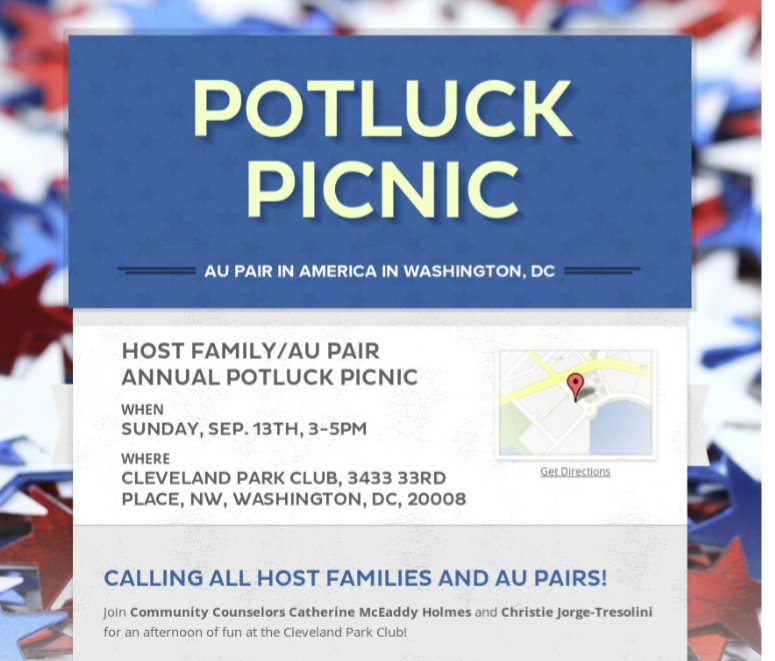
 On Sunday, September 13th, APIA Host Families and Au Pairs gathered at the Cleveland Park Club for a wonderful afternoon of fun, food, and friendship. Continue reading
Tag Archives: au pair
What is Labor Day Anyway?
Labor Day Weekend is a new holiday for many au pairs. Here is a brief history of this American holiday, along with some ideas of ways to celebrate with your host children.
July, August, and September Webinars for Au Pairs

Image: The Sales Whisperer (Flickr)
These FREE and informative webinars are designed specifically for you and are hosted by your orientation trainers. Topics include travel tips, working vacations, communicating with your host family, activity ideas, homesickness, and much more. Don’t miss these important tips that will help you get the most out of your year! Continue reading
July Calendar Ideas
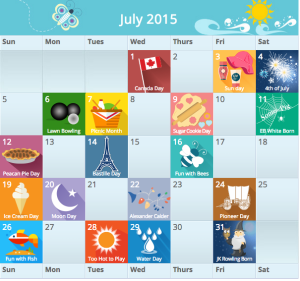
APIA’s July 2015 Calendar
Each month, Au Pair in America provides a calendar full of helpful information and fun activities for everyone in the family.
2015 Summer Camp Ideas in DC

Illustration: www.hikingArtist.com (Flickr)
Does it seem like the days are getting longer, but the hours are getting shorter? Too much to do and never enough time to do it all? You’re not alone- many host parents are struggling with the same challenges as school comes to a close for the year.
The flexible schedule is one of many reasons many families champion the Au Pair program. We all know that our au pairs can work no more than 10 hours per day and 45 hours per week. However, summer can be a real challenge for host parents who are working full-time. Once kids are out of school, an Au Pair’s regulation hours may not be enough time to cover all of your childcare needs.
Day camps are a great way to fill in the gaps, and there are many options in the DC area. Below is a list of camps not too far from our part of town. At posting time, all still had some availability. If you know of others your kids have enjoyed, please share on our private Facebook group page. Let’s work together to find options for our cluster kiddos– and make it a great summer for everyone!
- Beauvoir Summer Camp* (rising pre-k-rising 5th grade; half-day, full-day, before and aftercare , and speciality camps; CIT program; weekly sessions)
- BloomBars‘ Fit Kids Hit the State: Summer Adventure
- CCBC Children’s Center’s Summer Camp* (ages two-five; 9 am-1 pm; potty training NOT required; weekly sessions available; brochure and application)
- Headfirst Summer Camps- St. Albans and NCS campuses (age 3-rising 7th grade; half-day, full-day, before and aftercare, and specialty camps; weekly sessions)
- Lowell School’s Summer Camp (age 2.75-rising 9th grade; half-day, full-day, before and aftercare, and specialty camps; CIT programs; weekly sessions
- National Presbyterian School’s Summer Horizon’s Camp* (age 3-rising 4th grade; half-day, full-day, before and aftercare, and speciality camps; CIT program; weekly sessions)
- Sidwell Summer Camp- DC Campus (age 3-rising 10th grade; half-day, full-day, before and aftercare; specialty camps, weekly sessions)
- Silver Stars Gymnastics Camp* (ages 3.5-15; half-day, full-day, before and aftercare; weekly sessions; registration)
*My children have attended these camps. Please reach out to me with any questions about them.
Webinars for Au Pairs
Did you know APIA offers webinars to help you get the most out of your experience in America? Hosted by the orientation trainers, these free on-line events are full of helpful tips. Sign up for as many as you like!

Illustration: Jurgen Appelo http://www.noop.nl/ (Flickr)
APIA Flag Day Contest
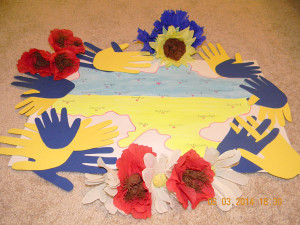
Flag Day 2014 Winner Olena from Ukraine
UPDATE: The 2015 Winners have been posted. Click here to see the creative results!
Flag Day is celebrated in the US on June 14th. In celebration of Flag Day, Au Pair in America is asking our au pairs to submit their creative interpretations of their country’s flag.
Three Winners will be chosen for the most creative creation and prizes awarded! You can take a look at past year’s entries on the Global Awareness website. Good luck!
Details: Submit to gaapia@gmail.com by June 10th. Entries must include your name, country, and counselor’s name. Winners will be announced on July 16th.
Education Requirements for Au Pairs

Photo: www.gotcredit.com (Flickr)
Click on this link for the latest info on au pair education requirements.
Required Credits
Au pairs are required earn at least six academic credits during their year by completing classes/courses at accredited US post-secondary colleges and universities.
6 academic credits = approximately 8 CEUs = approximately 80 classroom hours
Universities and colleges use several different systems for credits, and au pairs use any combination of academic credits, CEUs, or hours as long as they add up to the required number of hours. (The absolute minimum is 72 classroom hours.)
Accredited Schools
Choosing Classes
Be flexible. Remember that your childcare responsibilities come first. Class schedules need to be arranged with your host family and around your childcare duties. Your favorite class may not be available when you are. Schools vary in what they offer, but most offer a wide range of choices and offer day, evening, and Saturday classes.
The APIA Advantage UCLA Course is the only State Department approved class with an online component. No other online classes are accepted.
Tuition
Your host family will pay an education allowance of $500 to assist you in completing your education requirement. There are a few ways to get your credits for just your education allowance, but choices are limited. Normally au pairs will contribute some of their own money ($200+) towards their education.
Transportation
Your host family will provide transportation, including gasoline, parking, or public transportation costs, to and from your classes in your community until you complete your education requirement.
Travel Classes
Au pairs should only take one “weekend/travel” course for their education requirement. These courses usually meet for one or several weekends and involve travel. They are clearly marked on the Au Pair Education Options post. Using only “weekend/travel” courses to meet your education requirement could result in the denial of your extension application (should you decide to extend.).
Education Proof
Submit any of the following as proof of your education:
- Letter from the school on letterhead
- Completion certificate from the school
- School transcript
All proof of education must state your name, school attended, course title, start and end date of the course, and number of credits/hours earned. If your community counselor does not have proof that your education requirement has been completed, you will not receive a completion certificate upon your return to your home country and you forfeit the opportunity to extend.
Extending
In order to extend, you must show proof that you have completed the education requirement no later than 30 days before the end of your first year.
If you are still in the process of completing your education, you must obtain proof from the school stating that the course(s) you are taking will conclude at least 30 days before the end of your year and the number of credits/hours/CEUs that you will earn.
All proof of education must state your name, school attended, course title, and number of credits/hours earned. Completed verification should be given to your community counselor. Your extension request will not be processed without this proof.
May Host Family Tips

Illustration: www.onewaystock.com (Flickr)
Several host families have asked me to share more about our experience as host parents. Of course every day is different and no two host families or au pairs are alike, but here are some ways we have found to successfully communicate with our au pairs.
1. Weekly meetings: We meet every Sunday evening with our AP to discuss schedules, the children’s behavior, and other issues. This helps my husband and me communicate as well, so we think it’s important for both host parents to attend these meetings. (We’ve also had meetings during the work week with my husband using Facetime from his office.)
2. Schedule: We use the weekly meeting to go over the upcoming week’s schedule and discuss future changes (vacations, etc.). An online calendar is critical for our planning purposes. Cozi works for us, but Google Calendar is great too. We schedule everything online for the kids- school drop-off and pick-up, playdates, haircuts, doctors’ appointments, etc. All 3 of us can access the calendar and know who is responsible for each event.
3. Texting: I work from home, and it’s easier if my kids don’t see me during the day, so my AP and I text a lot with each other. For example, if I need a snack, I’ll send our AP a text and give her time to take the kids to the basement or outside before heading to the kitchen.
4. Compliments: We use our meetings to compliment our au pair on areas we’ve found her to be particularly successful (even the smallest thing). This is really helpful when we need to address an issue that isn’t as positive.
5. Rewards: We look for ways to surprise our AP. Has she been great about entertaining the kids during a snow day? Did she soldier through a bad round of strep throat? Do we know she’s excited to see an upcoming movie? Starbucks gift cards, pedicure gift certificates, and movie gift cards go a long way to helping an AP feel appreciated and loved. (You can find discounted movie and restaurant gift cards at Costco.)
For more ideas, check out the Tips for Current Host Families on the APIA website.