Yearly Archives: 2018

Daylight Saving Time Begins March 11

What is Daylight Saving Time?

During Daylight Saving Time, clocks are turned forward one hour, effectively moving an hour of daylight from the morning to the evening. Today, approximately 70 countries worldwide utilize Daylight Saving Time, in at least some portion of the country. The U.S. started observing it in 1918, so it celebrates it’s 100th birthday, this year.

In March, we move the clock forward one hour, losing an hour of sleep. In November, we move the clock back one hour, regaining that extra hour of sleep.

An easy way to remember it is: Spring forward, Fall back.

Before you go to bed on March 10, be sure to set the clocks forward one hour!

Photo: Mark Lee

St. Patrick’s Day 2018

DCC Au Pairs having St. Patrick’s Day fun! (Photo: Scott Montgomery)

St. Patrick’s Day is on March 17th and has been celebrated in the US since 1737. St. Patrick is said to have given a sermon from a hilltop that drove all the snakes from Ireland. Traditional icons of the day are the shamrock, leprechaun, the color green and the pot of gold at the end of the rainbow.

Celebration Ideas

Washington, DC commemorates St. Patrick’s Day every year with a variety of festivals and parades held in the weeks leading up to the holiday. Here are some ways you can celebrate:

  • Celebrate the season at a one of the St. Patrick’s Day parades in DC, Maryland, and Virginia.
  • Ireland on the Wharf: Celebrate the beauty and tradition of the Emerald Isle with bagpipers, Irish dancers, live music, and plenty of family-friendly activities on March 10 at DC’s Southwest Waterfront
  • Au Pair in America’s St. Patrick’s Day pinboard has lots of creative suggestions for crafts, baking, and other fun ideas.
  • Take your picture in front of a green fountain! The White House was designed by Irish architect James Hoban. Traditionally, the White House fountain has been dyed green on March 17th in celebration of the holiday.

    On March 15, 2018, the fountain on the South Lawn of the White House turned green in celebration of St. Patrick’s Day. (Official White House Photo by Andrea Hanks)

2018 Options for Those Last Few Education Hours

Do you know how many total classroom hours you need to complete in your first year?
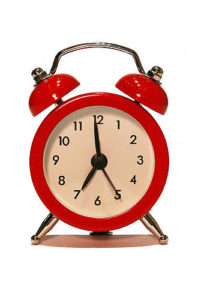
Image: Alan Cleaver (Flickr)

Au pairs are required to earn at least six academic credits during their year by completing classes/courses at accredited US post-secondary colleges and universities.

6 academic credits = approximately 8 CEUs = approximately 80 classroom hours 

(The absolute minimum accepted is 72 hours.)

Certain combinations of classes can leave you just a few hours short of the requirement. Here are several options for completing those last few hours. Information listed is correct as of February 28, 2018, and is subject to change. Consult the university websites for full information.

Virginia International University Saturday Museum Classes

Students spend 5 hours participating in an interactive, themed museum tour facilitated by ESL instructors.

  • Credits: 5 hours (.5 CEUs)
  • Cost: $40 (+$20 for new VIU students)
  • Schedule: Held almost every Saturday morning (10:30 am or 11:30 am)
  • Location: DC-area museums

Virginia International University Grammar Tune-Up

Grammar Tune-Up is a special weekend course for au pairs and is designed to target common errors made by intermediate to advanced-level English learners. Students will gain confidence facing their trouble spots in grammar, vocabulary, and pronunciation.

  • Credits: 15 hours (1.5 CEUs)
  • Cost: $120 (+$20 for new VIU students)
  • Schedule: April 7 and 14 from 9 am – 3 pm
  • Location: Fairfax, VA campus (4401 Village Drive)

University of Virgin Islands Experience America through Art Galleries & Museums

Students self-guide through a local museum over a 3 hour period and complete an outside assignment where they create a detailed pictorial report of the visit, due within 7 days of the course.

  • Credits: 5 hours (.5 CEUs)
  • Cost: $50
  • Schedule: Held on a Saturday (10 am or 1:30pm) in DC-area museums

Looking for longer classes that offer more credits? For a complete list of classes approved for your DC-area cluster, click on this link.
Presidents Day 2018

Photo: Bill & Vicki T (Flickr)

Presidents Day is a Federal holiday created to commemorate the births of former Presidents George Washington (Feb. 22) and Abraham Lincoln (Feb. 12). 

In 2018, Presidents Day is celebrated on February 19th. Throughout America, Presidents Day is observed by big sales in the stores and no mail delivery. School is probably closed on February 19th in honor of Presidents Day, too.

Presidents Day Fun Facts and Questions for Host Kids

  • The United States has had more than 40 presidents. How many can the children name?
  • Who has been president during their lifetime?
  • Take a look at American coins and bills; who are the Presidents pictured on each coin and bill?
  • Apostrophe or not? You’ll see references to the holiday as Presidents Day, President’s Day, and Presidents’ Day. Learn more about the confusion surrounding whom this holiday honors in this Washington Post article.
  • 10 things you may not know about Abraham Lincoln

Celebrate Presidents Day in DC

Valentine’s Day Activities

Image: JWI_ValentinesOwl

Valentine’s Day is a time of love, friendship, giving, and caring. Americans use Valentine’s Day as an opportunity to tell friends and family how much they care.  Celebrated on February 14th, children usually exchange cards at school on that day or one close to the holiday. 

Au Pair in America’s Valentine’s Day Pinterest Pinboard has lots of ideas for fun crafts and activities:

APIA’s Valentine’s Day Pinterest Board

Have a happy Valentine’s Day!

Focus on Play: New Ideas for Some Classic Toys

It is good to offer kids a balance of independent play time and play where you are actively engaging with them. You can make toys they may be bored with, feel new and exciting, by suggesting different ways to play with them. Try some of the ideas below as a starting point.

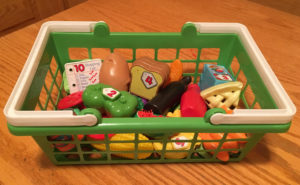
Play Food/Dishes

  • Teach your host children how to say the names of some of the food and dishes in your language.
  • Using English and/or your language play games where you are ordering food like in a restaurant. Take turns with who will be the waiter and who is the customer.
  • Come up with silly food combinations.  For example: Who wants pickles on their slice of cake?
  • Play a guessing game where the children have to figure out what food you are talking about.  For example: I grow under the ground in the dirt.  People eat me fried, mashed and baked.  What am I? (a potato)
  • Play a game with setting the table using your language to ask for the different items (plate, spoon, etc.)
  • Ask the children to divide the foods up into the different food groups (vegetables, meat, dairy, etc.)

Lego Blocks and Other Building Toys

  • Divide up all of the blocks between the people playing, by taking turns for each person to select block by block.
  • Suggest specific things to build (robots, houses, mountains etc.) and build together.
  • Challenge everyone to use all of their blocks.
  • Sort the blocks by color or shape and make patterns with them (red, blue, red, blue or square, triangle, rectangle.)  You can create a pattern and ask the child to fill in what comes next to continue the pattern.
  • Make the tallest block tower you can and let them knock it down (over and over again, if like most kids, they like destroying things.)

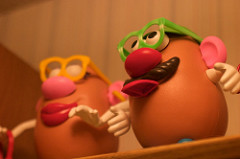
Mr. Potato Head

  • Teach your host children the names of the different parts in your language and play a game asking them to put on the body parts by name.
  • Play Hide and Seek with Mr. Potato Head. Have the children cover their eyes and count, while you hide Mr. Potato Head, then they go looking for him. Switch things up by letting them hide Mr. Potato Head and then you are the one to locate him.
  • Play the same game above, but using Simon Says.  Simon Says is a game where the leader gives commands by saying “Simon says” first. For example, “Simon says, put on the nose.”  The players are only to follow the commands when the leader says “Simon says.”  If the leader doesn’t say “Simon says” first and just says, “put on the nose,”  and the player follows the command, they are out of the game.  Repeat the game multiple times, so all kids get a turn to be the leader at least once.

Photos:  Lisa Maxwell (top) & Tom Smalls (bottom)