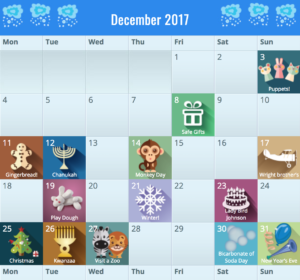
 Each month, Au Pair in America provides a calendar full of fun activities and helpful information for everyone in the family.
Category Archives: Blog
Christmas 2017

We have host families from a wide variety of backgrounds and faiths; some of our host families celebrate Christmas, some celebrate Hanukkah, some celebrate Kwanzaa, and some celebrate more than one holiday or none at all. If you’re an au pair living with a host family who celebrates Christmas and you do not, I encourage you to take part and experience it with them. This can be a great opportunity for learning and culture sharing. I also encourage host families to ask their au pairs to share their holiday traditions and customs.
History
Christmas is both a sacred religious holiday and a worldwide cultural and commercial phenomenon. For two millennia, people around the world have been observing it with traditions and practices that are both religious and secular in nature. Christians celebrate Christmas Day as the anniversary of the birth of Jesus of Nazareth, a spiritual leader whose teachings form the basis of their religion.

Image: Alan Cleaver (Flickr)
In the United States, popular customs include exchanging gifts, decorating Christmas trees, attending church, sharing meals with family and friends and, of course, waiting for Santa Claus to arrive. December 25–Christmas Day–has been a federal holiday in the United States since 1870. (Source: History.com)
Christmas Traditions in the US
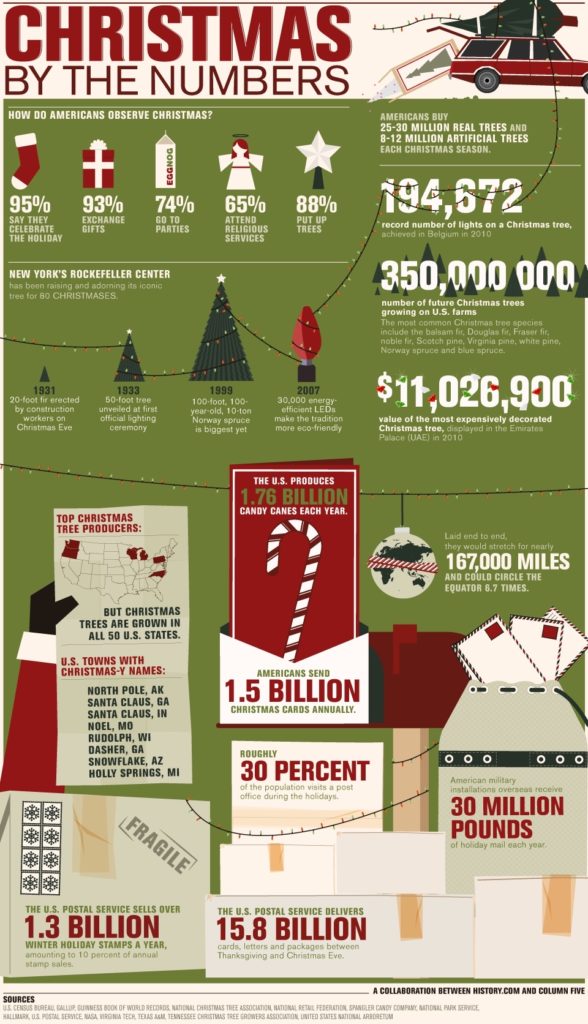
Infographic: History.com
In the US, Americans celebrate Christmas with traditions that have been introduced from different cultures as well as some uniquely American celebrations.
- The period of time in the US from Thanksgiving through New Year’s Day is called “the holidays.”
- Decorated Christmas trees begin lighting up windows in homes, and shops and outdoor plazas shortly after Thanksgiving.
- Christmas tree ornaments can be found in almost every store, but many families have boxes of treasured ornaments made by children out of paper and other crafts which are lovingly hung year after year.
- Christmas lights decorate trees indoors as well as the front lawns and porches of houses. Many parks have special holiday light displays.
- Children write letters to Santa Claus requesting gifts. Shopping malls, parties, churches, and some schools host events where children can have their photo taken with Santa Claus and ask him for gifts in-person.
- Christians remember the birth of Christ with nativity scenes displayed on church lawns, Christmas pageants performed by children in churches and some schools, and delicate, often handcrafted manger scenes set out among the Christmas decor at home.
- On December 24, Christmas Eve, many families have special traditions and often attend Christmas Eve church services. Children hang Christmas stockings, leave cookies and milk for Santa Claus, and try their best to fall asleep so Santa can deliver their presents.
- On December 25, Christmas Day, children wake up early to see the gifts Santa Claus left them. Families exchange gifts, which have been wrapped and placed under the Christmas tree.
- Americans mail Christmas and holiday cards (often with photos of the family) throughout the holiday season. In 2010, Americans mailed 1.5 billion holiday cards.
-
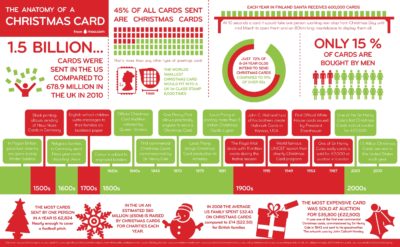
Source: Moo.com
Many Americans view the same beloved Christmas movies year after year. Some classic favorites include, “A Charlie Brown Christmas,” “It’s a Wonderful Life,” “The Christmas Story,” “Home Alone,” “Rudolf the Red-Nosed Reindeer,” “Frosty the Snowman,” “The Grinch Who Stole Christmas,” “Elf” and “A Miracle on 34th Street.”

Photo: www.GlynLowe.com (Flickr)
Celebrating Christmas in Washington, DC
- The 2017 KFDC Guide to the Holiday Season in DC
- December 2017 Festivals and Events in Washington, DC
A very Merry Christmas to all!
Hanukkah 2017
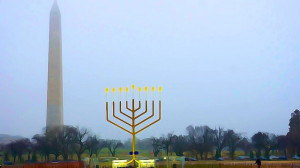
You can visit the world’s largest menorah on the Ellipse in Washington, DC. Photo: Ted Eytan (Flickr)
We have host families from a wide variety of backgrounds and faiths; some host families celebrate Hanukkah, some celebrate Christmas, some celebrate Kwanzaa, and some celebrate more than one holiday or none at all. If you’re an au pair living with a host family who celebrates Hanukkah and you do not, I encourage you to take part and experience it with them. This can be a great opportunity for learning and culture sharing. I also encourage host families to ask their au pairs to share their holiday traditions and customs.
Hanukkah is the Jewish Feast of Lights or Feast of Dedication. The Hebrew word Hanukkah means dedication. The holiday begins on the eve of the 25th day of the Hebrew Month of Kislev and lasts eight days. Hanukkah usually falls in the month of December, but occasionally can start in November. This year Hanukkah begins at sundown on Tuesday, December 12, 2017, and ends the evening of Wednesday, December 20, 2017.
How Do You Spell Hanukkah?
According to Judaism 101, the process of writing Hebrew words in the Roman (English) alphabet is known as transliteration. Transliteration is more an art than a science, and opinions on the correct way to transliterate words vary widely. This is why the Jewish festival of lights (in Hebrew, Cheit-Nun-Kaf-Hei) is spelled Chanukah, Chanukkah, Hanuka, and many other interesting ways. Each spelling has a legitimate phonetic and orthographic basis; none is right or wrong.
History
The books of the Maccabees tell the story of Hanukkah which occurred in 165 B.C. After three years of struggle, the Jews in Judea defeated the Syrian tyrant Antiochus. The Jewish people held festivities in the Temple of Jerusalem and rededicated it to God. After removing all Syrian idols from the Temple, the Jews found only one small pot of oil to light their holy lamps. Miraculously, the small pot provided oil for eight days. Judas Maccabaeus, the Jewish leader, then proclaimed a festival to be observed by Jewish people. (Source: www.apples4theteacher.com)
Hanukkah Traditions (Source: www.bhg.com)
- The Menorah
The centerpiece of the Hanukkah celebration is the Hanukkah or menorah, a candelabra that holds nine candles. Eight candles symbolize the number of days that the Temple lantern blazed; the ninth, the shamash, is a helper candle used to light the others. Families light one candle on the first day, two on the second (and so on) after sundown during the eight days of Hanukkah while reciting prayers and singing songs. The menorah — either store-bought or homemade and crafted of metal, wood, papier-mache, or clay — is filled from right to left, but lit left to right so each new candle is lit first. (Source: www.bhg.com)
- Singing Songs
Hanukkah — one of the most family-oriented of Jewish holidays — comes with its own set of carols sung around the glowing menorah. These celebrate everything from the glory of God and the ancient Temple of the Jews (“Maoz Tzur”) to the simplicity of a dreidel (see below), as in “Dreidel, dreidel, dreidel/I made it out of clay/And when it’s dry and ready/Dreidel I shall play.”
- Yummy Treats
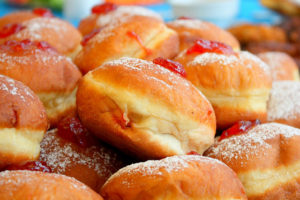
Photo of Sufganiyot (Donuts): Avital Pinnick (Flickr)
There’s nothing low-fat about Hanukkah – many of the traditional foods of the holiday are deep-fried. In honor of the oil-y miracle people celebrating Hannukah like to eat foods that are fried in oil like latkes (potato pancakes) and sufganiyot (jelly-filled doughnuts) and different fried breads. Want to have a go at making something? There are lots of recipes for yummy treats here.
- Spinning Tops
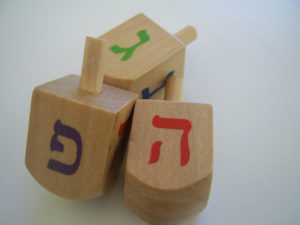
Photo: Marina Shemesh (Flickr)
It’s customary to play with dreidels (spinning tops) during the holiday, even wage gambling games in which players guess which side of the top will fall face up. Legend has it that during the Greek-Syrian dictatorship in Israel of yore, Jews got around the ban on reading the Torah by bringing spinning tops to study sessions so their oppressors would think they were just playing around. The Hebrew characters carved into the four sides of today’s dreidels are the first letters of “Ness Gadol Haya Po/Sham,” which roughly translates to “Great Miracle Happened Here/There” (depending on whether you’re in Israel or not).
Directions to play the Dreidel game
More fun and educational Hanukkah activities for children
Celebrating Hanukkah in Washington, DC
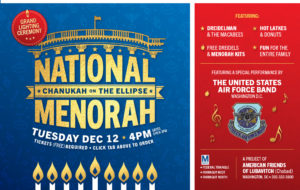
- National Menorah Lighting: Tuesday, December 12, 4 pm on the National Ellipse
The lighting of this menorah – the world’s largest – is attended by thousands every year and seen via media by tens of millions across the nation and around the world. Along with the lighting, there will be live entertainment and menorah kits and dreidels to take home. Tickets are free but must be ordered in advance.
A very Happy Hanukkah to all!
It’s Cold! A Guide to DC Winter Weather

When I moved to DC from the warm South Carolina coast for graduate school, I refused to believe that winter weather would actually arrive and (even worse) stick around for several months.
That first September, I was confused by the empty hooks hanging in the back of all of the classrooms. I couldn’t imagine that in a few short months each hook would be holding a winter coat.
In October, I ignored the racks of coats and stacks of sweaters displayed in all of the stores. My lightweight jacket and jeans seemed to work just fine.
In November, I dashed to and from the car, grateful for the warmth and heat inside my house and university. “It’s just a cold snap,” I told myself.
And then it snowed.
I watched my neighbors shovel their sidewalks and head off to work. I checked the university website and was shocked that classes hadn’t been canceled. December had arrived and I was living in DC without a hat, gloves, scarf, or boots. I slipped and slid my way to my car, carefully drove to Nordstroms (marveling at the snow plows clearing the roads), and bought the only pair of snow boots left in the store.
Seventeen years later, my closet is fully stocked with coats and everything else necessary to live, work, and play in the winter. Because that’s the biggest lesson I’ve learned about living in a city with winter weather- unless we have a blizzard, people go outside in the cold weather. In fact, they even have fun outdoors.
Children love to play in the snow- and they need the exercise. Staying cooped up inside only leads to grumpiness and fights. It’s much more fun to stay outside and build a snowman. Au pairs need to be prepared to join in the excitement.
For those of you not used to this weather, I understand your dismay. However, I encourage you to take advantage of this unique experience. Embrace the cold weather months as a chance to wear sweaters, try out a pair of gorgeous boots, and experience the snow. The au pair year is over very quickly, and before you know it, you’ll be home again showing your friends and families pictures of the first snowman you ever built.
Important Tips*
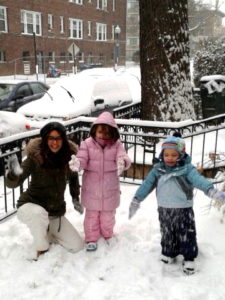
Photo credit: Catherine McEaddy Holmes
Dress in Layers – Consider buying sweaters, jackets and long underwear. If you wear several layers, you can take off things to be comfortable. For example, when it might be too warm for a heavy jacket, but too cold for just a sweater, you can combine different pieces of clothing.
Set a Good Example – Host parents will expect you set the example for your kids by wearing a coat when it is cold outside. You should have a winter coat, hats, gloves, boots, and scarves. Your host kids will fight wearing a coat if you don’t wear one. Think of yourself as a celebrity and everyone wants to look like you — especially your kids.
Check the “Emergency Change of Clothes” – With young children, we often keep an emergency change of clothes in the car, diaper bag or at their school. If you haven’t already switched out the shorts and t-shirt for something warmer, now is the time to do it.
Buy Cold Weather Clothing Now – Many stores have sales this time of year. Target, T J Maxx, WalMart, and Macy’s have lots of outdoor gear in their stores. DSW has tons of warm and stylish boots and has many DC-area locations, including Columbia Heights, Friendship Heights, and Georgetown. Lands End and Amazon are great online alternatives. An even more affordable option would be to go to a thrift shop. There are many in the area and you can often find a very warm jacket for a small price compared to buying one new.
Monitor School Closings and Delays– Because DC doesn’t get as much snow as the Alps, school is often canceled or delayed when it snows just a little. Au pairs from Germany, Poland, and other cold-weather countries will laugh at the DC area’s dysfunction in the winter ice and snow. Talk with your host family now, so you can all understand the plan for these inevitable schedule changes.
(*Important Tips includes information first posted on Christine Connally’s Au Pair Chatter blog. )
Fashionably Winterized

It’s possible to look great and still be warm. Here are a few articles to inspire you:
-
Forget Weather.com: Here’s an Outfit Guide For Every Temperature
- How To Look Fashionable While Staying Warm
-
What to Wear When It’s Really Cold: 4 Outfits for Below-Freezing Temperatures
- 6 Winter Fashion Tips for Looking Good When It’s Too Cold to Deal
Au Pair Technology Tips

Imagine if you went to the hospital and the doctors and nurses were more interested in texting or tweeting than caring for you. How would that make you feel, about yourself and about them? Would you think that you were getting the treatment you deserved? Would you feel like paying the bill after your stay?
Life as an au pair is a fine balance between employee and family member. You live with your host family and participate with them as a member of the family, but you also have clear responsibilities as a childcare provider.
Being a childcare provider is a very important job because you are helping to shape our next generation. What message are you sending to your host kids when you would rather interact with a computer than with them? How will they feel about themselves and about you? Children feel as though everything is about them. They will see this as a rejection of them and they will be more likely to act out.
Not paying enough attention to your host kids poses safety concerns too. Accidents happen, but when an adult caregiver is close by and appropriately supervising children, the chances of a major injury are dramatically reduced.
When you are working, you should not do any of the following:
- Texting
- Talking to friends on the phone
- Chatting with friends online
- Using Skype or FaceTime
- Messaging
- Emailing
- Tweeting
- Updating your status on Facebook or any other social media site
- Using Snapchat, WhatsApp or any other app or social media site
- Watching videos on YouTube
- Uploading photos on Instagram
- Playing Pokemon Go
- Using the phone or tablet while driving
- Exceptions- the only time it’s okay to use your computer, phone, tablet, etc. is when your host parents have given your specific permission to text or call them, help your host children find a pre-approved website (like Nickjr.com), or some other job-related task that your host family has asked you to complete. When in doubt- ask your host parents.
Finally, please do not text, scroll through Facebook, answer your phone, etc. when eating meals with your host family or talking with your host parents. Even if you think you’re a great multi-tasker, your host family will think you are being rude.
Going unplugged during work may seem impossible, but think about this — even if you work 45 hours a week, you still have 123 hours left in the week for all of that other stuff, or about 70 hours (if you are getting the recommended 7-8 hours of sleep per night).
Host Parents – Please be clear about what you consider acceptable technology use during work hours to avoid misunderstandings. Your au pair is most likely very accustomed to being plugged in at all times. Her intention is not to be rude, but she might not realize how her actions will be perceived. Please use this information as an opportunity to begin a dialogue on the issue.
(Adapted from Christine Connally’s blog post, Going Unplugged During Work Hours)
November 2017 Calendar Ideas
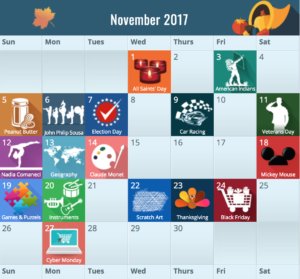 Each month, Au Pair in America provides a calendar full of fun activities and helpful information for everyone in the family.
Education Requirements for Au Pairs

Required Credits
Au pairs are required earn at least six academic credits during their year by completing classes/courses at accredited US post-secondary colleges and universities.
6 academic credits = approximately 8 CEUs = approximately 80 classroom hours
Universities and colleges use several different systems for credits, and au pairs use any combination of academic credits, CEUs, or hours as long as they add up to the required number of hours. (The absolute minimum is 72 classroom hours.)
Accredited Schools
Choosing Classes
Be flexible. Remember that your childcare responsibilities come first. Class schedules need to be arranged with your host family and around your childcare duties. Your favorite class may not be available when you are. Schools vary in what they offer, but most offer a wide range of choices and offer day, evening, and Saturday classes.
The APIA Advantage UCLA Course is the only State Department approved class with an online component. No other online classes are accepted.
Tuition
Your host family will pay an education allowance of $500 to assist you in completing your education requirement. There are a few ways to get your credits for just your education allowance, but choices are limited. Normally au pairs will contribute some of their own money ($200+) towards their education.
Transportation
Your host family will provide transportation, including gasoline, parking, or public transportation costs, to and from your classes in your community until you complete your education requirement.
If the class is remote (out of town), host families pay for the class and what is included; au pairs pay for transportation, food, & lodging.
Education Proof
Submit any of the following as proof of your education:
- Letter from the school on letterhead
- Completion certificate from the school
- School transcript
All proof of education must state your name, school attended, course title, start and end date of the course, and number of credits/hours earned. If your community counselor does not have proof that your education requirement has been completed, you will not receive a completion certificate upon your return to your home country and you forfeit the opportunity to extend.
DCC cluster au pairs should use this link to submit their education proof to their Community Counselor, Catherine.
Extending

Image: NEC Corporation of America (Flickr)
In order to extend, you must show proof that you have completed the education requirement no later than the end of your 11th month.
If you are still in the process of completing your education, you must obtain proof from the school stating that the course(s) you are taking will conclude no later than the end of your 11th month and the number of credits/hours/CEUs that you will earn.
All proof of education must state your name, school attended, course title, and number of credits/hours earned. Completed verification should be given to your community counselor. Your extension request will not be processed without this proof.
Au Pair Healthcare (or what to do if you are sick)

General Information
APIA’s health (medical) insurance plan is administered by Cultural Insurance Service International (CISI) and is part of the Aetna Health Network. It is valid anywhere in the world except your home country. Continue reading
2019 Au Pair Education Options

Photo: William Warby (Flickr)
- APs are required earn at least six academic credits during their year by completing classes/courses at accredited US post-secondary colleges and universities. 6 academic credits = approximately 8 CEUs = approximately 80 classroom hours (72 classroom hours is absolute minimum allowed).
- For a summary of State Department education requirements, click on this link.
- If the class is remote (out of town), HFs pay for the class and what is included. APs pay for transportation, food, & lodging.
- Most courses require homework to receive class credit.
LANGUAGE CLASSES
Georgetown University Evening and Weekend English
- Details: Conversational English courses (weeknights), ESL Business English courses (weeknights), and Advanced TOEFL Test Prep course (Saturdays)
- Credits: 3.2 CEUs for 8-week summer course; 3.6 CEUs for 9-week fall and spring course
- Cost: $480 for summer course; $540 for fall & spring courses (10% Early Enrollment Discount)
- Placement: Mandatory placement test
- Location: Georgetown, DC (Take shuttle from Dupont Circle Metro)
International Language Institute (ILI) English Programs and other foreign languages
- ESL and TOEFL Prep Au Pair Promotion- $500 Tuition for 72-75 hours
- Day Classes (Monday-Friday 9 am-2:10 pm; earn 75 hours in 3 weeks)
- Evening Classes (Tuesday-Thursday 6:40-8:45 pm; earn 75 hours in 10 weeks)
- Saturday Classes (Saturday 9 am-1:05 pm; earn 72 hours in 16 weeks)
- Other foreign languages
- Cost: $75 one-time application fee + tuition (usually offers 10% discount for Au Pairs)
- Schedule: Weekday, evening, and weekend courses offered year-round; foreign language classes begin 4 times per year
- Placement: Testing offered daily
- Location: Dupont Circle (Dupont and Farragut North Metro)
LADO International Institute English courses
- Details: Intensive, Semi-intensive, TOEFL Prep, and TEFL Prep classes
- Credits: 7.6 or 7.2 CEUs for Intensive 4-week program; 7.2 CEUs for Semi-intensive 8-week program, 3.6 CEUs for 8-week Saturday program
- Cost: $85 one-time registration fee + tuition (10% APIA tuition discount usually offered)
- Schedule: Weekday, evening, and weekend courses offered year-round
- Placement: Testing offered daily
- Locations: DC (Archives, Gallery Place, Metro Center), Arlington (Rosslyn Metro), Silver Spring (Silver Spring Metro)
Mentora College Intensive ESL Program
- Details: Intensive 4-week program (ask about a 30% APIA scholarship discount)
- Location: DC (McPherson Square and Metro Center)
GENERAL INTEREST CLASSES
- Details: BMCC offers au pairs two ways to earn educational credits:
- Learning Local: Attend class at Trinity University in DC and then take a study trip to the destination (usually Niagara Falls or Amish Country).
- Credits: 40 hours/4 CEUs, 36 hours/ 3.6 CEUS, or 32 hours/3.2 CEUs
- Cost: Varies by class (check for additional housing and transportation costs)
- Schedule: Learning Local classes meet on Saturdays and Sundays. Study trip dates vary and may include weekdays. Learning Express classes meet over one long weekend on Friday, Saturday, and Sunday. Carefully check class descriptions dates and times.
- BMCC continues to add new courses to its Learning Across America program so make sure to check the schedule regularly!
George Washington University School of Business Women’s Business Leadership
- Details: GWU’s School of Business Center for Entrepreneurial Excellence Women’s Leadership Seminar series
- WBL 101: Intro to Women’s Business Leadership (Fall- Nov 2 and 3, 2019)
- WBL 102: Personal Leadership Journey (Spring- March 7 and 8, 2020)
- Credits: 3 credits/ 36 hours
- Cost: $360 early registration; $385 regular registration + $25 for workbook
- Schedule: TBA (also pre and post-class assignments)
- Location: George Washington University (Foggy Bottom Metro)
University of DC Community College Au Pair Weekend Class
- Details: Learn important skills for dealing with the cultural and personal challenges that international visitors in the U.S. often face and also learn about Washington, DC.
- Credits: Receive up to 45 hours for a 3-day weekend class
- Cost: Varies by course (housing not provided)
- Location: 801 N Capitol St NE (near Union Station)
University of the Virgin Islands International Program (based in DC and other locations)
- Details: Courses that meet for multiple times for several weeks, weekends, or months (include Accent Reduction, ESL Small Talk, Sign Language, art classes, business classes, and more).
- Credits: Between 20-40 hours (2-4 CEUs) and varies by course
- Cost: Varies by course; create student account to register and pay
- Locations: Throughout DC Metro and other locations
Other Classes located at Universities all over the US, including California, New York, Florida, Virginia, Hawaii and others. Click here for more information.
ONLINE CLASS
UCLA Extension American Studies
- Credits: 6 credits
- Cost: $500
- Schedule: September 23, 2019 – February 3, 2020. Course #364702. Registration opens July 29, 2019.
- Location: Online (Note: This is the only online class approved by the State Department and is only available to APIA Au Pairs.)
OTHER DC-AREA OPTIONS
Below is a list of accredited DC-area schools you may wish to research for class options. However, they tend to be more expensive and do not have special programs designed to fit into an au pair’s typical schedule.
American University Nondegree Student (over $1000 per credit)
Corcoran Arts Continuing Education classes (around $1000 per credit)
Georgetown University Visiting Non-Degree Student (over $1500 per credit)
Montgomery College Work Force Development & Continuing Education (must pay non-resident fee)
Prince George’s Community College classes (must pay out-of-state tuition)
This blog post was last updated on 07/13/2019.
October 2017 Calendar Ideas
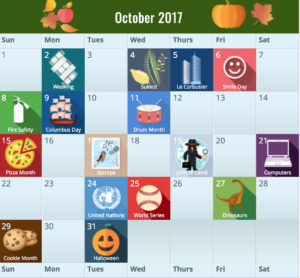 Each month, Au Pair in America provides a calendar full of fun activities and helpful information for everyone in the family.